
Capillary Rheometer
A capillary rheometer is an apparatus designed to measure shear viscosity and other rheological (= flow) properties. Capillary rheometers for plastics are piston-die systems designed to measure viscosity of polymer melts as a function of temperature and rate of deformation. They are capable of testing basic polymers, compounds, various composites with small reinforcing particles or fibers, feedstock for metal injection molding and similar materials.
The basic principle is that a thermoplastic sample (originally in the shape of granules, powder or flakes) is made fluid by heating and forced to flow out of a cylinder through a capillary die. The measured quantity is normally the generated pressure under steady state conditions. A flow curve is the typical output, obtained by interpolation of several experimental data. Viscosity is represented as the Greek letter “eta” (η) and expressed (in SI units) in pascal seconds (Pa·s) or newton seconds per square meter (N·s/m2).
Capillary rheometers ensure testing conditions which are truly representative of processing conditions, especially for high-pressure and high-speed techniques like injection molding, therefore they are key for process optimization.
Other rheological properties that can be measured or estimated from capillary rheometers data include extensional viscosity, extrudate swell, thermal stability, wall slip. Ancillary measurements can be carried out for thermal conductivity, density dependence on pressure and temperature (pvT), melt strength.
References
- Walters K. “Rheometry”, Chapman & Hall (1975)
- Ferry, J. D. “Viscoelastic Properties of Polymers”, John Wiley & Sons (1980)
- Dealy, J.M. and Wissbrun K.F. “Melt Rheology and its Role in Plastics Processing”, Van Nostrand Reinhold (1990), Chapman & Hall (1995)
- Macosko C.W. “Rheology – Principles, Measurements, and Applications”, Wiley-VCH (1994)
- Malkin A.Y. “Rheology – Concepts, Methods, & Applications”, ChemTec Publishing (2006)
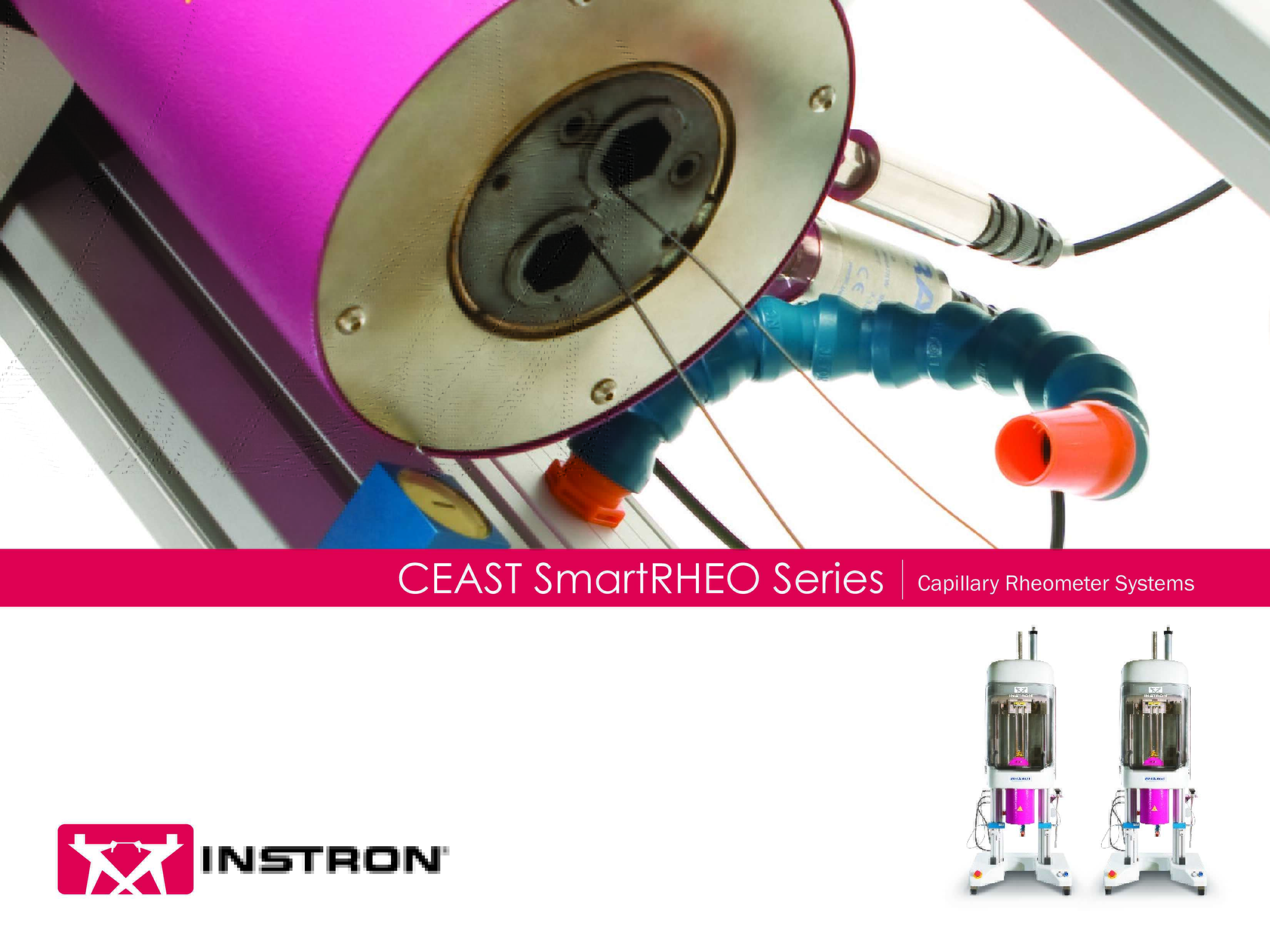
CEAST SmartRHEO Series: Capillary Rheometer Systems
Thermoplastic materials are processed as fluids under the effect of temperature and pressure. The ability of plastics to be formed into a wide variety of shapes, by the common plastics conversion processes, has a fundamental importance in polymer science and application. The innovative Instron® line of CEAST SmartRHEO Series of Capillary Rheometer systems are designed for an accurate investigation of the rheological properties of polymeric materials.
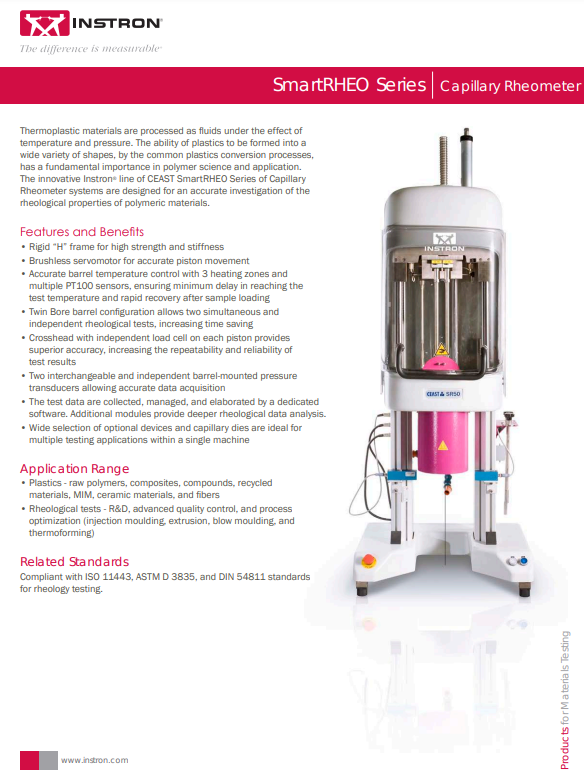
Capillary Rheometer Systems
The innovative Instron® line of CEAST SmartRHEO Series of Capillary Rheometer systems are designed for an accurate investigation of the rheological properties of polymeric materials.
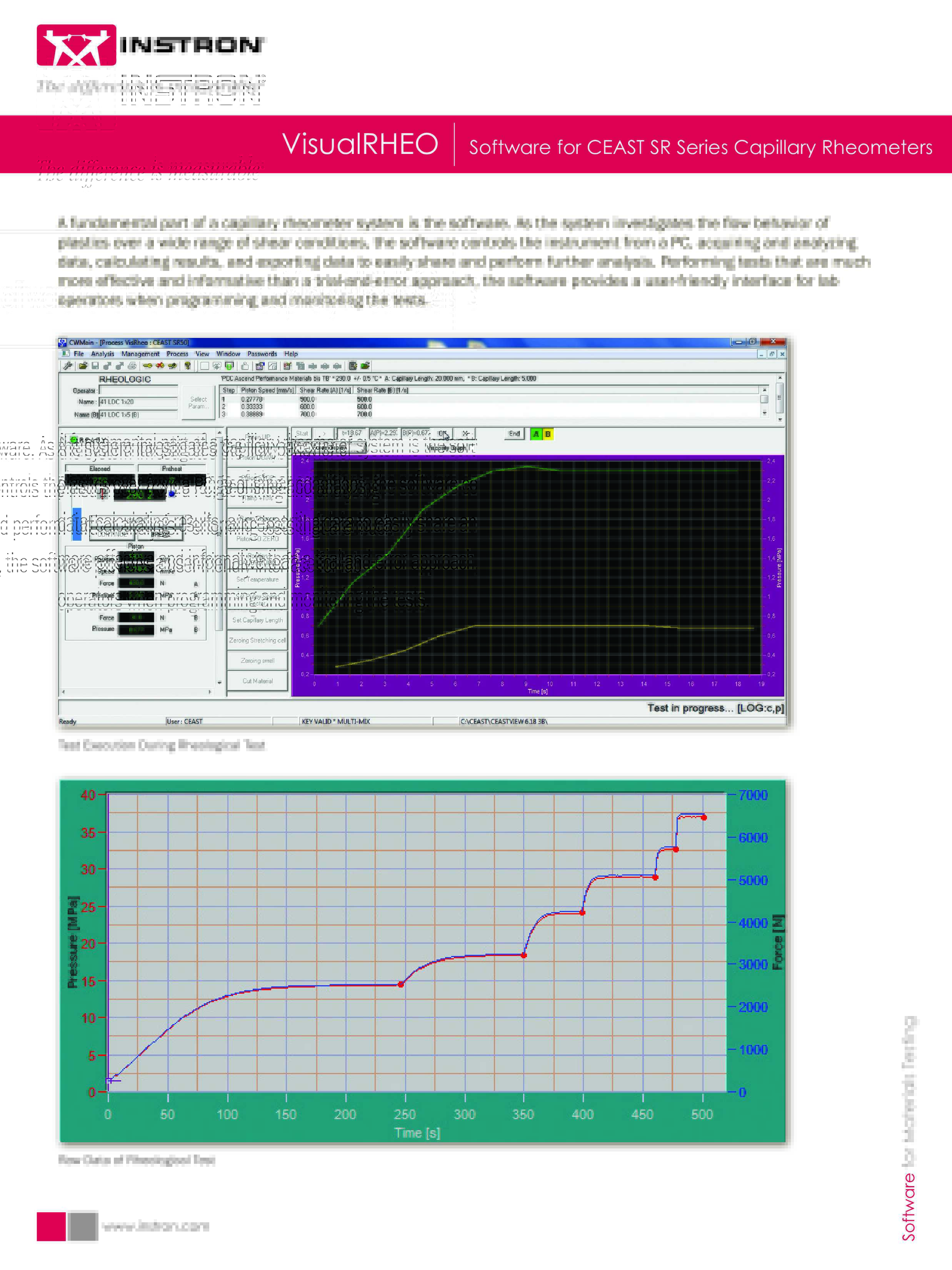
VisualRHEO | Software for CEAST SR Series Capillary Rheometers
A fundamental part of a capillary rheometer system is the software. As the system investigates the flow behavior of
plastics over a wide range of shear conditions, the software controls the instrument from a PC, acquiring and analyzing
data, calculating results, and exporting data to easily share and perform further analysis. Performing tests that are much
more effective and informative than a trial-and-error approach, the software provides a user-friendly interface for lab
operators when programming and monitoring the tests.
