Instron

Seatbelt High Strain Rate Test

Automotive » Safety Systems

Seatbelt High Strain Rate Test

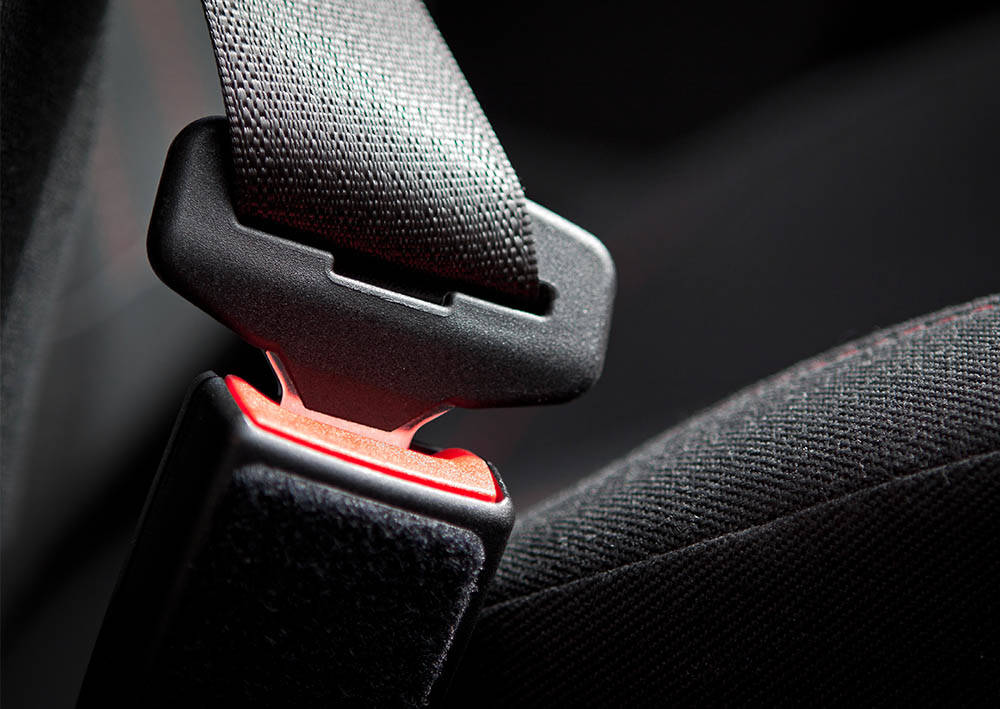
In the automotive field, the safety of passengers is key and many research and development efforts have been put to ensure each critical safety component is tested and up to standard. Seatbelts play a big role in car safety as it decreases the momentum of passengers, reducing the force of secondary impacts with interiors and prevents passengers from being ejected from a vehicle in a crash or a sudden stop. 

The Challengecar seatbelt

In the automotive field, the safety of passengers is key and many research and development efforts have been put to ensure each critical safety component is tested and up to standard. Seatbelts play a big role in car safety as it decreases the momentum of passengers, reducing the force of secondary impacts with interiors and prevents passengers from being ejected from a vehicle in a crash or a sudden stop. This greatly reduces the risk of major injuries when used in conjunction with other safety features such as airbags and shock absorbing mechanism in dashboards and steering wheel columns. In addition to tensile strength and durability of seatbelts, the behavior of seatbelt materials under high strain rate is a topic of interest, as polymers exhibit different mechanical properties under high strain rate impact during crashes without breaking.

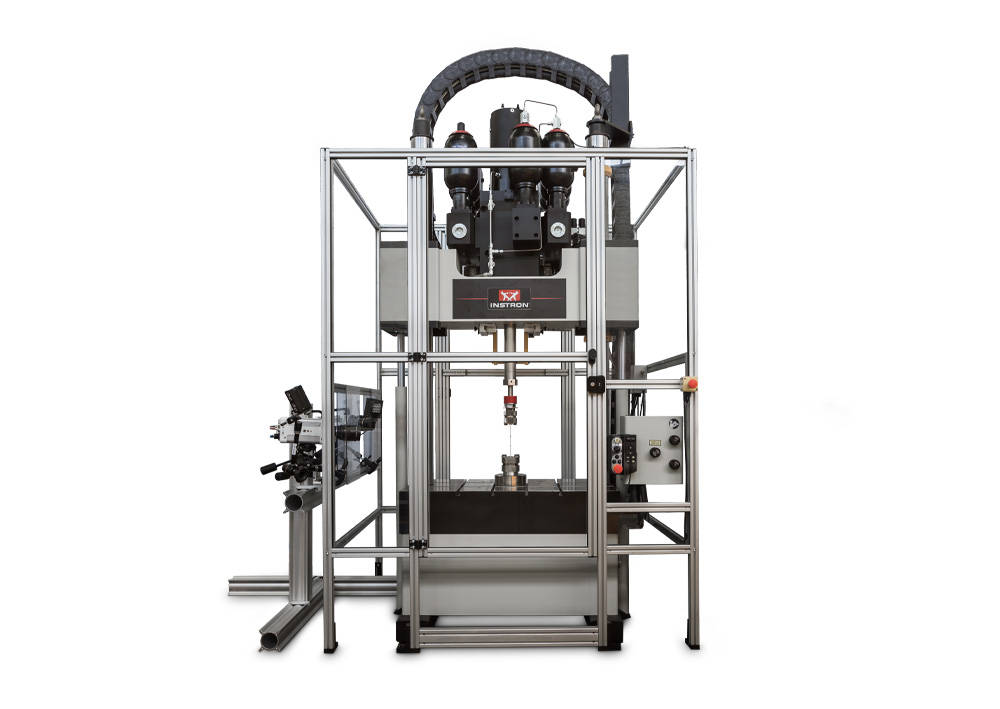
Our SolutionHigh Strain Rate VHS Testing System with Slack Rod Grips

In order to meet the challenges of characterizing high strain rate behavior of seatbelt material, Instron developed a long stroke variation of the High Strain Rate Testing System VHS. Its static capacity sits at 35 kN, dynamic capacity at 50 kN with a nominal stroke of 600 mm and a maximum test velocity of 20 m/s, which is sufficient for more compliant polymeric components. We have also developed accompanying custom grip fixtures and incorporating DIC onto the system as a non-contact strain measurement system, offering an integrated solution for testing compliant materials under high strain rate.


Learn more about our automotive solutions

Frontal Crash Testing

Automotive » Safety Systems

Frontal Crash Testing

THE CHALLENGE

front crash

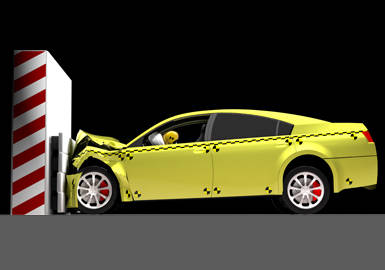
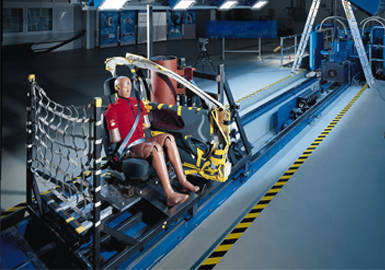
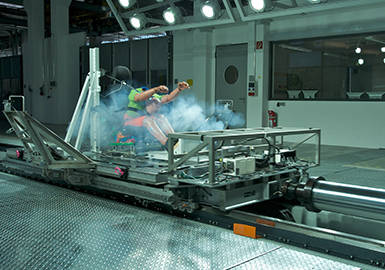
Development and adaptation of frontal restraint systems are carried out on the basis of international laws and regulations concerning crash protection, and international consumer protection test programs such as NCAP. Crash pulses (acceleration-time histories) are determined during an actual frontal crash and subsequently used for crash simulation on an acceleration sled system. These acceleration sled systems play a crucial role in the expert design and adaptation of advanced safety components such as airbags, seats, child seats, rear seat, seatbelts and belt force limiters, knee padding, steering columns etc. Due to the broad spectrum of requirements and the resulting high number of test runs, advanced acceleration sled systems must be designed for maximum efficiency and productivity.

Our Solution

front crash

Instron's CSAadvanced acceleration sled systems permit the execution of a variety of testing procedures, including dynamic seat tests, frontal crash simulation with synchronized, actively controlled vehicle pitch movement, or testing of cargo restraint systems. With short charging cycles and a high degree of automation, Instron acceleration sled systems can be ready for another shot within 10 minutes. Intelligent solutions for rapid changeover between test setups (such as a 2-piece sled, or pallet systems for a 1-piece sled) enable more than 2000 test cycles to be conducted per year. In addition, the CrashSim-Office software enables crash pulses to be imported and edited offline, outside the test laboratory, including the generation of the associated drive signal for the test and without the need to use the crash simulation rig for validation of the feasibility of a new test pulse. All these features make Instron CSAadvanced acceleration sled systems a highly efficient and powerful development tool.

Side Impact and Whiplash Testing

Automotive » Safety Systems

Side Impact and Whiplash Testing

THE CHALLENGE

side crash

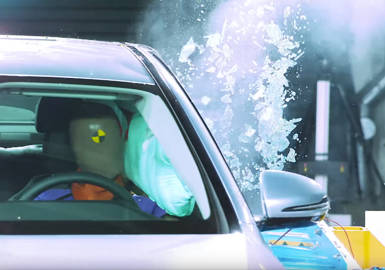
The safety of vehicle occupants plays a crucial role in vehicle development. In addition to frontal impacts (Full Width Frontal and Offset Frontal Impact), international standards and guidelines, along with consumer protection programs established in many countries (such as NCAP) define extended crash tests to safeguard the safety of a vehicle. In these tests, vehicles are evaluated specifically with a view to their resistance to side and pole impacts, as well as the risk of sustaining whiplash injuries during a rear impact, also referred to as Low Speed Rear Impact test.

our Solution

side crash

Test procedures that can be carried out on Instron acceleration sled systems include MDB side impact tests, pole side impact tests and whiplash (low speed rear impact) tests.
To perform a barrier side impact simulation, a servo-hydraulically actuated extension facility is used, which can handle the "negative" accelerations encountered during side impact tests. In addition, dedicated sled setups are available allowing loads to be introduced into the dummies used in such a way that compliance with specified limits for head, shoulder and thorax protection criteria can be evaluated.
The Whiplash test is conducted in low-pressure mode. This mode of operation enables compliance with the stricter pulse corridors of the EuroNCAP specifications.
The different test procedures are selected with a simple mouse click. All necessary modifications of the parameters and hydraulic system settings are made fully automatically by the RS CrashSim simulation software.

Learn more about our automotive solutions