
Foil Testing for Electric Vehicle Batteries

The electric vehicle battery industry is constantly improving the energy density and safety of their products. A significant focus is on the aluminum and copper foils used in each cell as current collectors. Thinner foil helps to reduce battery weight (contributing to energy density), and longer/wider foil increases production efficiency (contributing to cost reduction). However, as innovation drives foil materials to become thinner, it becomes even more critical to accurately capture their material properties and ensure that adequate quality control measures are in place.
Many companies in the industry are currently working on producing copper foil between 4 and 12 microns thick. However, as copper foil becomes thinner, longer, and wider, improved technology is required to address wrinkling and tearing concerns during production. Given that batteries need to be able to withstand the mechanical loading under normal use, as well as expansion and contraction when charging and discharging over time, the current collector foil must also be able to withstand these factors without yielding. Ensuring that these newer foils are able to withstand the loads required of it during both use and production, increased mechanical testing is needed.
Relevant standards for this application include ASTM E345, EN 546-2, and DIN 50154, which can be used as guidance for testing EV battery foils.
Tensile Test
A standard tensile test is the most appropriate way to determine the mechanical properties of aluminum and copper foil specimens. Typically, elongation at break and maximum load are the key material properties that are calculated in mechanical testing, as these properties help ensure the quality of the foil; whether or not it will be able to withstand the mechanical loading and expansion/contraction in use.
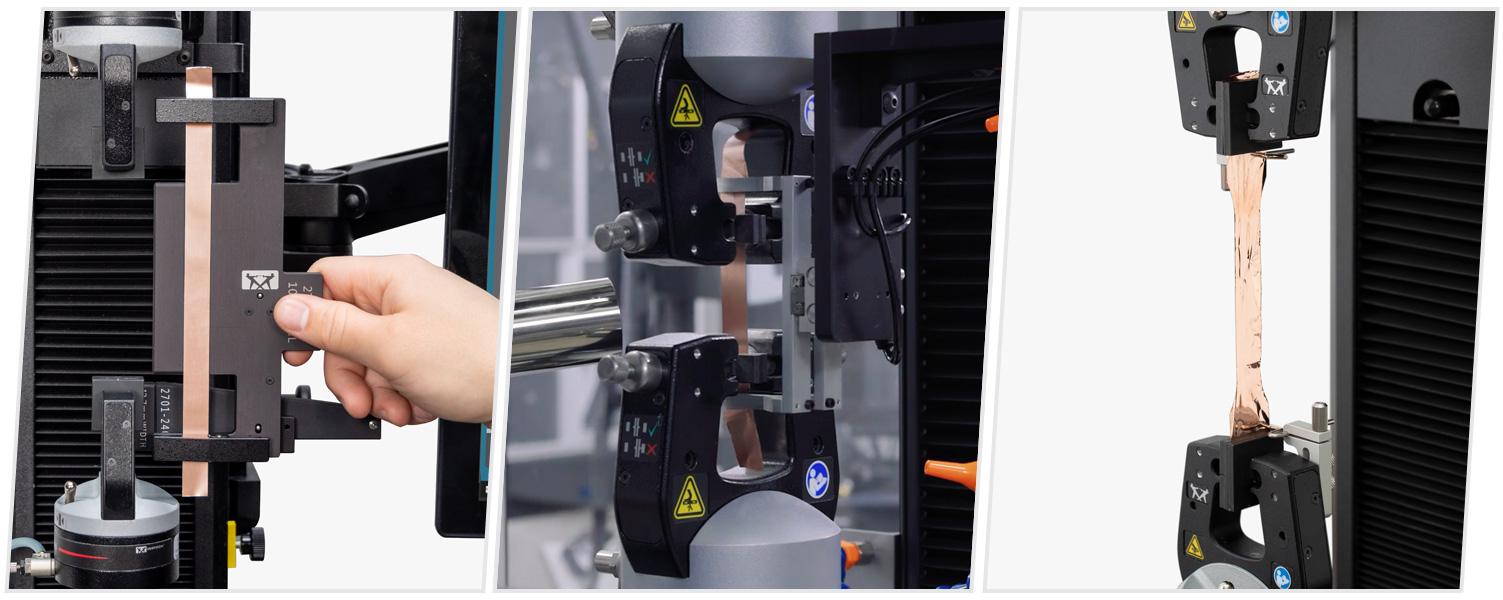
While some standards may call out gripping options, such as wedge action grips, Instron has found that pneumatic side action grips are the optimal solution for foil under 20 microns thick. Pneumatic side action grips offer the ability to fine tune the clamping pressure and they will always provide constant pressure throughout each test. The use of pneumatic grips also improves throughput for these high-volume materials, as quality control labs can test hundreds of specimens per day. An additional factor that must be considered is the type of clamping surface, such as the jaw faces used. The optimal jaw faces to pair with pneumatic side action grips are rubber-coated faces. The soft and pliable rubber is able to adequately hold foil material throughout the duration of a test, while minimizing the stress concentration added by clamping the specimens.

Specimen Preparation and Alignment
Two of the biggest challenges that come from testing foil material are the preparation and alignment of the specimen. Specimen preparation is extremely critical for such fragile specimens. The better the quality of the cut, the better the quality of the edges will be for each specimen. Poorly cut edges increase the chances of the material breaking prematurely. Premature failure reduces the quality of the test results, and can lead to the need for re-testing.
Specimen alignment is also critical for repeatability and protection of the specimen, as thin foils can be noticeably affected by minor misalignment within the grips. Additionally, having to adjust foils within the grips multiple times can sometimes lead to premature breaks due to the damage caused by clamping and unclamping. We highly recommend using Instron’s Precision Specimen Loader to reduce variability in test results while improving ergonomics and safety.
Automation
Automation systems from Instron introduce a new level of productivity for foil testing. As battery production volumes continue to increase, throughput and efficiency are critical to keep up with demand. Utilizing an automation system with the recommended equipment for each application can free up operators and maximize throughput, while maintaining optimal results.

6800 Series Premier Testing Systems Brochure
Instron 6800 Series Universal Testing Systems provide unparalleled accuracy and reliability. Built on a patent-pending Operator Protect system architecture with an all-new Smart-Close Air Kit and Collision Mitigation features, the 6800 Series makes materials testing simpler, smarter, and safer than ever before.

3400 Series Universal Testing Systems Brochure
Instron 3400 Series universal testing systems for tensile, compression, bend, and other material property tests.

Bluehill Universal Brochure
Bluehill Universal is Instron’s advanced materials testing software, designed for intuitive touch interaction and streamlined workflows. It offers pre-loaded test methods, QuickTest for rapid setup, enhanced data exporting, and Instron Connect for direct service communication. Users of Bluehill 2 and Bluehill 3 can easily upgrade to the latest version for improved performance and usability

2712-04X Series Pneumatic Side-Action Grips
Pneumatic side-action grips offer a versatile gripping solution for a wide range of materials. Rated capacities between 1 and 10 kN.

Mechanical Testing of Electric Vehicle Batteries White Paper
Static mechanical testing is key to assessing the safety and reliability of electric vehicles (EVs). Soaring EV sales combined with ever-changing battery technology are leading to an expanding range of components and materials that require thorough testing. This white paper examines the key static mechanical testing methods and technologies associated with EV battery applications.

How to Choose the Right Test Machine for You EV Battery Application
Mechanical testing is key to assessing the performance and safety of an electric vehicle’s (EV) battery system. Accurate, efficient, and safe testing equipment is critical for companies trying to increase productivity and decrease time-to-market in this competitive new industry. The e-guide will walk you through three key steps to selecting the most appropriate test equipment for EV battery applications.
