
เครื่องวัดความหนืดแบบแคปิลลารี
เครื่องวัดความหนืดแบบแคปิลลารีเป็นอุปกรณ์ที่ออกแบบมาเพื่อวัดความหนืดเฉือนและคุณสมบัติทางรีโอโลยี (= การไหล) อื่นๆ เครื่องวัดความหนืดแบบแคปิลลารีสำหรับพลาสติกเป็นระบบลูกสูบ-แม่พิมพ์ที่ออกแบบมาเพื่อวัดความหนืดของพอลิเมอร์หลอมเหลวเป็นฟังก์ชันของอุณหภูมิและอัตราการเสียรูป สามารถทดสอบพอลิเมอร์พื้นฐาน สารประกอบ คอมโพสิตต่างๆ ที่มีอนุภาคเสริมแรงขนาดเล็กหรือเส้นใย วัตถุดิบสำหรับการขึ้นรูปโลหะด้วยการฉีด และวัสดุที่คล้ายคลึงกัน
หลักการพื้นฐานคือตัวอย่างเทอร์โมพลาสติก (เดิมอยู่ในรูปของเม็ด ผง หรือเกล็ด) จะถูกทำให้เป็นของเหลวด้วยการให้ความร้อนและถูกบังคับให้ไหลออกจากกระบอกสูบผ่านแม่พิมพ์แคปิลลารี ปริมาณที่วัดได้โดยปกติคือความดันที่เกิดขึ้นภายใต้สภาวะคงตัว เส้นโค้งการไหลเป็นผลลัพธ์ทั่วไป ซึ่งได้จากการประมาณค่าของข้อมูลการทดลองหลายชุด ความหนืดแสดงด้วยตัวอักษรกรีก "อีตา" (η) และแสดงออก (ในหน่วย SI) เป็นปาสคาลวินาที (Pa·s) หรือนิวตันวินาทีต่อตารางเมตร (N·s/m2)
เครื่องวัดความหนืดแบบแคปิลลารีรับประกันสภาวะการทดสอบที่เป็นตัวแทนที่แท้จริงของสภาวะการประมวลผล โดยเฉพาะสำหรับเทคนิคความดันสูงและความเร็วสูงเช่นการขึ้นรูปด้วยการฉีด ดังนั้นจึงเป็นกุญแจสำคัญในการปรับปรุงกระบวนการ
คุณสมบัติทางรีโอโลยีอื่นๆ ที่สามารถวัดหรือประมาณได้จากข้อมูลเครื่องวัดความหนืดแบบแคปิลลารี ได้แก่ ความหนืดเชิงขยาย การขยายตัวของผลิตภัณฑ์ที่ออกมา ความเสถียรทางความร้อน การลื่นไถลที่ผนัง การวัดเสริมสามารถดำเนินการได้สำหรับการนำความร้อน การพึ่งพาความหนาแน่นต่อความดันและอุณหภูมิ (pvT) ความแข็งแรงของการหลอมเหลว
เอกสารอ้างอิง
- Walters K. "Rheometry", Chapman & Hall (1975)
- Ferry, J. D. "Viscoelastic Properties of Polymers", John Wiley & Sons (1980)
- Dealy, J.M. and Wissbrun K.F. "Melt Rheology and its Role in Plastics Processing", Van Nostrand Reinhold (1990), Chapman & Hall (1995)
- Macosko C.W. "Rheology – Principles, Measurements, and Applications", Wiley-VCH (1994)
- Malkin A.Y. "Rheology – Concepts, Methods, & Applications", ChemTec Publishing (2006)
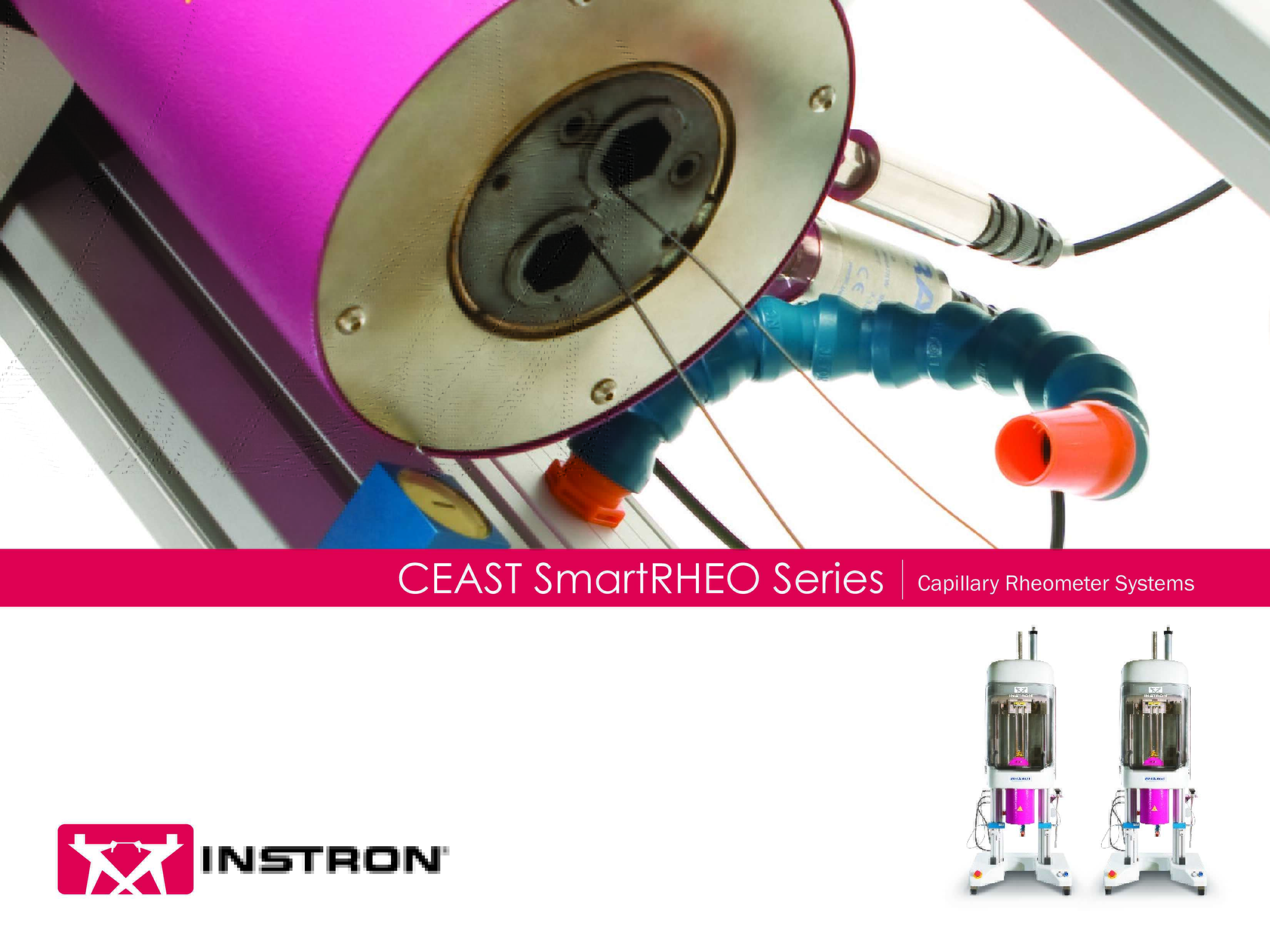
CEAST SmartRHEO Series: Capillary Rheometer Systems
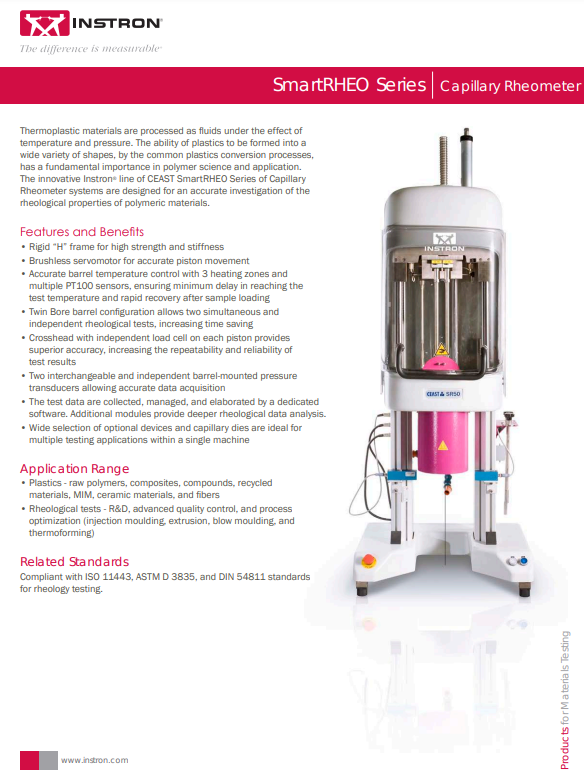
Thermoplastic materials are processed as fluids under the effect of temperature and pressure. The ability of plastics to be formed into a wide variety of shapes, by the common plastics conversion processes, has a fundamental importance in polymer science and application. The innovative Instron® line of CEAST SmartRHEO Series of Capillary Rheometer systems are designed for an accurate investigation of the rheological properties of polymeric materials.
Capillary Rheometer Systems
The innovative Instron® line of CEAST SmartRHEO Series of Capillary Rheometer systems are designed for an accurate investigation of the rheological properties of polymeric materials.
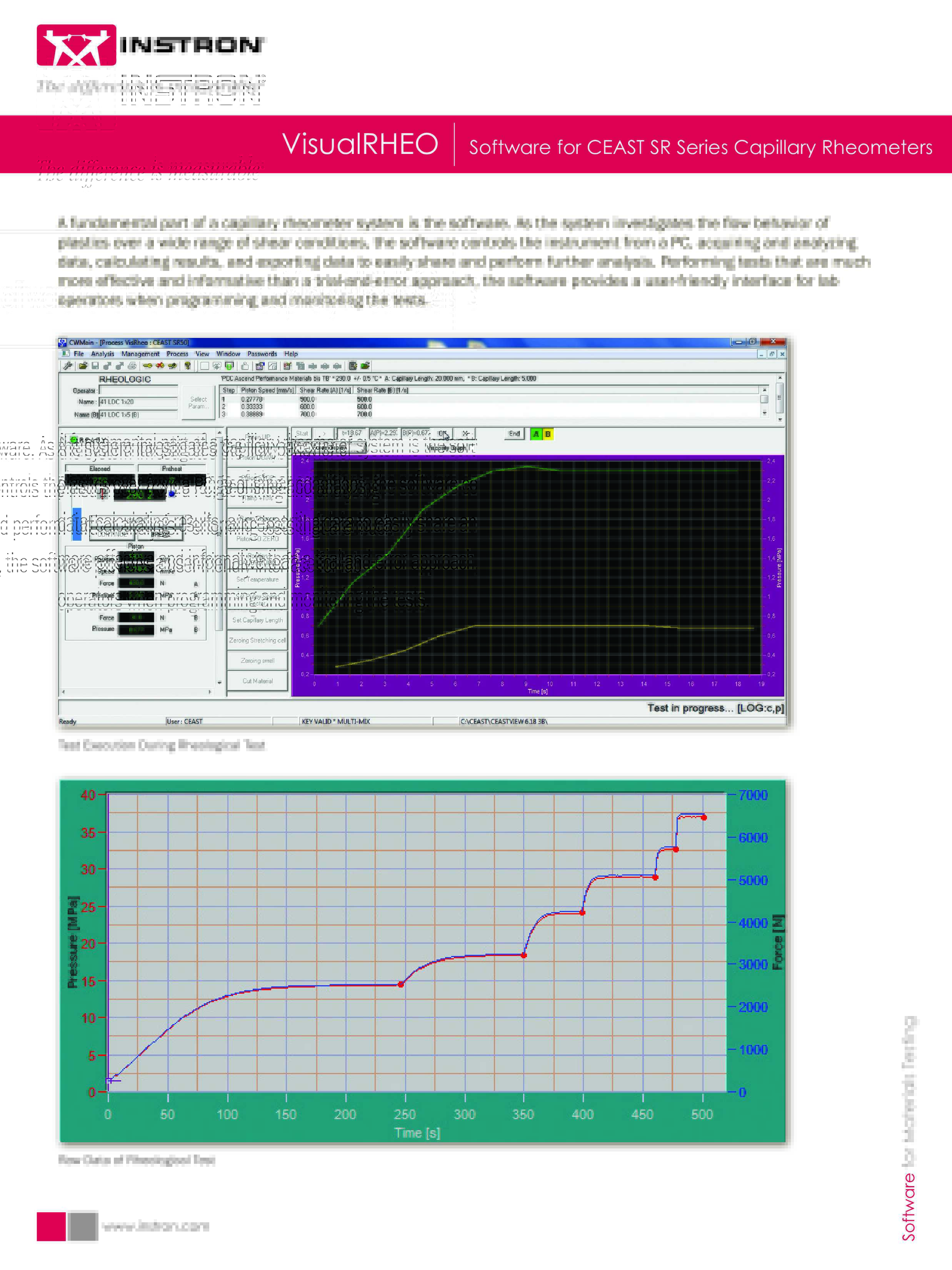
VisualRHEO | Software for CEAST SR Series Capillary Rheometers
A fundamental part of a capillary rheometer system is the software. As the system investigates the flow behavior of
plastics over a wide range of shear conditions, the software controls the instrument from a PC, acquiring and analyzing
data, calculating results, and exporting data to easily share and perform further analysis. Performing tests that are much
more effective and informative than a trial-and-error approach, the software provides a user-friendly interface for lab
operators when programming and monitoring the tests.
