
Calibration
Calibration is the process of comparing an unknown value to a known value. To calibrate a device is to compare a characteristic of that device with the characteristic of a similar device called a “standard.” Using load cells as an example, the load cell being calibrated and the standard load cell are mounted together in series and a range of loads is applied. Both load cells experience the same load and therefore the output values should ideally be identical. A calibration result most often indicates a difference between the two values.
A common misconception is that calibration means adjusting the output of a device to bring its performance “within limits.” Any adjustment made to the output of the device is separate from the calibration and verification process, and must be followed by a further calibration and verification to prove the adjustment was successful.
NOTE: It is important not to confuse CALIBRATION with the term "calibrate" that is sometimes used on instruments to refer to the actions of setting up a transducer such as a loadcell or extensometer to work with the system.
Below are the definitions as defined by the International Vocabulary of Metrology.
2.39 (6.11) calibration
Operation that, under specified conditions, in a first step, establishes a relation between the quantity values with measurement uncertainties provided by measurement standards and corresponding indications with associated measurement uncertainties and, in a second step, uses this information to establish a relation for obtaining a measurement result from an indication
NOTE 1: A calibration may be expressed by a statement, calibration function, calibration diagram, calibration curve, or calibration table. In some cases, it may consist of an additive or multiplicative correction of the indication with associated measurement uncertainty.
NOTE 2: Calibration should not be confused with adjustment of a measuring system, often mistakenly called "self-calibration," nor with verification of calibration.
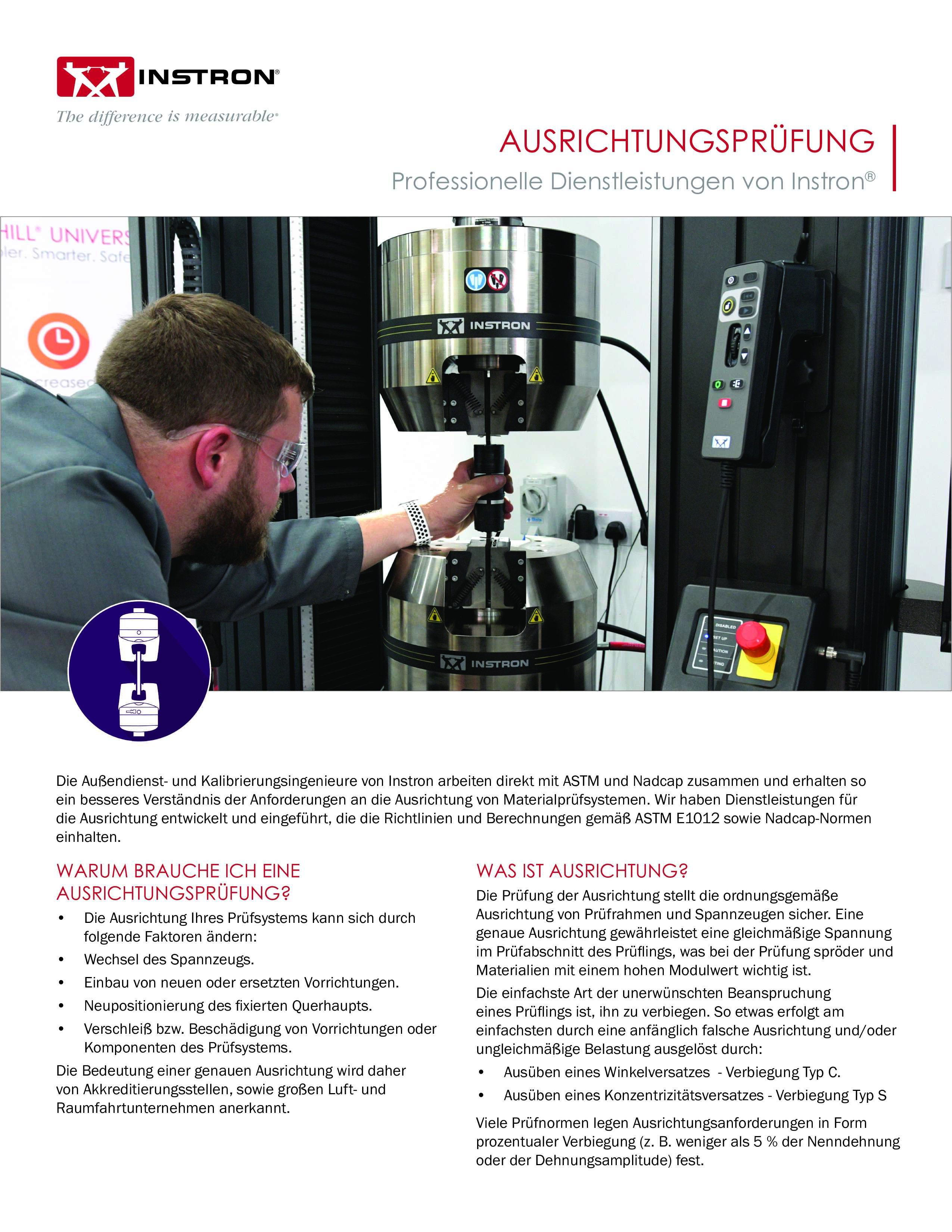
Ausrichtungsprüfung
Die Außendienst- und Kalibrierungsingenieure von Instron arbeiten direkt mit ASTM und Nadcap zusammen und erhalten so ein besseres Verständnis der Anforderungen an die Ausrichtung von Materialprüfsystemen.
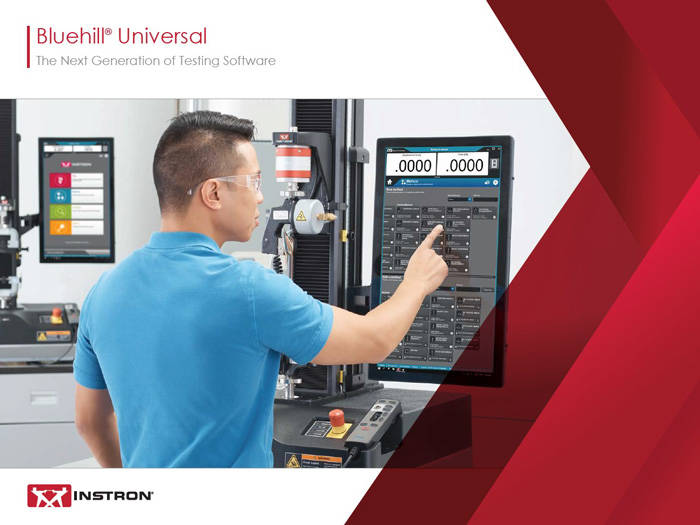
Bluehill Universal Broschüre
Bluehill Universal ist die fortschrittliche Materialprüfsoftware von Instron, entwickelt für intuitive Touch-Interaktion und optimierte Arbeitsabläufe. Sie bietet vorinstallierte Prüfmethoden, QuickTest für eine schnelle Einrichtung, verbesserten Datenexport und Instron Connect für die direkte Servicekommunikation. Anwender von Bluehill 2 und Bluehill 3 können problemlos auf die neueste Version upgraden, um die Leistung und Benutzerfreundlichkeit zu verbessern.

Broschüre Serie 6800 Premier Testing Systems
Universal-Testsysteme der Instron Serie 6800 bieten unvergleichliche Genauigkeit und Zuverlässigkeit. Die 6800 Serie basiert auf einer zum Patent angemeldeten Operator-Protect-Systemarchitektur mit einem brandneuen Smart-Close Air Kit und Collision-Mitigation-Funktionen, wodurch Materialtests einfacher, intelligenter und sicherer sind als je zuvor.

Broschüre der Universalprüfsysteme der Serie 3400
Instron Universalprüfsysteme der Serie 3400 für Zug-, Druck-, Biege- und andere Materialeigenschaftsprüfungen.
