Instron

Shock Absorbers Impact Test

Automotive » Drivetrain

Shock Absorbers Impact Test

The automotive industry remains one of the most common and vulnerable to impact events. Depending on the component, impact damage can have a minor effect on appearance or lead to a major failure in vehicle safety. Both car assemblers and OEM part suppliers must comply with strict safety standards in order to produce high-quality products. Automotive test standards and regulations place an emphasis on impact performance of assemblies and components.
The Challengeautomotive

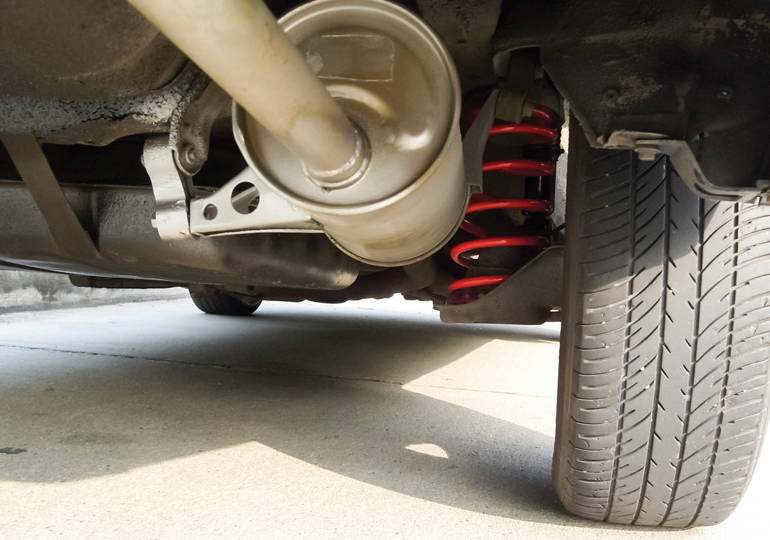
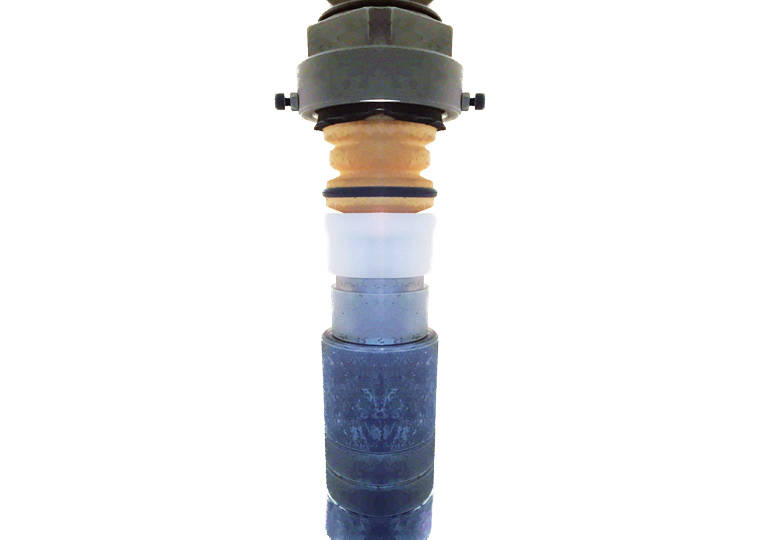
Shock absorbers used in an automotive suspension assembly can experience impact damage. In real life conditions, these dampers are exposed to multiple impacts and are expected to make vibrations as smooth as possible (e.g. speed bumps). It’s necessary for suppliers to understand the behavior of the rubber damper or plastic part connected to it after repeated impact cycles.

Our SolutionShock Absorber Impact Test

Instron designed a special tall thermostatic chamber for a 9450 Drop Tower to accommodate a 600 mm tall damper assembly and developed a dedicated software module to perform multiple impacts on it. This software module enables automatic repetitive impact tests up to 1200 consecutive cycles to simulate the actual use scenario. This helped our customer with new product development and material selection for dampers to be used in this application.

Learn more about our automotive solutions

Drive Shaft Torsion Testing

Automotive » Drivetrain

Drive Shaft Torsion Testing

The Challenge

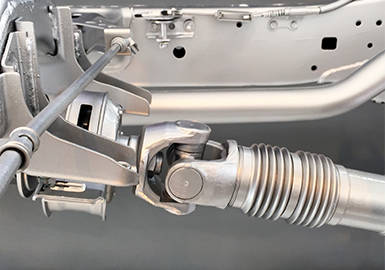
Because they rotate at very high speeds and experience high torque forces, driveshafts must be precisely balanced and weighted. Inferior driveshafts can cause problems that affect the drivability of the vehicle. 

Most commonly made of steel, a driveshaft transfers power from the transmission to the wheels of a vehicle. As the drive for light weighting increases the range of materials used in automobiles, composite driveshafts are now being developed; made of carbon and polymer fiber that are designed to break into small fiber fragments upon failure, increasing safety. Composite driveshafts are also lighter weight (than typical steel) with higher torque capacity, higher rpm value, and reduced noise and vibration.

Determining the torque and rotation properties of driveshafts is critical to determine the performance and quality of these safety critical components.

Our Solution

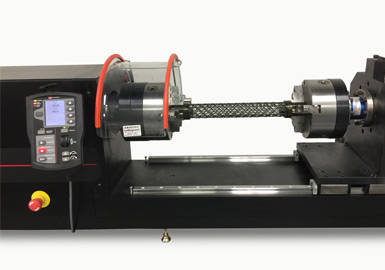
Torsion Testing Composite Drive Shaft on MT10

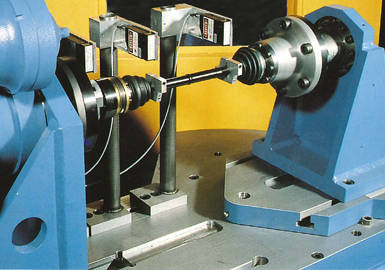
Instron® MT Series systems offer a range of capacities for torsion testing ideal for testing drive shafts. These systems offer accurate, multi-turn capability with high torsional stiffness. Adjustable horizontal test openings and lathe chuck grips facilitate easy specimen loading.

The system utilizes powerful Bluehill® Universal software, with a specific torsion application module providing default methods. The TestProfiler module can also be used for more complex loading scenarios, such as applying torque at different rates within the same test or cyclic testing.


Axle Test System

Automotive » Drivetrain

Axle Test System

THE CHALLENGE

axle test

Time to market pressure increases the demand to test at the sub-system level, and axle development is one area where designs can be validated prior to having the prototype vehicle available. Complete axles, including sub frames, steering systems, drive shafts, stabilizers, brakes, and active components need to be tested as a system using road loads, strains, accelerations, and vehicle control signals to accurately simulate track conditions and validate service life. Electric vehicle development can add to the challenge by introducing drive motors into the axle design, and the need to simulate characteristics, such as drive and brake torques, reaction torques, motor mass, and control systems.

our Solution

axle test

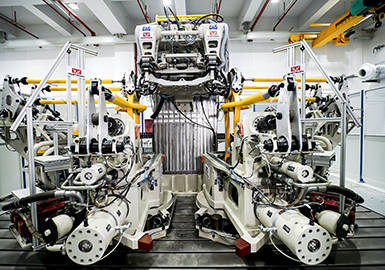
Instron® axles test systems for passenger cars and commercial vehicles allow development engineers to simulate road loads on a complete axle sub-system. The spindle coupled design allows the introduction of all six axes of force and displacement at each wheel. Further control axes can be integrated, such as steering input, engine mount simulation, and control of active components such as stabilizers. The axle is mounted into a support frame which reproduces the vehicle mounting points and then, using data from wheel force transducers and other sensors, it’s possible to run accelerated durability cycles and validate the service life of the axle assembly. A suite of analysis software is available for on-line monitoring and post-test analysis of the results. A high dynamic performance coupled with a low cost of ownership makes the Instron axle test system a valuable asset in the development process.

Learn more about our automotive solutions
Clutch Durability Testing

Automotive » Drivetrain

Clutch Durability Testing

THE CHALLENGE

clutch test

As the interface between engine and transmission, clutch system are exposed to high dynamic loads under harsh environmental conditions.
In addition to quickly and reliably separating and connecting the power from the engine to the transmission the clutch must also ensure the smooth startup of the vehicle whilst damping the torsional vibrations in the drive train. New transmission designs introduce further demands for clutch performance and service life which are reflected in the continued development and testing of these key components.

our Solution

clutch test

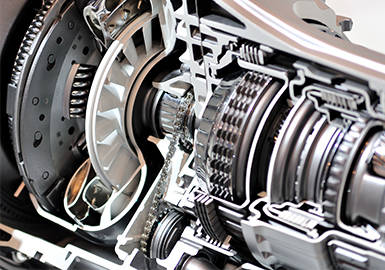
Instron's dynamic clutch test rig allows a co-axial torsion test, in which both quasi-static and highly dynamic torque loads can be generated while the clutch is rotating. The test rig enables validation of the durability and the performance characteristics of clutch components. Inclusion of thermal loads enables the entire lifecycle of clutch components to be simulated.

Drive Shaft Durability Testing

Automotive » Drivetrain

Drive Shaft Durability Testing

THE CHALLENGE

driveshaft

Under driving conditions, drive shafts are exposed to a full range of service loads. To ensure optimum transmission of the torque from the gearbox or differential to the wheels, drive shafts must compensate for the suspension geometry and wheel accelerations whilst ensuring perfect synchronism between the joints at all times. To test the durability of drive shafts, dynamic torques have to be introduced over the full range of movement and under various environmental conditions.

our Solution

driveshaft

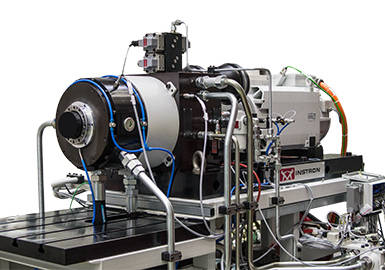
Hydrostatically mounted Hydropuls® rotary actuators are ideally suited to the generation of torsional loads. The standard models provide angular amplitudes up to ±50° and torque up to ±60kNm to simulate the range of service angles and dynamic load. To cover a wide spectrum of test scenarios we offer a variety of rotary actuators with different capacities. We also offer numerous accessories for compensating eccentricity, misalignment, or shortening of specimens under load. Climatic chambers for simulating environmental conditions and temperature are also available.