How Drop Weight Impact Testing Optimizes Ductile to Brittle Transition Temperature Measurement
Written By: Andrea Incardona, Drop Tower Application Specialist, Instron
The ductile to brittle transition temperature is a critical parameter for any application where plastics must perform reliably under impact — particularly in automotive and aerospace, where materials may be routinely exposed to sub-zero conditions and where failure can have serious safety consequences. Drop weight impact testing machines analyze this transition using puncture or tensile impact test methods, and the latest technology offers significant advances in throughput, accuracy, and repeatability. This post explains what the ductile to brittle transition is, how it is measured, and how modern drop weight impact testers address the key challenges of low-temperature testing.
What Is the Ductile to Brittle Transition Temperature?
The toughness of a polymer — its ability to absorb impact energy before breaking — is not a fixed property. As temperature decreases, most polymers become progressively less ductile until they reach a point at which they behave in a brittle manner. This is known as the ductile to brittle transition. At or below the transition temperature, a material loses most of its impact strength, and the risk of catastrophic failure increases significantly.
For applications such as automotive body panels, bumpers, and structural components — or aircraft components exposed to high-altitude temperatures — this transition can occur within the range of temperatures the material encounters in normal service. It is therefore essential that materials used in these applications are tested and validated to confirm they remain sufficiently ductile at the lowest temperatures they are likely to experience.
How Is the Ductile to Brittle Transition Temperature Measured?

Puncture Test Method
The puncture test is the most widely used method for measuring the ductile to brittle transition temperature in plastics. Standards ISO 6603-2- Puncture Impact Behavior of Plastics and ASTM D3763 - High-Speed Puncture Properties of Plastics define the test procedure, which involves a striker hitting a disc or square-shaped specimen perpendicularly at a specified impact energy. A load cell measures the energy absorbed by the material during the impact event, allowing the transition temperature to be identified from the resulting data. This test is a prerequisite for many materials used in automotive applications where advanced impact performance must be demonstrated.
Tensile Impact Test Method
An alternative approach is the tensile impact test, which measures the force required to fracture a specimen under a high-speed tensile load of up to 20 m/s. ISO 8256 provides guidance on performing this test. Like the puncture method, it requires specimens to be conditioned to the desired test temperature before testing.
Both methods require the specimens to be brought to a specified temperature — a process known as conditioning — before the impact event. Without an integrated conditioning solution, this step introduces significant challenges.
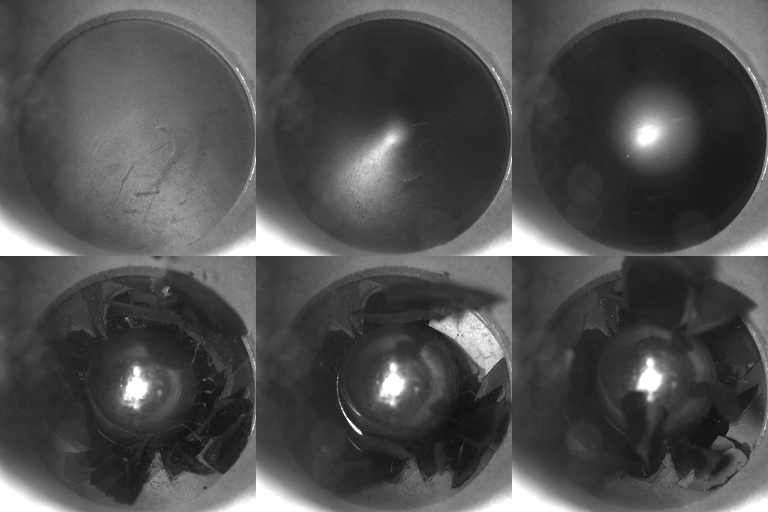
The Challenges of Low-Temperature Testing
Traditionally, conditioning specimens for low-temperature impact testing requires the use of an external cryostat. This approach has several well-recognized disadvantages:
- Downtime — Each test cycle requires time to transfer specimens from the cryostat to the impact tester, increasing the time between tests and reducing overall throughput in high-volume QC environments.
- Accuracy — Between the moment a specimen is removed from the cryostat and the moment it is struck, its temperature begins to rise. Even a small temperature variation can affect the result, particularly near the transition temperature where material behavior changes rapidly.
- Cost and footprint — Cryostats represent an additional capital and maintenance cost, and their physical footprint can be significant in laboratory environments where floor space is already limited
Some laboratories use alternative conditioning methods — such as directing cold air from a cryostat through a pipe directly onto the specimen — but these approaches are energy-intensive and do not provide the enclosed, controlled environment needed for consistent temperature maintenance.
Low-Temperature Testing with Integrated Thermostatic Chambers
The latest drop weight impact testing machines address all of these limitations through optional integrated thermostatic chambers that enclose the support fixture and specimens during conditioning. With specimens already loaded onto the tester when cooling begins, the transfer step is eliminated entirely — removing both the downtime and the temperature variation risk associated with external conditioning.
Advanced drop weight machines with integrated chambers can test across a temperature range of -70°C to +150°C, covering the vast majority of environmental conditions relevant to automotive and aerospace applications. Combined with an automatic specimen feeding system capable of loading up to 30 samples simultaneously, these systems enable seamless consecutive testing at multiple temperatures — with temperature step variations as small as 2°C between tests — without stopping the test sequence.
The result is faster throughput, better accuracy, and improved repeatability compared to any external conditioning approach. Every specimen is at the correct temperature at the moment of impact, every time.
Drop Weight Impact Tester vs. Pendulum: Which Is Right for Your Application?
Pendulum impact testers remain the most widely used instruments for measuring ductile to brittle transition temperature, and they are well suited to many standard test methods. However, drop weight impact testers offer several advantages that make them the preferred choice for more demanding or flexible testing requirements:
- Test method flexibility — Pendulum testers are limited to tensile impact tests, while drop weight testers support both puncture and tensile impact testing, expanding the range of standards and materials that can be evaluated on a single platform.
- Energy and speed range — Pendulum testers operate at a fixed impact energy and speed determined by the selected hammer. Drop weight testers offer a wide and continuously adjustable energy and speed range, enabling testing across a broader spectrum of material types and performance requirements.
- Integrated temperature conditioning — Drop weight impact testers are available with integrated thermostatic chambers for controlled low-temperature testing. Pendulum testers do not offer this capability, requiring external conditioning solutions with all the associated limitations described above.
For laboratories that test a wide range of materials at varying temperatures and require high throughput, a drop weight impact tester with integrated conditioning is the more capable and efficient solution.
Materials Innovation at Low Temperatures
Beyond quality control, the capabilities of modern drop weight impact testers are enabling research and development teams to push the boundaries of what is achievable with polymer and composite materials. By testing across multiple temperatures with high accuracy and repeatability, R&D laboratories can map the full ductile to brittle transition behavior of new material formulations — identifying opportunities to extend the temperature range over which a material remains ductile, or to develop new materials with superior low-temperature toughness for the next generation of automotive and aerospace components.
Conclusion
The ductile to brittle transition temperature is not just a materials property — it is a safety-critical parameter for any application where plastics must perform reliably under impact at low temperatures. Traditional external conditioning approaches introduce downtime, accuracy risks, and operational complexity that modern integrated thermostatic chambers eliminate. Combined with automatic specimen feeding and flexible energy and speed control, the latest drop weight impact testers provide a faster, more accurate, and more versatile solution for both quality control and materials research.
Discover Instron's Drop Weight Impact Testing Machines

Andrea Incardona
Andrea Incardona is an Application Engineer and Product Specialist at Instron, based in Italy. With a background from Politecnico di Torino, Andrea specializes in drop tower and impact testing applications, helping customers select and optimize testing solutions for demanding materials characterization requirements.

Talk to an Instron Expert
Whether you are evaluating drop weight impact testers for the first time or looking to add low-temperature testing capability to your existing setup, our team can help you identify the right solution for your application and throughput requirements.
Contact Our Sales Department.
Please complete the form below and we will be happy to contact you with a response. Our typical response time for an online request is within 1-2 business days. For a faster response, please call +1-800-473-7838.