What Is Torsion Testing?
Torsion testing is a type of mechanical testing that evaluates the properties of materials or devices while under stress from angular displacement — essentially, twisting a specimen and measuring how it responds. This type of loading occurs constantly in the real world, from a driveshaft transmitting power in a vehicle to a bottle cap being twisted open, which makes torsion testing an essential tool for understanding how materials and products will actually perform in service.
Torsion testing can be split into two distinct categories: testing raw materials, like metal wires or plastic tubing, to determine fundamental properties such as shear strength and modulus, or functional testing of finished products subjected to torsion, such as screws, pharmaceutical bottles, and sheathed cables. The first approach helps material suppliers and engineers characterize a material before it's ever built into a product, while the second verifies that a completed part or assembly can withstand the twisting forces it will encounter throughout its service life.
The most common mechanical properties measured by torsion testing are modulus of elasticity in shear, yield shear strength, ultimate shear strength, modulus of rupture in shear, and ductility. Together, these properties give engineers a complete picture of how a material or component will behave under torsional load — from its initial elastic response, through the point of permanent deformation, and ultimately to failure.
Use the links below to jump directly to the section you are interested in:
Why Perform a Torsion Test? | Types of Torsion Tests | Torsion Testing Equipment | Calculating Results | Common Torsion Testing Standards
Why Perform a Torsion Test?
Many products and components are subjected to torsional forces during their operation. Torsion testing is necessary when engineers wish to change or update the materials used in these products. For example, the metal used in vehicle drivetrains experiences complex combined loading in use, with torsion being the main component. An engineer trying to design a more fuel-efficient vehicle may need to change the material of the driveshaft to reduce vehicle weight. Torsional testing can help the engineer identify an appropriate material that possesses the required torsional strength while also contributing to the goal of lightweighting.
Many finished products are also subjected to torsional forces during their operation. Products such as biomedical tubing, switches, and fasteners are just a few devices subjected to torsional stresses in everyday use. By testing their products in torsion, manufacturers can simulate real-life service conditions, check product quality, verify designs, and ensure proper manufacturing techniques.

Types of Torsion Tests
Torsion tests can be performed by applying only a rotational motion, or by applying both axial (tension or compression) and torsional forces. Types of torsion testing vary from product to product, but can usually be classified as failure, proof, or product operation testing.
- Torsion Only: Applying only torsional loads to the test specimen.
- Axial-Torsion: Applying both axial (tension or compression) and torsional forces to the test specimen.
- Failure Testing: Twisting the product, component, or specimen until failure. Failure can be classified as either a physical break or a kink/defect in the specimen.
- Proof Testing: Applying a torsional load and holding this torque load for a fixed amount of time.
- Functional Testing: Testing complete assemblies or products, such as bottle caps, switches, dial pens, or steering columns, to verify that the product performs as expected under torsion loads.
Torsion Testing Equipment
Torsion testing can be performed on a few different testing systems, depending on the specific application. A universal testing system, such as the 6800 Series, can be configured with a Torsion Add-On that enables the system to perform biaxial testing (simultaneous and independent axial and torsional loading). Functional testing of finished products is often performed on a dynamic fatigue system, such as Instron's ElectroPuls®.
Depending on the specimen, torsion testing also relies on specialized grips and fixtures — such as wire torsion grips for round wire specimens, or custom fixtures designed to hold finished products like bottle caps or fasteners securely without slipping under angular load.
Calculating Results
The torque-vs-rotation curve produced by testing raw materials in torsion is, in many ways, analogous to the force-displacement curve captured during axial testing. Most materials exhibit a similar linear region, representing the shear modulus, followed by yield and ultimate failure.
As with axial testing, specimen geometry plays an important role in torsion test results — factors such as gauge length and cross-sectional shape can influence the calculated shear modulus and strength values, so consistent specimen preparation is important for repeatable results.

Common Torsion Testing Standards
Torsion testing is governed by a range of industry standards, depending on the material or product being evaluated. The table below highlights some of the most common standards Instron supports, spanning medical devices, metallic wire, and fluid connectors.
| Standard | Description |
|---|---|
| ASTM F543 | Axial and Torsion Testing of Bone Screws |
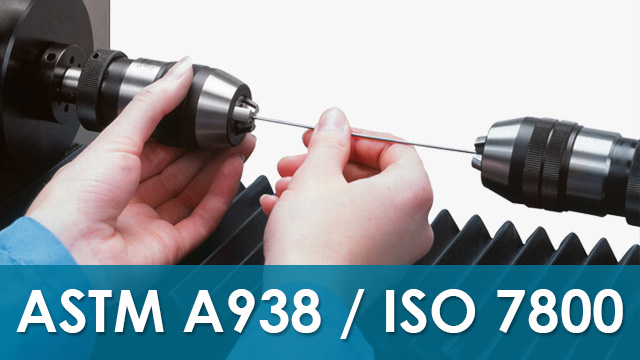
| ASTM A938 / ISO 7800 | Torsion Testing of Metallic Wire |
| ISO 594 / ISO 80369 | Testing of Conical Luer Fittings |
| ISO 7206 | Endurance and Fatigue Testing of Artificial Hip Implants |

Talk to an Instron Expert
Not sure which torsion testing system fits your application? Tell us about your requirements and we will help you find the right solution.
Talk to an Applications Engineer
Tell us about your testing needs, and we'll help you configure the right frame, load cell, grips, and software for your lab. Please complete the form below, and we'll respond within 1-2 business days. For a faster response, call +1-800-473-7838 or +1 781 828 2500 if you are outside of the US.