Dynamic Torsion Testing System
New technology, and the demands it places on modern clutch systems, requires existing systems to be developed further. The main focus is on the power flow between the engine and the transmission, including:
- Rapid, reliable separation and connection of the power flow
- Smooth moving-off
- Damping of engine vibrations
- Easy operation
- Long life without sacrificing comfort
- Minimal installation space
To meet these requirements, dynamic component inspections and operational strength tests must be carried out on coupling components and dual-mass flywheels under rotation, with the corresponding centrifugal forces. The real-world wear of clutch components and damping elements must also be examined, and torque characteristics must be determined over the angle of rotation.
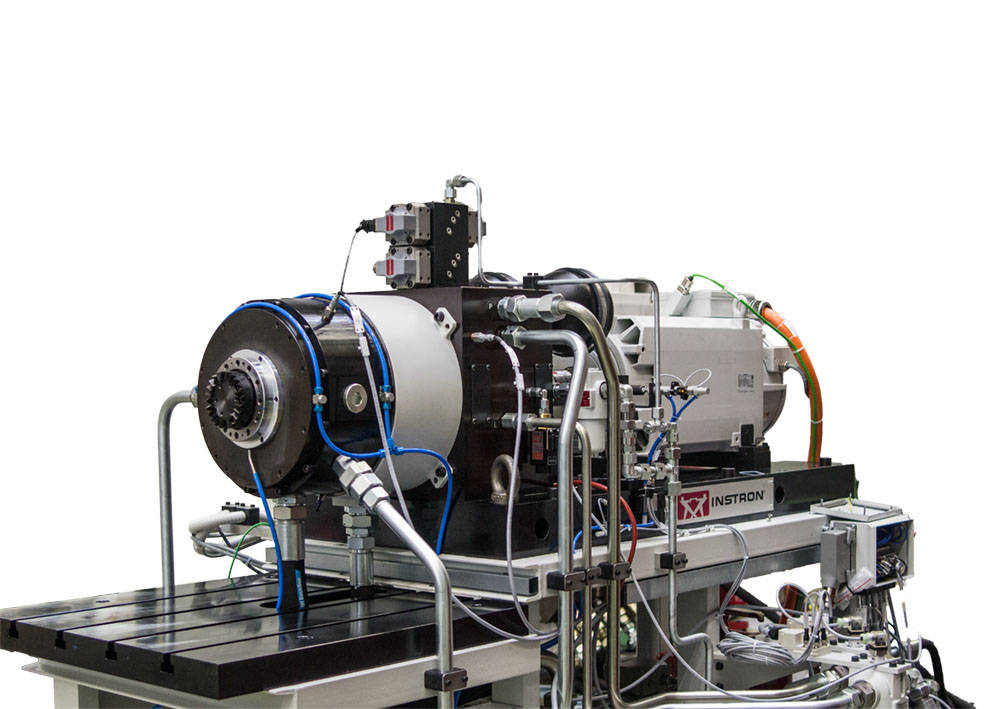
The dynamic torsion testing system is designed for the operational fatigue testing of torsional vibration dampers under rotational speed. These dampers are used as damping elements in the dual-mass flywheels of modern clutch systems, where they serve to reduce the vibrations generated by the clutch and the rotating transmission masses.
The long-term behavior of the bearing and damping elements in the flywheel is examined. In addition, multi-stage torsional characteristics (clutch hysteresis loops) can be determined as a function of rotational speed during torque changes (thrust and tension).
Nominal torques of up to 2,500 Nm, along with high-frequency torsional vibrations, are generated by a spinning Hydropuls® rotary cylinder using a rotary vane principle. The cylinder rotates at a controllable speed together with the test specimen, allowing all loads that occur under operating conditions to be simulated on the specimen.


Talk to an Instron Expert
Not sure if the dynamic torsion testing system fits your clutch or flywheel testing program? Tell us about your application and we will help you find the right solution.
Talk to an Applications Engineer
Tell us about your testing needs, and we'll help you configure the right frame, load cell, grips, and software for your lab. Please complete the form below, and we'll respond within 1-2 business days. For a faster response, call +1-800-473-7838 or +1 781 828 2500 if you are outside of the US.