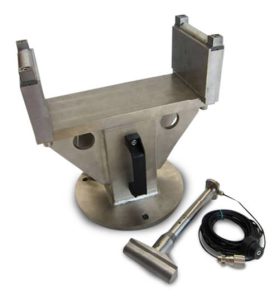
3-Point Bend Impact Testing
Flexural Test on Rigid Plastics and Composites Under Impact Conditions
How to Perform a 3-Point Bend Test
The 3-point bend test is a flexural test that is widely used to characterize the mechanical behavior of materials. A small flat beam with rectangular cross-section is placed on a 3-point bend fixture consisting of two parallel supports and the tup insert strikes the specimen in the middle.
The ideal 3-point bend test machine for a high velocity flexural test is an instrumented drop weight impact testing machine equipped with a 3-point bend fixture and an insert of a given shape attached to the tup.
During the impact, the load is recorded by the sensor (piezoelectric or strain-gauge) embedded in the tup. The load-time curve is then processed to obtain a force-deflection curve. The resulting curve is dependent on the strain rate experienced by the specimen impacted and the drop weight impact testing machine allows to cover a broad range of impact velocity to assess the material performances.
The ASTM D256 and ISO 179-2 Charpy impact test are the main standard methods used to perform flexural bend testing, however there are some variants and many customizations are allowed.

The specific setup for the 3 point bending test method involves:
- Support with shoulders
- Dedicated tup insert
Consult accessories, such as supports, tup holders and tup inserts for 3-point bend, charpy izod impact tests.