

Tensile Testing: How It Works, What It Measures, and How to Get Started
Tensile testing is a fundamental mechanical test performed by engineers and materials scientists in manufacturing and research facilities around the world. A tensile test — also known as a tension test — applies uniaxial force to a material specimen to measure its key mechanical properties: tensile strength, yield strength, elastic modulus, and elongation. These measurements tell product designers and quality engineers how a material will behave under load, where it will begin to deform permanently, and the point at which it will break — providing the data needed to select the right material for an application and verify that it meets the required specifications.
Why Perform a Tensile Test?
Tensile testing and material characterization are crucial for manufacturers and researchers in all industries. In order for a material to be selected for a new product or use, researchers must ensure that it can withstand the mechanical forces that it will encounter in its end-use application. For example, tire rubber must be elastic enough to absorb inconsistencies in road surfaces, while surgical sutures must be strong enough to hold living tissue together. Furthermore, materials and products might be exposed to mechanical forces for short or long periods of time, through cyclical or repeated use, and in a wide variety of different temperature and environmental conditions. Automotive tires are expected to last for a certain number of miles under a variety of weather conditions, while surgical sutures, though only used once, must maintain a consistent tensile strength for long enough for the body to heal.
In addition to its importance to the R&D process, tensile testing is also used by quality assurance departments to ensure that batches of finished product are meeting the required specifications for tensile properties. This is important from both a safety and a business perspective, as defective products can be dangerous to the end user and can also cause significant harm to manufacturers in the form of product delays, lost revenue, and damaged reputations.
How To Perform a Tensile Test
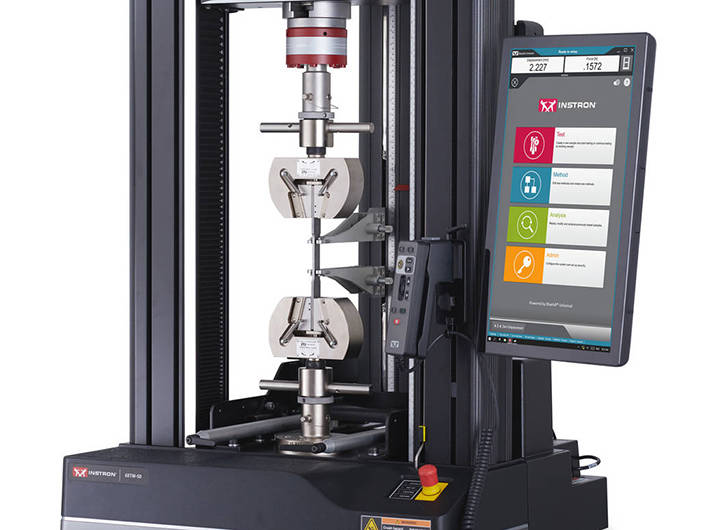
Tensile tests are performed on universal testing machines, also known as tensile machines or tensile testing machines. These machines consists of a single or dual column frame equipped with a load cell, testing software, and application-specific grips and accessories such as extensometers. Universal testing machines come in a wide variety of force capacities and can be configured with different fixtures to test any product, component, or material.
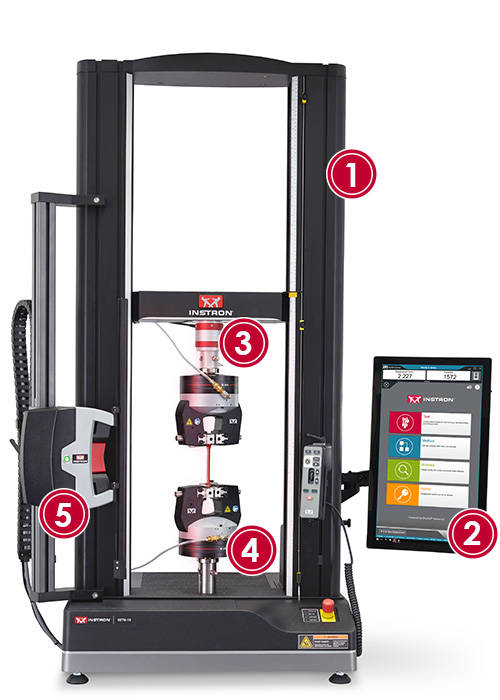
Tensile Testing Machine: Key Components and Their Functions
- Load Frame - Tensile testing machines can come in single or dual column configurations depending on their force capacity.
- Software - Test software is where operators configure test methods and output results.
- Load Cell - The load cell is a transducer that measures the force applied to the test specimen. Instron load cells are accurate down to 1/1000 of load cell capacity.
- Grips and Fixtures - A wide range of specimen grips and fixtures are available to accommodate test specimens of different materials, shapes, and sizes.
- Strain Measurement - Some test methods require measurement of a specimen's elongation under load. Instron's AVE2 can measure changes to specimen length down to ±1 µm or 0.5% of reading.
Setting Up A Tensile Test
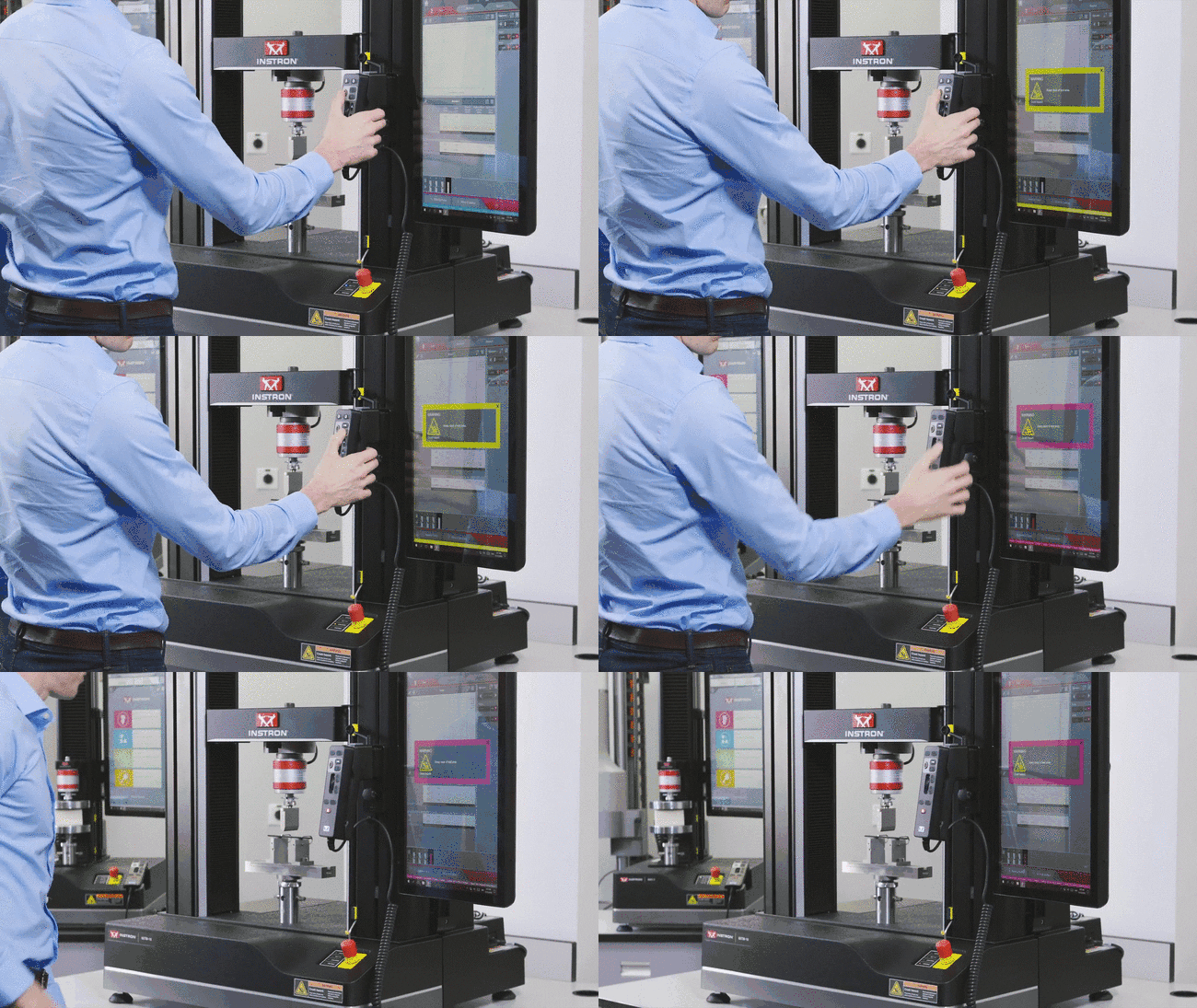
In order to perform a tensile test, an operator must perform a variety of tasks to ensure that the test is being conducted in accordance with internal and/or external testing standards. Depending on the lab, these tasks might be partially or entirely automated, though responsibility for the correctness of the setup always resides with the operator.
Test Method Selection
Once your specimen is loaded into the grips and your extensometer is attached, you are ready to begin. In Bluehill Universal, select your test method and configure key parameters including test speed, specimen dimensions, and end-of-test criteria such as break detection or a maximum load limit.
When you start the test, the machine applies tensile force at the prescribed rate, continuously recording load, extension, and strain data as the specimen deforms. The test runs until the defined end criteria are met, typically specimen break or a percentage drop in load.
Once complete, Bluehill Universal automatically calculates the mechanical properties defined in your method: tensile strength, yield strength, elongation, and modulus, ready for review, export, or reporting.

Preparing Specimens
Specimen geometries vary widely depending on the material being tested and the test method or standard being used. Governing bodies such as ASTM and ISO have standardized specimen requirements for different materials, which allows their properties to be reliably compared between different batches and manufacturers.
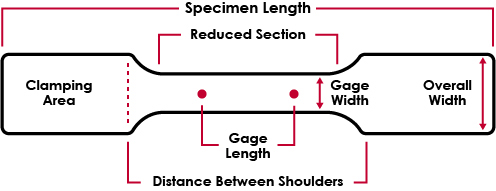
Tensile specimens are commonly machined or die cast in the shape of dogbones, which provide 'shoulders' designed to be held by the grips of the testing machine and a 'gage length' where the tensile properties will be measured. The dimensions of these shoulders, the gage length between them, and the length and width of the entire specimen are all prescribed by the testing standard.
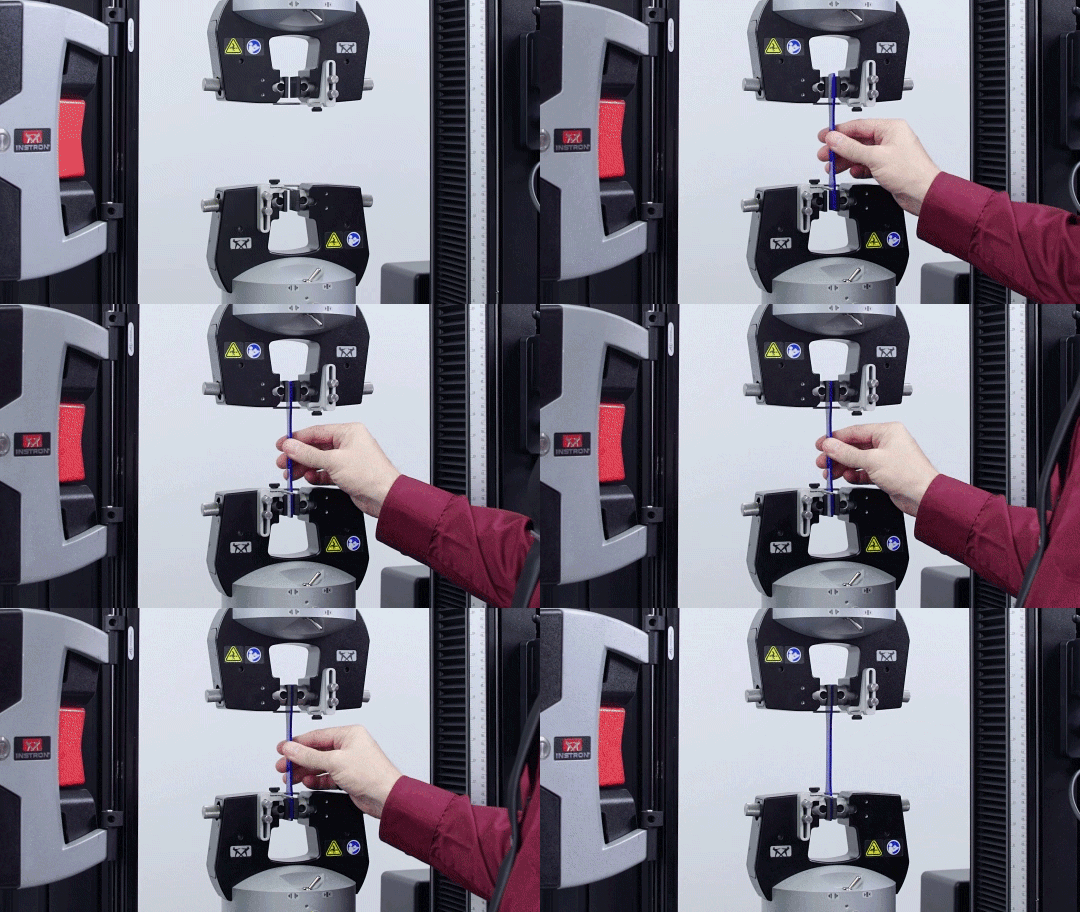
Inserting Specimen into Grips
Selecting the right grip for your specimen is critical to getting accurate, repeatable results. Depending on the dimensions, texture, and material type of your specimen, different grip designs and jaw face surfaces may be required. Grips are available in a wide variety of force capacities and with rubber-coated, smooth, serrated, and other surface types to accommodate everything from soft elastomers and thin films to high-strength metals and composites.
Proper alignment is equally important. Misalignment during specimen insertion introduces off-axis forces that can skew results or cause premature failure at the grips rather than in the gage length. To help operators insert specimens consistently and correctly, Instron offers a range of alignment devices and fixtures designed to ensure that force is applied along the correct axis every time.
For high-volume testing environments, pneumatic and hydraulic grips can significantly reduce setup time and operator variability, opening and closing at the press of a button rather than requiring manual adjustment between specimens.
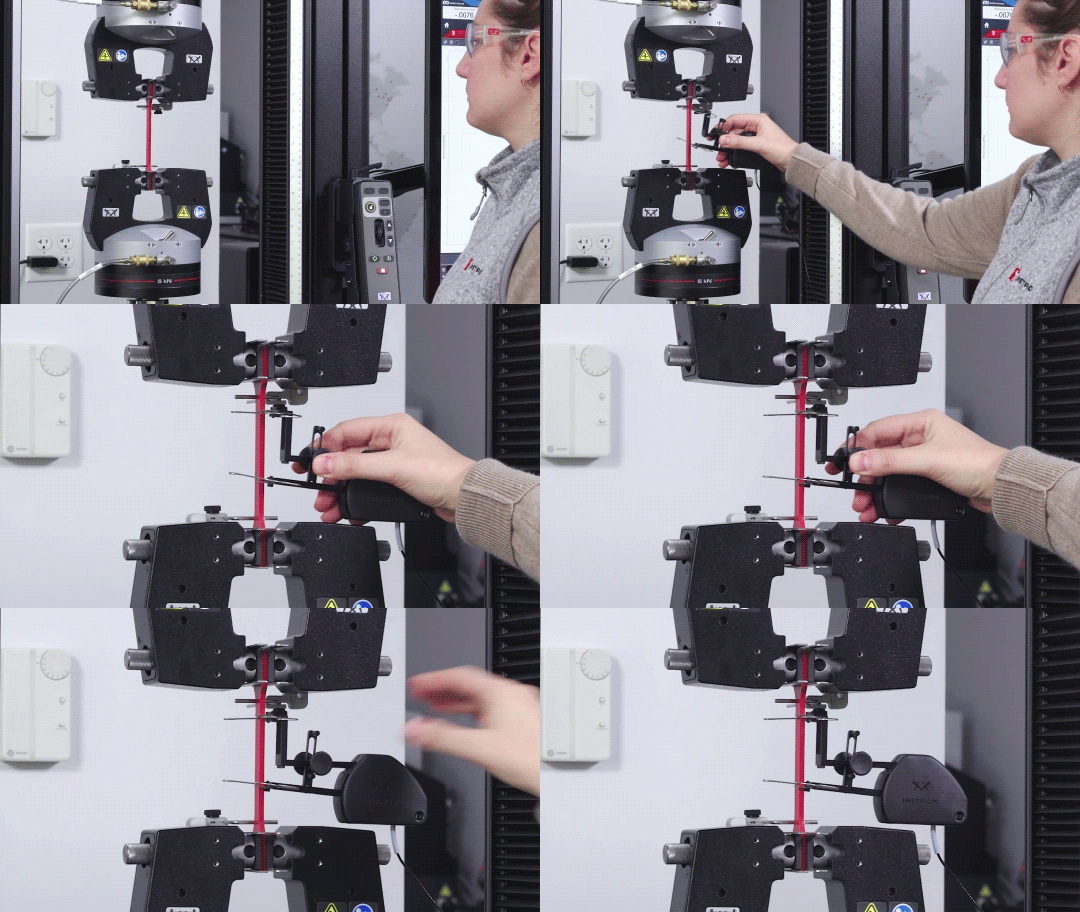
Strain Measurement Devices
Strain is a measurement of a specimen's deformation under stress and is a fundamental part of materials characterization required by most tensile testing standards. Accurately measuring strain requires a dedicated measurement device rather than relying on crosshead displacement, which can introduce error from machine compliance and grip seating.
Extensometers are the most common solution. Contacting devices such as clip-on extensometers attach directly to the specimen at a fixed gage length, measuring the change in distance between two contact points as the specimen deforms. They are attached after the specimen has been placed in the grips, prior to starting the test. For applications where attaching a device to the specimen is not practical — such as very thin films, high-elongation elastomers, or brittle materials — non-contacting video extensometers offer an alternative, tracking deformation optically using markers or surface features on the specimen.
Starting the Test and Recording Data
Once your specimen is loaded into the grips and your extensometer is attached, you are ready to begin. In Bluehill Universal, select your test method and configure key parameters including test speed, specimen dimensions, and end-of-test criteria such as break detection or a maximum load limit.
Once complete, Bluehill Universal automatically calculates the mechanical properties defined in your method: tensile strength, yield strength, elongation, and modulus, ready for review, export, or reporting.
Tensile Test Data Analysis: Understanding the Stress-Strain Curve and Key Material Properties
Measuring a material in tension produces a complete profile of its mechanical properties. When plotted on a graph, the recorded load and extension data generates a stress-strain curve that shows how the material responded to the applied force at every stage of the test. While the specific properties required vary by standard and application, the key measurements engineers look for are ultimate tensile strength, modulus of elasticity, yield strength, and strain — each of which reveals something different about how the material will behave in use.

Ultimate Tensile Strength
One of the most important properties we can determine about a material is its ultimate tensile strength (UTS). This is the maximum stress that a specimen sustains during the test. The UTS may or may not equate to the specimen's strength at break, depending on whether the material is brittle, ductile, or exhibits properties of both. Sometimes a material may be ductile when tested in a lab, but, when placed in service and exposed to extreme cold temperatures, it may transition to brittle behavior.
Hooke's Law
For most materials, the initial portion of the test will exhibit a linear relationship between the applied force or load and the elongation exhibited by the specimen. In this linear region the line obeys the relationship defined as Hooke's Law, where the ratio of stress to strain is a constant. E is the slope of the line in this region where stress (σ) is proportional to strain (ε) and is called the modulus of elasticity or young's modulus:
Modulus of Elasticity
The modulus of elasticity is a measure of the material's stiffness that only applies in the initial linear region of the curve. Within this linear region the tensile load can be removed from the specimen and the material will return to the exact same condition it had been in prior to the load being applied. At the point when the curve is no longer linear and deviates from the straight-line relationship, Hooke's Law no longer applies, and some permanent deformation occurs in the specimen. This point is called the elastic or proportional limit. From this point on in the tensile test, the material reacts plastically to any further increase in load or stress. It will not return to its original, unstressed condition if the load is removed.
Yield Strength
A material's yield strength is defined as the stress applied to the material at which plastic deformation starts to occur.
Offset Method
For some materials (e.g. metals and plastics), the departure from the linear elastic region cannot be easily identified. Therefore an offset method to determine the yield strength of the material is allowed. This methodology is commonly applied when measuring the yield strength of metals. When testing metals according to ASTM E8/E8M, an offset is specified as a percentage of strain (usually 0.2%). The stress (R) that is determined from the intersection point "r" when the line of the linear elastic region (with slope equal to modulus of elasticity) is drawn from the offset "m" becomes the offset yield strength.
Alternate Moduli
The tensile curves of some materials do not have a very well-defined linear region. In these cases, ASTM Standard E111 provides for alternative methods for determining the modulus of a material, as well as young's modulus. These alternate moduli are the secant modulus and tangent modulus.
Strain
We are also able to find the amount of stretch or elongation that the specimen undergoes during tensile testing. This can be expressed as an absolute measurement in the change in length or as a relative measurement called "strain." Strain itself can be expressed in two different ways, as "engineering strain" and "true strain."
Engineering strain is probably the easiest and the most common expression of strain used. It is the ratio of the change in length to the original length:
The true strain is similar, but based on the instantaneous length of the specimen as the test progresses, where Li is the instantaneous length and L0 the initial length:
View our Tensile Testing and Tensile Testing Machines FAQ for additional information
Instron Tensile Testing Equipment: Choosing the Right System, Grips, and Strain Measurement for Your Application
Tensile testing machines are available in a variety of different sizes and force capacities ranging from 0.02 N to 2,000 kN. Most low force testing is performed on an electromechanical single-column or dual-column tabletop machine, while higher force applications require floor model frames. Instron's 6800 Series systems are available in capacity ranges up to 300 kN and can perform a wide range of different test types, including tensile, compression, bend, peel, tear, shear, friction, torsion, puncture, and more. Instron's Industrial Series servohydraulic systems are designed for even higher capacity testing of high strength metals, alloys, and advanced composites.
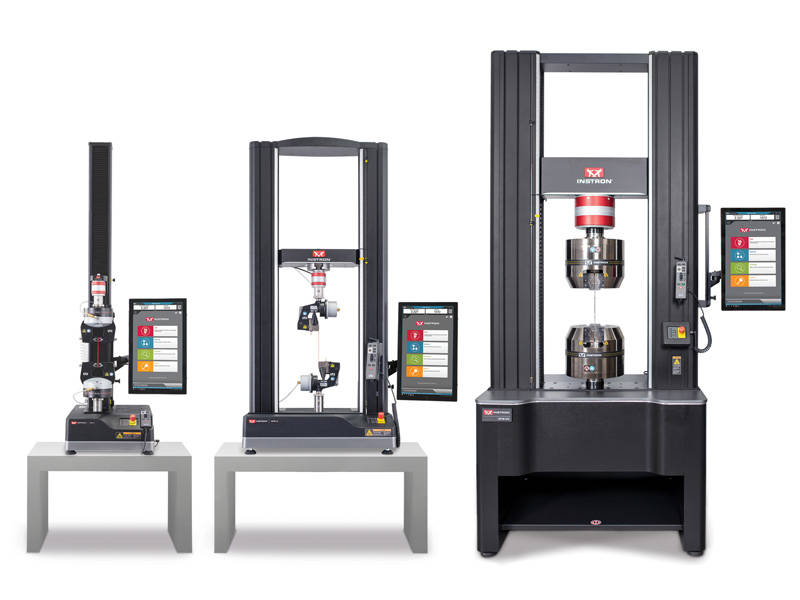
Universal Testing Systems up to 300 kN
Single and dual column table model and floor model testing systems with a force capacity range of 0.02 N (2 gf) to 300 kN.
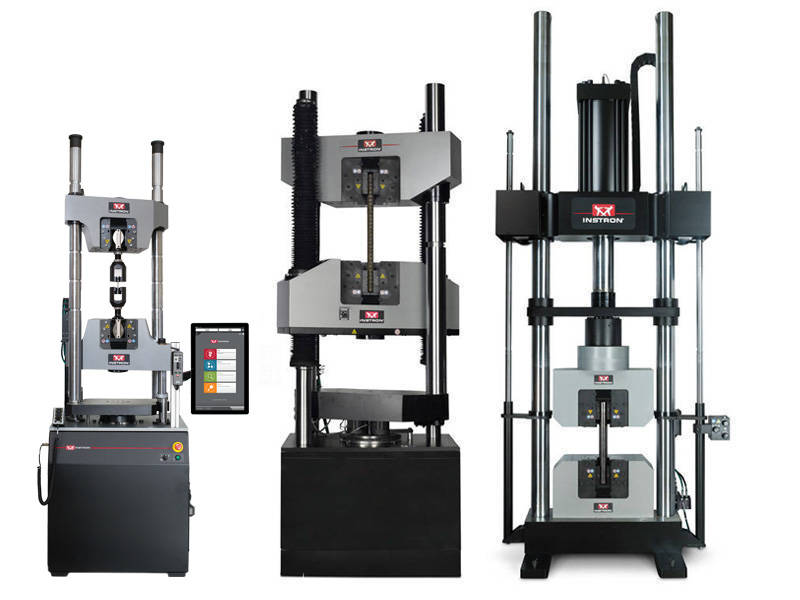
Industrial Universal Testing Systems up to 2000 kN
Instron’s Industrial Series includes frames with single or dual test spaces and range in force capacity from 300 kN to 2000 kN.
Tensile Grips For Testing Plastics, Metals, Composites, Elastomers, Textiles, and Components
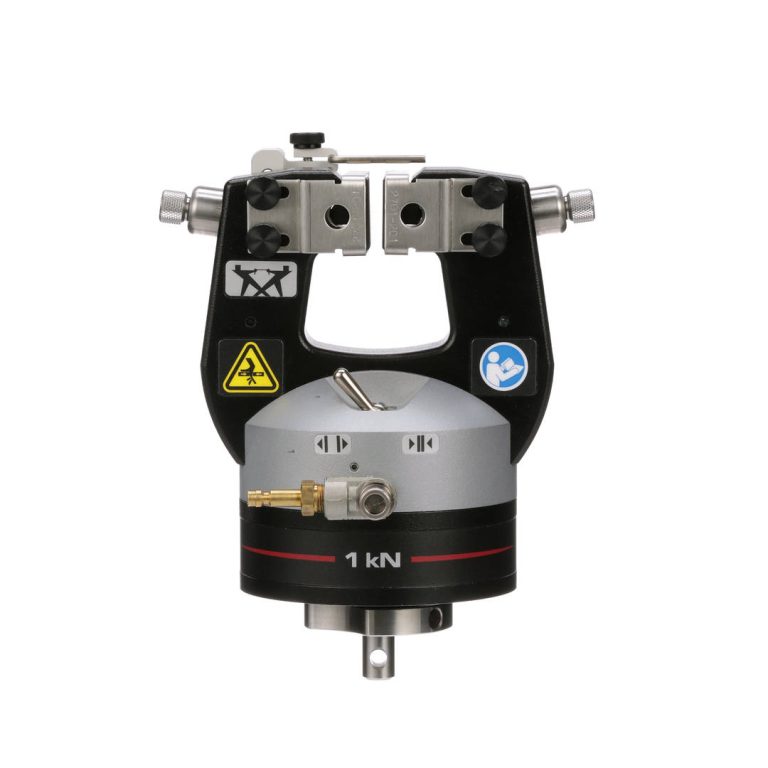
Pneumatic Side Action Tensile Grips
Catalog no. 2712-XXX
Our most popular tensile grip and installed on more than half of all Instron universal testing machines. These grips are easy to use, extremely versatile, and efficient for high volume testing. Up to 10kN force capacity.
Learn More
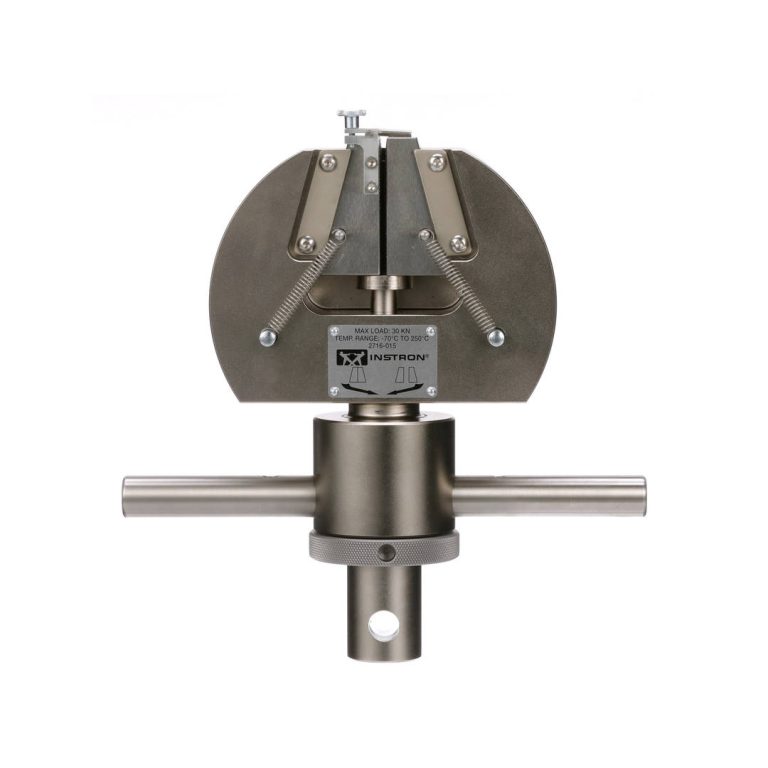
Mechanical Wedge Action Grip
Catalog no. 2716-XXX
A classic, simple, and robust tensile grip design; manual wedge action grips are perfect for metals, composites, and plastic. Designed for easy specimen loading, alignment, and positioning. Up to 250kN force capacity.
Learn More
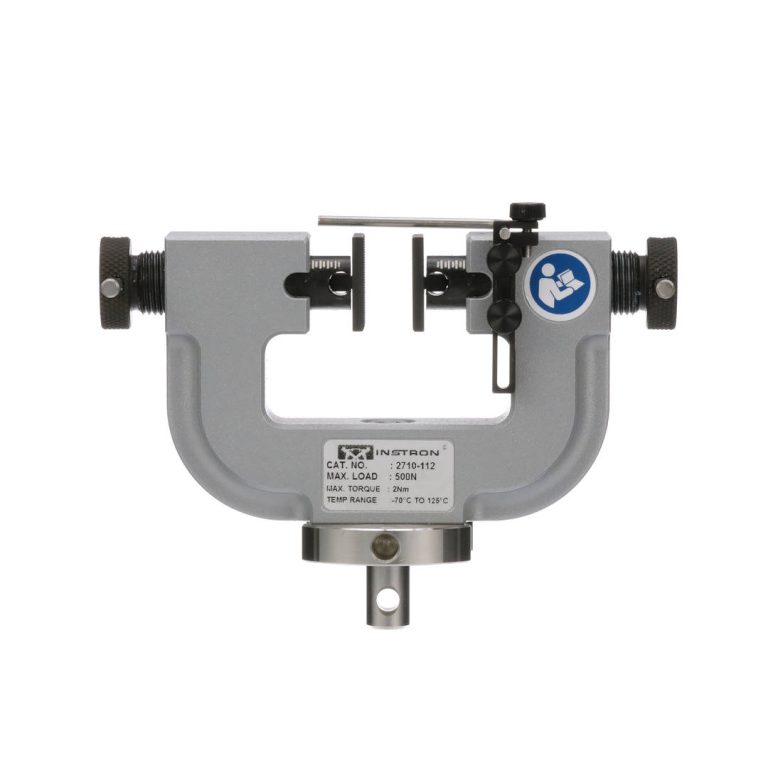
Advanced Screw Side Action Grips
Catalog no. 2710-XXX
Screw action grips provide a very simple and efficient method for holding test specimens and are most commonly used for biomedical, plastic film, electronic, and adhesive applications. Up to 10kN force capacity.
Learn More
Advanced Hydraulic Wedge Action Grips
Catalog no. 2742-XXX, 2743-XXX
The best grips available for most metal and composite tensile testing applications. A hydraulic grip pump is required if installing these on an electromechanical system. Up to 500kN force capacity.
Learn More
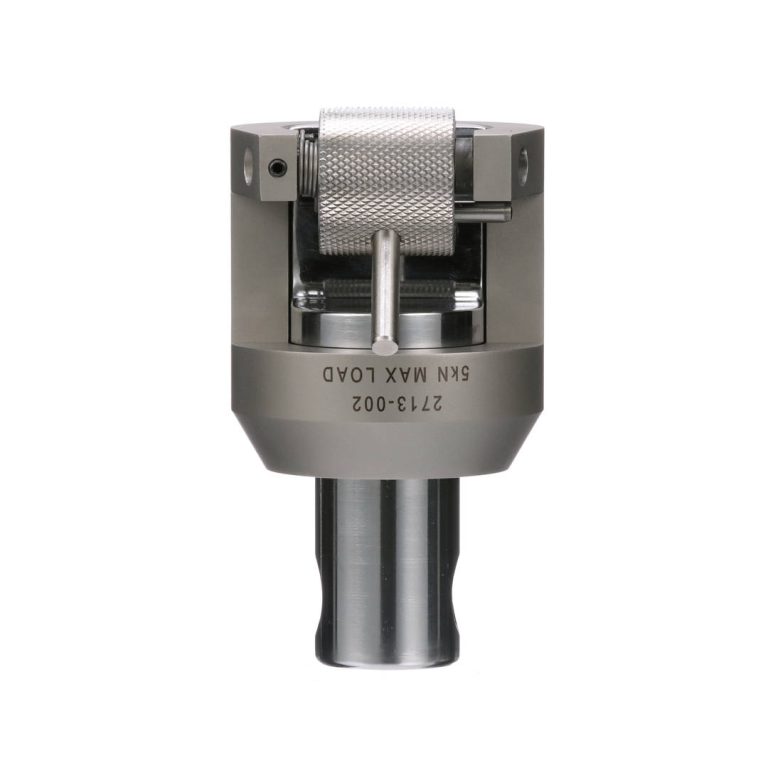
Self-Tightening Eccentric Roller Grips
Catalog no. 2713-XXX
Simple and efficient self-tightening tensile grips that are perfect for elastomers and thin films. Up to 5kN force capacity.
Learn More
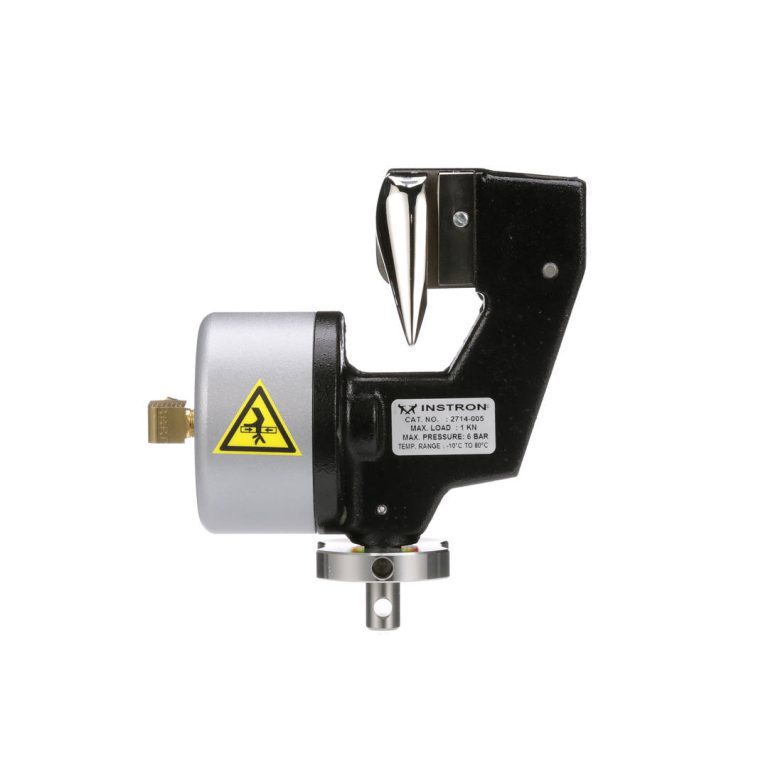
Pneumatic Cord and Yarn Grips
Catalog no. 2810-410, 2714-XXX
Grips designed specifically for tensile testing yarn, thread, rope, cord, tube, sutures, and wire.
Learn More
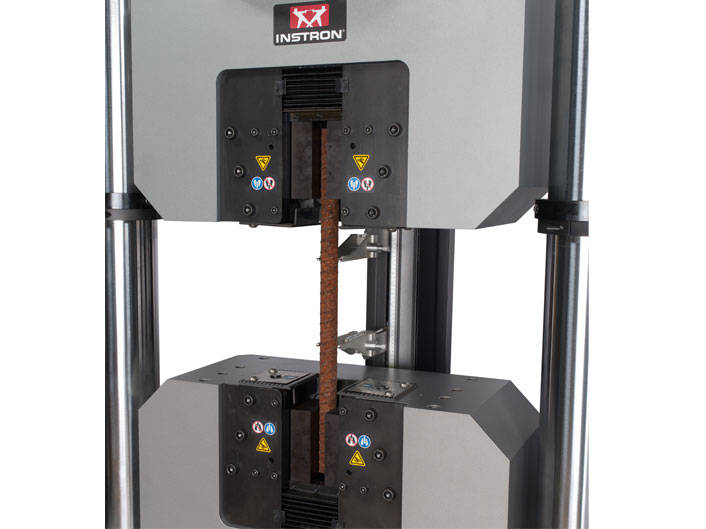
Hydraulic Wedge Action Grips
Catalog no. W-52XX, 53XX
Hydraulic wedge action grips for Instron's high-capacity static hydraulic universal testing systems. Up to 2,000kN force capacity.
Learn More
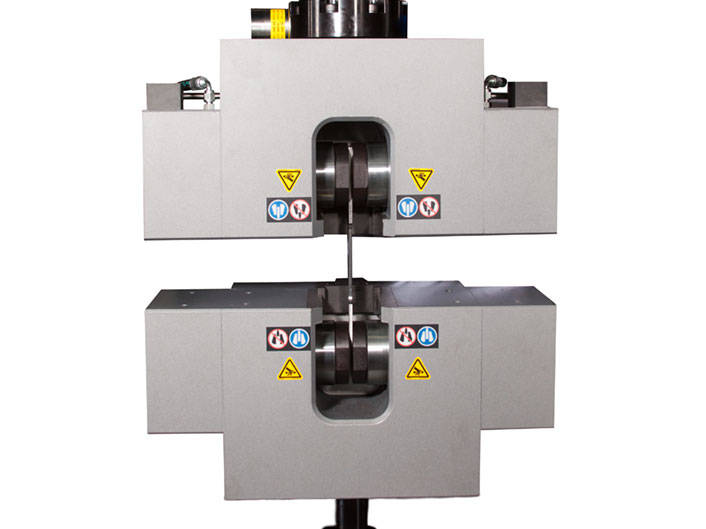
Hydraulic Side Action Grips
Catalog no. W-54XX
Hydraulic side-acting DuraSync™ high capacity grips deliver enhanced gripping performance, usability, and operator safety over traditional grip designs. Up to 2,000kN force capacity.
Learn More
Extensometers: Contacting and Non-Contacting Solutions for Strain Measurement
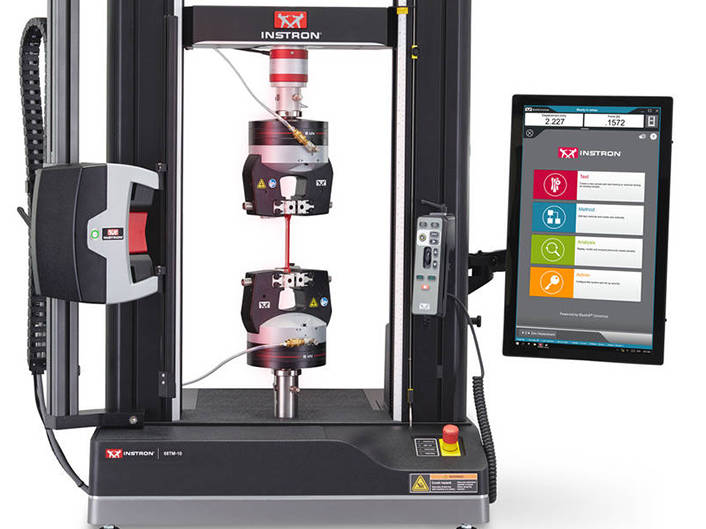
Automatic Non-Contacting Video Extensometer
A video extensometer is a non-contacting extensometer that can measure deformation by tracking the movement of two attached markers on the specimen, using high-resolution digital camera technology.
Learn More
Automatic Contacting Extensometer
Catalog no. 2665-750
The AutoX750 maximizes efficiency and revenue while maintaining high quality standards and safe operating conditions.
Learn More

Static Axial Clip-On Extensometer
Catalog no. 2630-XXX
Instron’s static axial clip-on extensometers are a quick and easy solution for measuring strain and are suitable for use on a wide range of materials such as plastics, metals, and composites.
Learn More
Tensile Testing Standards for Metals, Plastics, Elastomers, and More
Most tensile testing is performed to established standards published by standards organizations such as ASTM and ISO. Testing standards prescribe acceptable test parameters and results for different types of raw materials such as metals, plastics, elastomers, textiles, and composites, as well as for finished products such as medical devices, automotive parts, and consumer electronics. These standards ensure that materials and products entering the supply chain display predictable mechanical properties and are not likely to fail in their expected end use. Since the cost and safety implications of product failure cannot be overstated, companies are encouraged to invest in high-quality, accurate testing equipment that is designed to help them easily determine whether or not their products meet applicable standards.
ASTM D638 / ISO 527-2
ASTM D638 and ISO 527-2 are two of the most common standards used to evaluate the tensile properties of reinforced and non-reinforced plastics. Though these standards measure many different tensile properties, the most common are tensile strength, tensile modulus, elongation, and Poisson's ratio.
ASTM D412 / ISO 37
ASTM D412 and ISO 37 are the most common standards for determining the tensile properties of vulcanized (thermoset) rubber and thermoplastic elastomers. Compounds in this family are used to create a vast array of products from tires to medical gloves to O-rings. Key measurements for elastomer testing include ultimate elongation and tensile set.
ASTM E8 / ASTM A370 / ISO 6892
ASTM E8, ASTM A370, and ISO 6892 are major standards for the tensile testing metals and metallic materials. Methods of test control are a major consideration in metals testing, and a thorough understanding of crosshead compliance and strain control is necessary in order to produce accurate test results.
The following is a listing of some of the most common international testing standards. Ensuring compliance with these standards can be complex, but Bluehill Universal® software simplifies the process with pre-configured test methods designed to reduce setup time and minimize the risk of procedural error.
- ASTM A370 | Standard Test Methods and Definitions for Mechanical Testing of Steel Products
- ASTM A416 | Standard Specification for Low-Relaxation, Seven-Wire Steel Strand for Prestressed Concrete
- ASTM A48 | Standard Specification for Gray Iron Castings
- ASTM A746 | Standard Specification for Ductile Iron Gravity Sewer Pipe
- ASTM A996 | Standard Specification for Rail-Steel and Axle-Steel Deformed Bars for Concrete Reinforcement
- ASTM C297 | Standard Test Method for Flatwise Tensile Strength of Sandwich Constructions
- ASTM D1037 | Standard Test Methods for Evaluating Properties of Wood-Base Fiber and Particle Panel Materials
- ASTM D1414 | Standard Test Methods for Rubber O-Rings
- ASTM D1708 | Standard Test Method for Tensile Properties of Plastics by Use of Microtensile Specimens
- ASTM D2256 | Standard Test Method for Tensile Properties of Yarns by the Single-Strand Method
- ASTM D3039 | Standard Test Method for Tensile Properties of Polymer Matrix Composite Materials
- ASTM D4018 | Standard Test Methods for Properties of Continuous Filament Carbon and Graphite Fiber Tows
- ASTM D412 | Standard Test Methods for Vulcanized Rubber and Thermoplastic Elastomers—Tension
- ASTM D4632 | Standard Test Method for Grab Breaking Load and Elongation of Geotextiles
- ASTM D5034 | Standard Test Method for Breaking Strength and Elongation of Textile Fabrics (Grab Test)
- ASTM D5035 | Standard Test Method for Breaking Force and Elongation of Textile Fabrics (Strip Method)
- ASTM D5766 | Standard Test Method for Open-Hole Tensile Strength of Polymer Matrix Composite Laminates
- ASTM D5961 | Standard Test Method for Bearing Response of Polymer Matrix Composite Laminates
- ASTM D638 | Standard Test Method for Tensile Properties of Plastics
- ASTM D7269 | Standard Test Methods for Tensile Testing of Aramid Yarns
- ASTM D882 | Standard Test Method for Tensile Properties of Thin Plastic Sheeting
- ASTM A416 | Standard Specification for Low-Relaxation, Seven-Wire Steel Strand for Prestressed Concrete
- ASTM D885 | Standard Test Methods for Tire Cords, Tire Cord Fabrics, and Industrial Filament Yarns
- ASTM F2150 | Tensile Testing Polymer Hydrogels
- ASTM F606 | Tensile Testing of Fasteners, Washers, Direct Tension Indicators, and Rivets
- ASTM F2516 | Standard Test Method for Tension Testing of Nickel-Titanium Superelastic Materials
- ASTM E8 | Standard Test Methods for Tension Testing of Metallic Materials