ASTM D4632: Standard Test Method for Grab Breaking Load and Elongation of Geotextiles
ASTM D4632 is a grab test used to determine the breaking load (grab strength) and elongation (grab elongation) of geotextile fabrics. This standard is primarily used in quality control and acceptance testing labs comparing geotextiles of similar or identical structure. It is not recommended for comparing uniquely structured geotextiles or for testing knitted fabrics.
Use the links below to jump directly to the section you are interested in:
How Is the ASTM D4632 Test Performed?
The grab test is a tensile test where the central part of the specimen's width is tested to establish the "effective strength" of the fabric. The effective strength is the strength of the material at a specific width when combined with the additional strength of adjacent material. Test specimens are cut in both the machine direction and cross-machine direction, but are expected to have their results calculated separately. Specimens are cut to 101.6 mm x 203.2 mm (4 in x 8 in), with attention paid to the direction of the fabric.
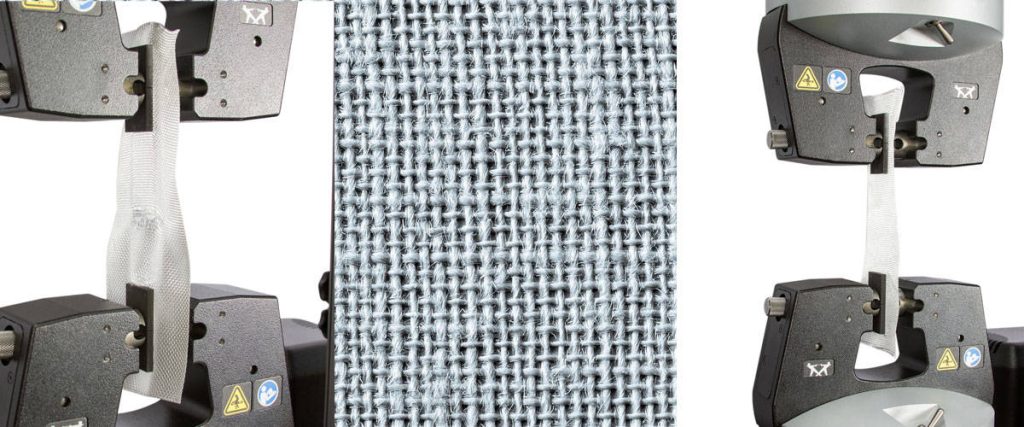
The specimen is loaded into the grips, leaving a 75 mm (3 in) separation between the jaw faces. ASTM D4632 calls for jaw faces that are at least 25.4 mm x 50.8 mm (1 in x 2 in). However, it allows each grip to include one jaw face larger than the other (a modified grab test), which can help reduce the effects of specimen/jaw face alignment. The test is conducted at a speed of 300 mm/min (12 in/min), with the required results being load at break and total elongation.
Recommended Testing System
Geotextile testing requires a test system with a data rate capture high enough to measure the failure of individual fabric fibers. Because of this, Instron recommends a high-tier 6800 Series universal testing system, which provides a data acquisition rate of up to 5 kHz and captures data peaks and valleys accurately at up to 2,500 or 5,000 points per second.
For most geotextile testing to ASTM D4632, a single-column frame such as Instron's 68SC-5 is appropriate, as loads rarely climb higher than 5 kN. The rapid data capture rate in Bluehill® Universal software allows data peaks and valleys to be captured accurately.
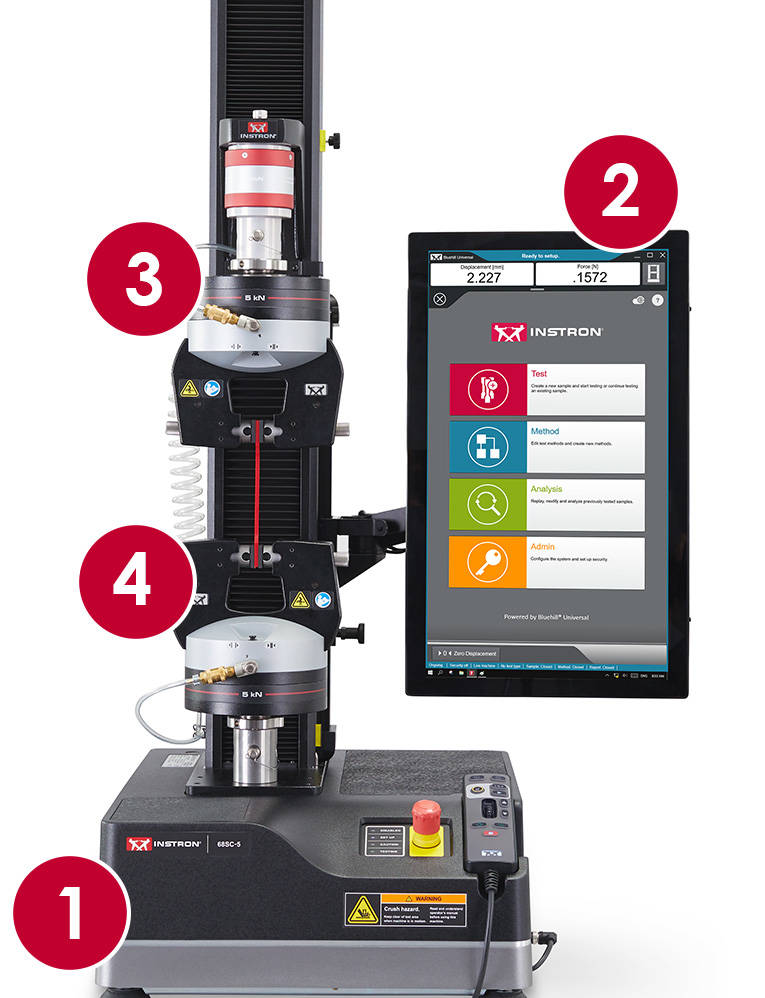
ASTM D4632 Test Setup
Instron 68SC-5 Testing System
Bluehill Universal Software
5 kN 2580 Series Load Cell
5 kN 2712 Series Pneumatic Grips
Tensile Grips
Geotextile materials tend to have coatings that can make them difficult to test without slippage or jaw breaks. These coatings, combined with the wide variety of weights, weaves, and surface textures found across geotextile products, mean that no single gripping pressure or jaw face type works well for every sample a lab might encounter. Instron's pneumatic side-action grips provide an easy, repeatable, high-throughput gripping solution that lets users quickly fine-tune gripping pressure to avoid jaw breaks or slippage, without needing to guess at the right setting for each new material.
Pneumatic side-action grips also feature Instron's quick-change technology, which allows jaw faces to be easily changed by hand, without requiring tools or pins. This matters in a lab setting where switching between specimen types throughout the day is common — every extra minute spent swapping jaw faces with a wrench is a minute not spent generating test data. Since different geotextiles require a range of clamping surfaces, from smooth to serrated to rubberized, quick-change jaw faces can significantly improve throughput in labs where these materials are common, letting operators move from one geotextile sample to the next with minimal setup time between tests.
Final Note
This guide provides an overview of key elements involved in an ASTM D4632/D4632M-15a test, however, it is not a substitute for the official standard. Anyone planning to perform this test should consult the full standard for complete instructions and compliance requirements.


Talk to an Instron Expert
Not sure which system or grips fit your geotextile testing needs? Tell us about your application and we will help you find the right solution.
Talk to an Applications Engineer
Tell us about your testing needs, and we'll help you configure the right frame, load cell, grips, and software for your lab. Please complete the form below, and we'll respond within 1-2 business days. For a faster response, call +1-800-473-7838 or +1 781 828 2500 if you are outside of the US.

About the Author

Charlie Pryor
Charlie Pryor is a Technical Program Manager at Instron, with nearly eight years of experience spanning applications engineering and technical program management. Charlie has led complex, cross-functional projects for customers in biomedical, electronics, plastics, and other key markets, and helped drive new product and testing solutions for the electric vehicle market, with a focus on lithium-ion battery applications. He also built and launched Instron's co-op internship program for the Low-Force Applications Business Team, including onboarding procedures and development planning for incoming students.
Throughout his career, Charlie has worked closely with customers, sales engineers, and product management teams to translate real-world testing challenges into practical solutions — combining hands-on applications expertise with a strong understanding of market needs. He shares his knowledge through technical articles and application guides, helping labs and manufacturers get the most out of their materials testing programs.