

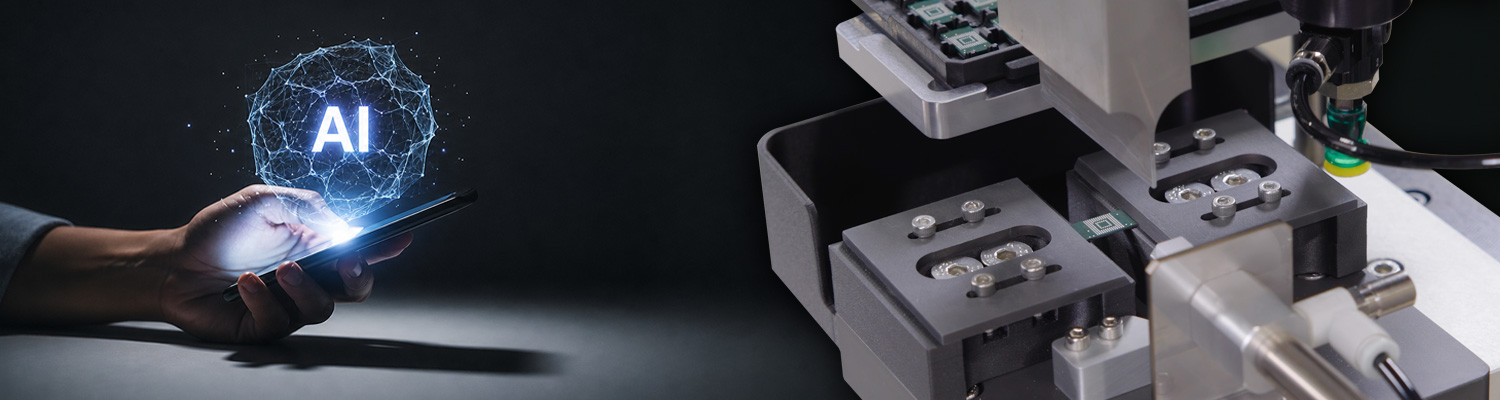
AI Is Reshaping Semiconductor Architecture — Here's How Mechanical Testing Must Evolve
Artificial intelligence is no longer just about software. It is now fundamentally changing the semiconductor industry. As AI workloads grow, they create new demands for processing power, memory bandwidth, and energy efficiency — and semiconductor design is responding with a major transformation.
The industry is moving past traditional transistor scaling and focusing on system-level innovation. Now, performance improvements come from advanced packaging, new materials, and combining different types of components. This shift is producing more powerful devices, but also more complex ones — with more interfaces and potential failure points that require more advanced, practical testing methods.
From Monolithic Chips to 3D-Integrated Systems
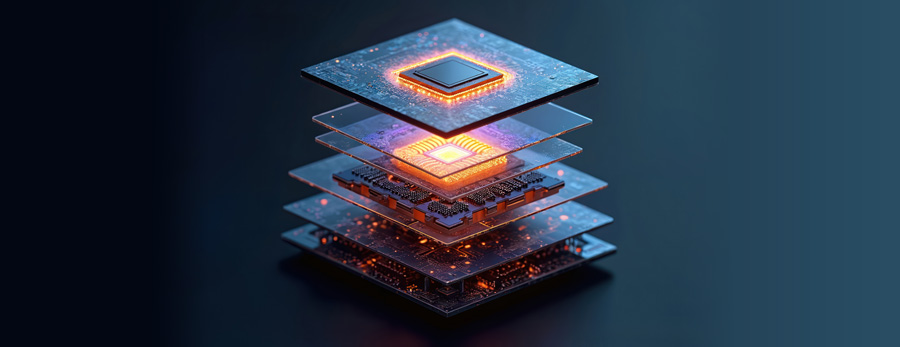
Modern devices are now built with advanced packaging architectures, progressing from traditional 2D chips to 2.5D designs that use chiplets and interposers, and ultimately to fully 3D-stacked devices. These new designs improve performance by placing processing units, memory, and connections closer together. However, as more features are combined in one package, the number of interfaces and possible failure points increases significantly.
This change also brings in co-packaged optics and complex material layers, turning the "package" into a highly integrated system. Because of this, testing must go beyond checking individual components and instead use methods that reflect how the whole system performs under real-world conditions.
Instron® 6800 Series universal testing systems are purpose-built for this shift — bridging component-level materials testing and system-level reliability validation on a single, configurable platform. Interchangeable grips, fixtures, and environmental accessories let engineers adapt to new architectures without investing in entirely new equipment.
New Materials Driving Innovation — and New Challenges
To support 3D integrations, manufacturers are adopting new materials such as advanced adhesives, thermal interface materials (TIMs), and glass substrates. These enable larger, more integrated designs and better thermal performance, but they also bring new risks that require targeted testing approaches.
Key challenges include:
- Coefficient of thermal expansion (CTE) mismatch across layers
- Warpage and stress accumulation
- Fracture risk in brittle materials like glass
- Sensitivity to thermal cycling and environmental conditions
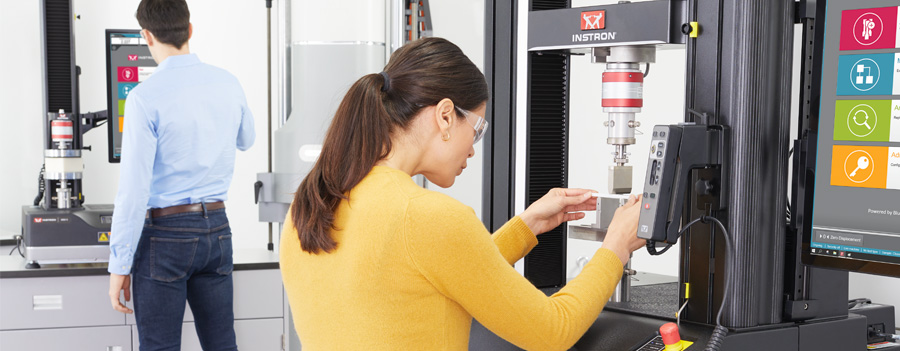
Each of these failure modes demands a different test method. Tensile testing reveals how adhesives perform under pull-out loads; flexural testing assesses fracture behavior on brittle substrates; shear testing evaluates bonded interface integrity. The Instron 6800 Series accommodates all of these on one frame using interchangeable grips and fixtures — which is critical as material sets continue to evolve and qualification cycles shorten.
Thermal Management as a Defining Design Constraint
As AI-driven devices push power density higher, thermal management has become one of the most important constraints in semiconductor design. In advanced packaging, where multiple dies and optical components are tightly integrated, heat directly affects performance and reliability — particularly in stacked configurations where heat dissipation is limited.
Testing must simulate real-world conditions rather than ambient-only environments. This means combining thermal cycling with mechanical stress, and capturing how materials respond to localized temperature changes over time.
Integrated environmental chambers paired with Instron testing systems allow engineers to characterize adhesives, TIMs, and bonded interfaces under simultaneous thermal and mechanical load — the conditions these materials actually face in service. This combined approach surfaces failure modes that ambient-only testing may miss.
Moving Beyond Component Testing to Real-World Simulation
Testing has shifted from measuring material properties in isolation to understanding how materials perform in their actual application environment. Engineers now need answers — not just "How strong is this material?" but "How does it behave in this assembly, under these loads, at this temperature?"
Application-specific test methods include:
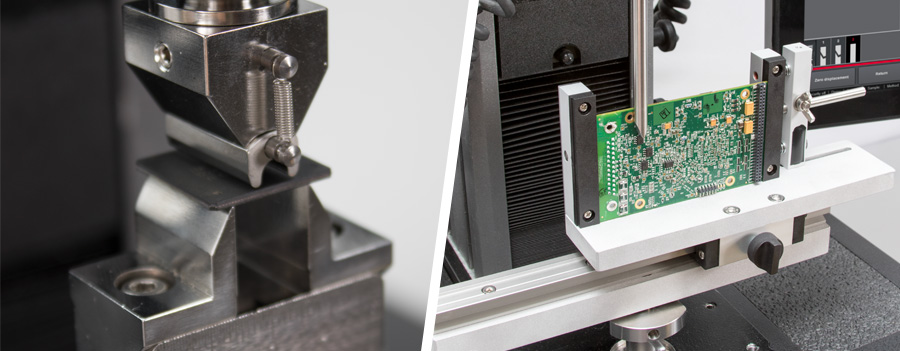
- Die shear testing for interconnect and adhesive integrity
- Micro-bend testing to assess die strength and fracture behavior
- PCB and package bend testing to simulate assembly and operational stresses
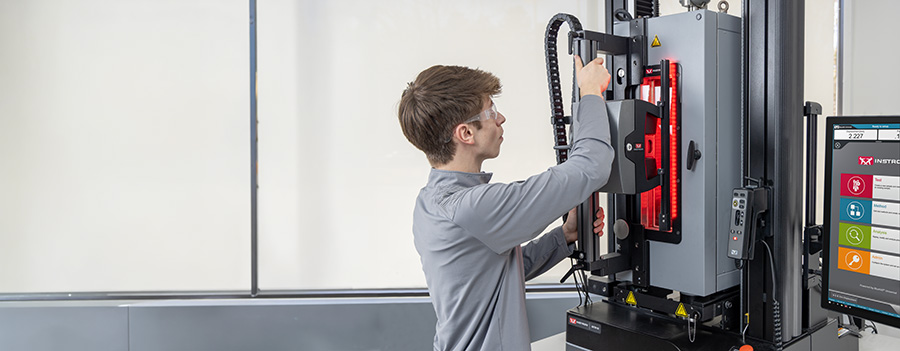
Dedicated fixtures — including Instron die shear and micro-bend fixtures — make these tests possible by providing the precise alignment and repeatable positioning these measurements require. Because they are designed for use on Instron universal testing systems, they can switch between test methods rapidly on a single system, reducing the number of dedicated instruments needed and accelerating qualification timelines.
Multi-Physics Data: Testing Mechanical, Thermal, Electrical, and Optical Behavior Together
As semiconductor systems become more complex, testing must capture behavior across multiple domains simultaneously. Measuring mechanical responses alone is no longer sufficient — engineers need to understand how force, displacement, temperature, electrical performance, and optical signal quality interact.
This is especially critical in systems integrating silicon photonics and co-packaged optics. Optical components demand extremely precise alignment: Even small mechanical shifts caused by thermal expansion or assembly stress can degrade signal transmission. In AI systems that combine optics with high-power components, CTE mismatch between materials can cause progressive misalignment across repeated thermal cycles — a failure mode that becomes visible only when mechanical and optical data are analyzed together.
Instron systems controlled by Bluehill® Universal software address this directly. Bluehill enables synchronized acquisition of mechanical, thermal, electrical, and optical data streams in real-time — with automated test sequences, exportable reports, and support for third-party sensor integration. Engineers can identify coupled failure modes, validate simulation models, and build a complete picture of system behavior from a single test run.
Scaling Semiconductor Testing for High-Volume Manufacturing
AI infrastructure growth is driving higher production volumes, putting pressure on manufacturers to test more samples faster without sacrificing data quality. As complexity increases, manual testing workflows become a bottleneck — introducing operator variability and limiting throughput.
Automation is the key enabler. Technologies such as automated XY stages allow repeatable, high-throughput testing with minimal operator involvement. Combined with automated test sequences in Bluehill Automation, these systems support continuous or unattended testing — maintaining data consistency across high-volume runs.
For manufacturers scaling AI hardware production, the combination of a universal testing platform with automation-ready hardware and software means testing capacity can grow alongside production volume without proportional increases in cost or staffing.
A Configurable Platform for a Rapidly Evolving Industry
Semiconductor innovation is accelerating. New materials, architectures, and integration approaches arrive faster than most labs can keep up with — and adding dedicated equipment for every new test requirement is not a practical path forward. In this environment, a single configurable platform that expands to meet new demands offers a meaningful advantage over a growing collection of single-purpose instruments.
The 6800 Series is designed for this reality — with interchangeable fixtures and grips, integrated environmental chambers, support for third-party sensor integration, and automation-ready hardware and software. From die shear and micro-bend fixtures for microelectronics applications to full system-level assemblies tested under combined thermal and mechanical load, one platform handles the range.
As AI continues to push the boundaries of what semiconductor devices can do, testing must keep pace: more integrated, more application-specific, and built to scale. Instron’s modular platform — from the universal testing machine to application-specific fixtures and Bluehill software — is designed to grow alongside semiconductor innovation, giving engineering teams the confidence that their reliability data reflects the real world.
Frequently Asked Questions (FAQs)
The most important tests depend on the materials and assembly types involved, but several are consistently central to semiconductor reliability validation. Die shear testing evaluates the strength of adhesive bonds and interconnects between a die and its substrate. Micro-bend testing assesses die strength and fracture behavior under bending loads. PCB and package bend testing simulates the stresses components experience during board assembly and in-service flexure. For materials characterization, tensile, compression, shear, and flexural tests are used to understand how adhesives, thermal interface materials, and substrates behave under load — particularly as new materials like glass substrates introduce new failure risks such as brittle fracture. As packaging architectures grow more complex, the ability to run all of these tests on a single platform becomes increasingly important for efficiency and data consistency.

Subscribe to the Instron Update
Stay up to date on industry trends, testing standards, applications, tips and tricks, and so much more!
Explore Instron Solutions for Semiconductor Testing
From the platform to the fixture to the software, Instron has the tools semiconductor and microelectronics engineers need to test with confidence.
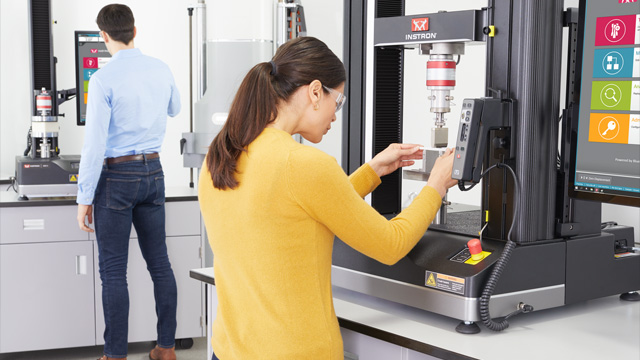
The 6800 Series can be configured for tensile, compression, shear, and flexural testing across materials, components, and assemblies.
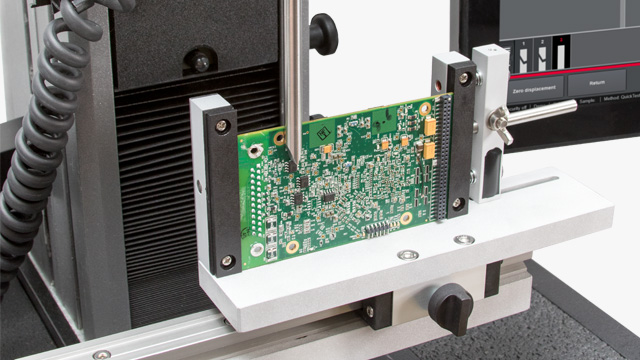
Die shear and micro-bend fixtures, temperature chambers, and automation solutions for semiconductor and microelectronics applications.
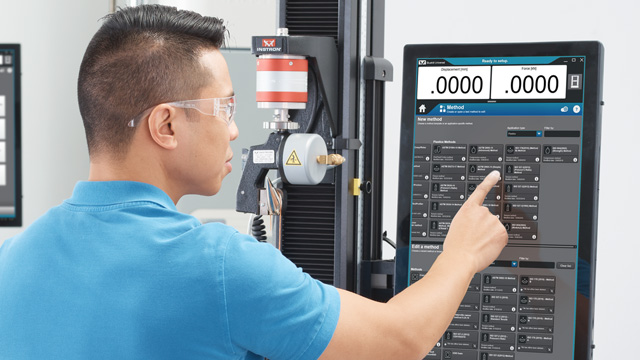
Synchronized multi-physics data acquisition, automated test sequences, and exportable reports — all in one platform.
or

Talk to an Instron Expert
Get application-specific guidance for your semiconductor testing challenges.
About the Author

Phil Levesque
Phil Levesque is Instron's Electronics Market Manager, with over 13 years of experience in materials testing across engineering and market development. As a former Principal Engineer, Phil led a wide range of projects spanning custom fixture design, automation, and application development for Instron's universal testing systems — building a deep understanding of the challenges and requirements unique to the electronics and semiconductor industries. Today, he applies that hands-on expertise to help customers develop testing strategies that keep pace with the rapid innovation reshaping the market.