
Creep Test
What Is a Creep Test?
A creep test, sometimes referred to as a stress-relaxation test, is used to determine the amount of deformation a material experiences over time while under a continuous tensile or compressive load at a constant temperature. The term "creep" is defined as deformation that occurs over a period of time when a material is subjected to constant stress at a constant temperature.
Creep tests are fundamental for materials that need to withstand certain operational temperatures under load. By analyzing creep test results, engineers can predict a material’s deformation and design products that avoid failure under varying environmental conditions.
For materials such as metals and alloys, properties can change significantly at elevated or reduced temperatures. Creep in metals typically occurs only at high temperatures, while creep at room temperature — known as cold flow or deformation under load — is more common in plastics.
Creep tests are commonly performed on the following components and materials:
- Metal Working
- Springs
- Soldered Joints
- High-Temperature Materials
Creep Test Curve Explained
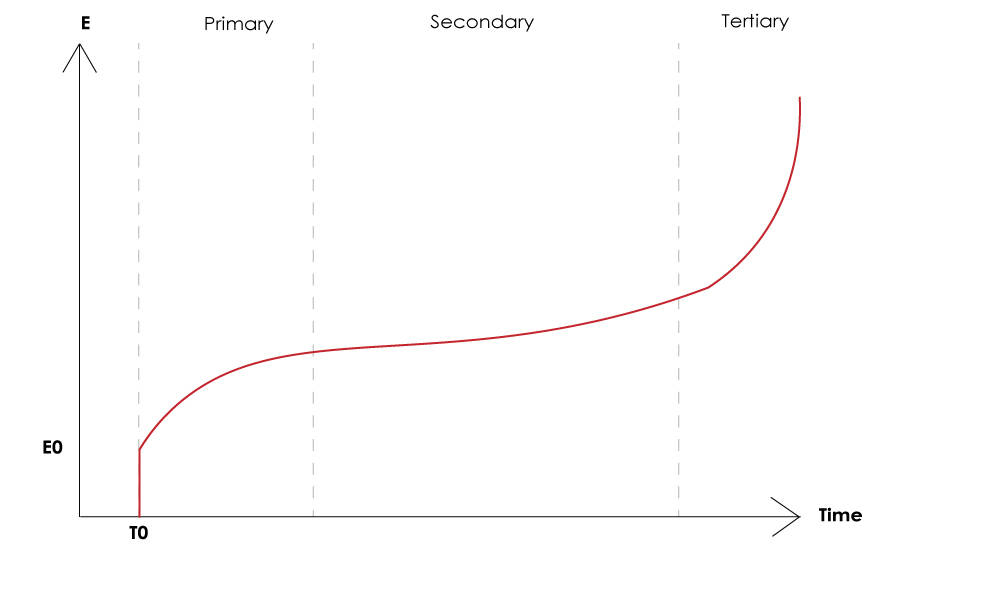
Data obtained in a creep test usually is presented as a plot of creep vs. time with stress and temperature constant. The slope of the curve is creep rate and the end point of the curve is time for rupture.
As indicated in the following diagram, the creep of a material can be divided into three stages.
- Primary creep starts at a rapid rate and slows with time.
- Secondary creep has a relatively uniform rate.
- Tertiary creep has an accelerating creep rate and terminates by failure of material at time for rupture.
If failure occurs, the time for rupture is recorded. If a specimen does not fracture within the creep test period, creep recovery may be measured.
How to Perform a Creep Test
To determine creep properties, a material is subjected to prolonged constant tension or compression loading at a constant elevated temperature. These tests are typically performed on universal testing machines or dynamic testing machines, which are designed to apply controlled loads over extended periods.
While testing, the material's deformation is recorded at specific time intervals and the overall data is plotted on a creep vs. time diagram. The slope at any point on this curve is known as the creep rate, in which units are expressed in terms of in/in/hr or percent(%) elongation/hr.
Maintaining a constant temperature during a creep test is critical due to the possible thermal expansion or shrinkage of the material.
Some examples of standards that require creep testing are ASTM E139, ASTM D2290, ASTM D2291, and ASTM D2294. For more details on testing procedures, please refer to these standards.
How to Determine Stress-Relaxation
To determine the stress-relaxation of a material, the specimen is deformed a given amount and a decrease in stress is recorded over prolonged period of exposure at constant elevated temperature.
The stress-relaxation rate is the slope of the curve at any point.
6800 Series Premier Testing Systems Brochure
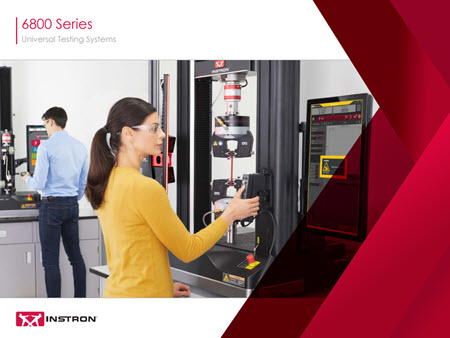
Instron 6800 Series Universal Testing Systems provide unparalleled accuracy and reliability. Built on a patent-pending Operator Protect system architecture with an all-new Smart-Close Air Kit and Collision Mitigation features, the 6800 Series makes materials testing simpler, smarter, and safer than ever before.

3400 Series Universal Testing Systems Brochure
Instron 3400 Series universal testing systems for tensile, compression, bend, and other material property tests.
Bluehill Universal Brochure
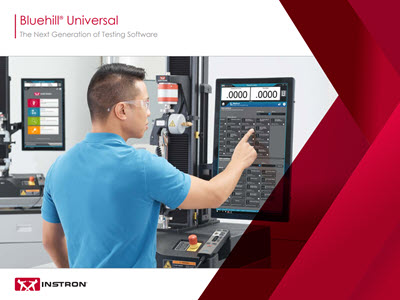
Bluehill Universal is Instron’s advanced materials testing software, designed for intuitive touch interaction and streamlined workflows. It offers pre-loaded test methods, QuickTest for rapid setup, enhanced data exporting, and Instron Connect for direct service communication. Users of Bluehill 2 and Bluehill 3 can easily upgrade to the latest version for improved performance and usability.