
Necking
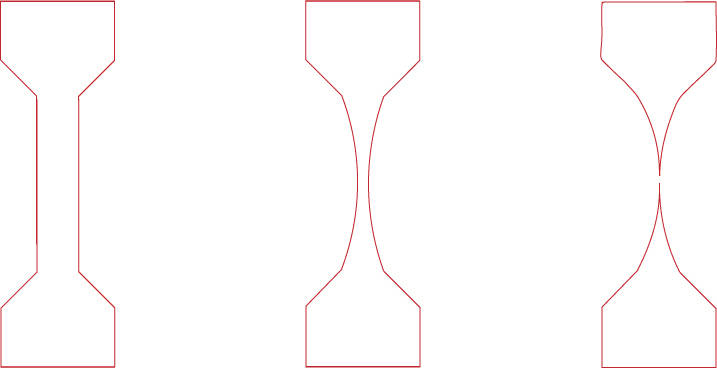
The term "necking" is used in engineering and materials sciences to describe the localized reduction of cross-sectional area of a specimen under tensile load. Necking occurs when an instability in the material causes its cross-section to decrease by a greater proportion than the strain hardens when undergoing tensile deformation. If the material begins to harden by a smaller proportion than the decrease in cross-sectional area, strain concentrates at the location of highest stress or lowest hardness. The greater the local strain, the greater the local decrease in cross-sectional area, which in turn causes even more concentration of strain, leading to an instability that causes the formation of a neck. Necking behavior is disregarded in calculating engineering stress but is taken into account in determining true stress.

3400 Series Universal Testing Systems Brochure
Instron 3400 Series universal testing systems for tensile, compression, bend, and other material property tests.

6800 Series Premier Testing Systems Brochure
Instron 6800 Series Universal Testing Systems provide unparalleled accuracy and reliability. Built on a patent-pending Operator Protect system architecture with an all-new Smart-Close Air Kit and Collision Mitigation features, the 6800 Series makes materials testing simpler, smarter, and safer than ever before.

Bluehill Universal Brochure
Bluehill Universal is Instron’s advanced materials testing software, designed for intuitive touch interaction and streamlined workflows. It offers pre-loaded test methods, QuickTest for rapid setup, enhanced data exporting, and Instron Connect for direct service communication. Users of Bluehill 2 and Bluehill 3 can easily upgrade to the latest version for improved performance and usability
