
ASTM D7136/D7136M-05 Measuring Damage Resistance of Composite to Impact Event

Based on the impact portion of Boeing BSS 7260 Type II, Class 2, ASTM D7136/D7136M-05, covers measuring the damage resistance of fiber reinforced polymer matrix composite plates that have been subjected to a drop-weight impact test. Five flat, rectangular specimens of each material/lay-up are to be tested. The potential energy to be used – defined as mass and drop height – is to be 4.94 ft-lb (6.7J) multiplied by the specimen thickness. Supported on a rigid support fixture with the appropriate sized window in the support base the specimen is subjected to an out of plane, concentrated impact using a hemispherical impactor/insert with a diameter of 0.625 inches (16mm). The damage resistance of the plaque is quantified in terms of the size and type of damage left in the specimen after impact thru post examination. Subsequent compression tests per ASTM D7137/D7137M-05 are conducted if required. Knowing the damage resistance properties of a laminated composite plate is useful for both product development and material selection.
When asked to offer a testing solution to this standard we recommend the use of either our Instron 9440 or 9450. For those customers whose impact energy requirements fall between 1.0 – 97.9 ft-lbs (1.356 – 132.8 J) we recommend using the 9340. With impact energies ranging from 1.9 – 1182 ft-lb (2.6 – 1603 J) either our 9350 or the 9350 with optional High energy System with our Data Acquisition System and Bluehill Impact Software would be our recommendation for those composite customers who need higher impact energies.
For the testing of plaques that are less than 1 inch (2.42 mm) thick we have optional lightweight crossheads to meet those lower impact energies. To prevent a secondary impact of the falling weight onto the composite plate we employ our anti - rebound device. For larger composite products we offer larger, extended support tables. To fully protect the operator from flying debris we include and offer a selection of interlocked safety enclosures.
Though the test defined in the standard calls for visual inspection and measurements after impact to determine if the specimen has failed, by including instrumentation with our Data Acquisition System complete with Visual Impact and a strain gauged tup failure points/modes that may remain hidden under normal test conditions can be found. One piece of information that may not be found without the use of instrumentation is the first crack or incipient damage point.
9400 Series Drop Tower Brochure
Instron Drop Towers are used to develop, fine tune, and validate material models. Testing materials under real impact conditions is a crucial step prior of product design. Using the characterization data obtained with the Instron 9400, coupled with customer supplied high-speed video, you can have confidence in your results and deliver new materials to your customers faster. Our Drop Tower impact systems, fixtures, and tups are designed to meet a wide range of applications and testing standards including: ISO, ASTM, ANSI, Airbus, Boeing, BSI, DIN, EN, FDA, Ford, GM, JIS, NASA, GOST, and more.
- Products
- 02/05/2020
- 763.1 KB
9400 Series Dashboard Brochure
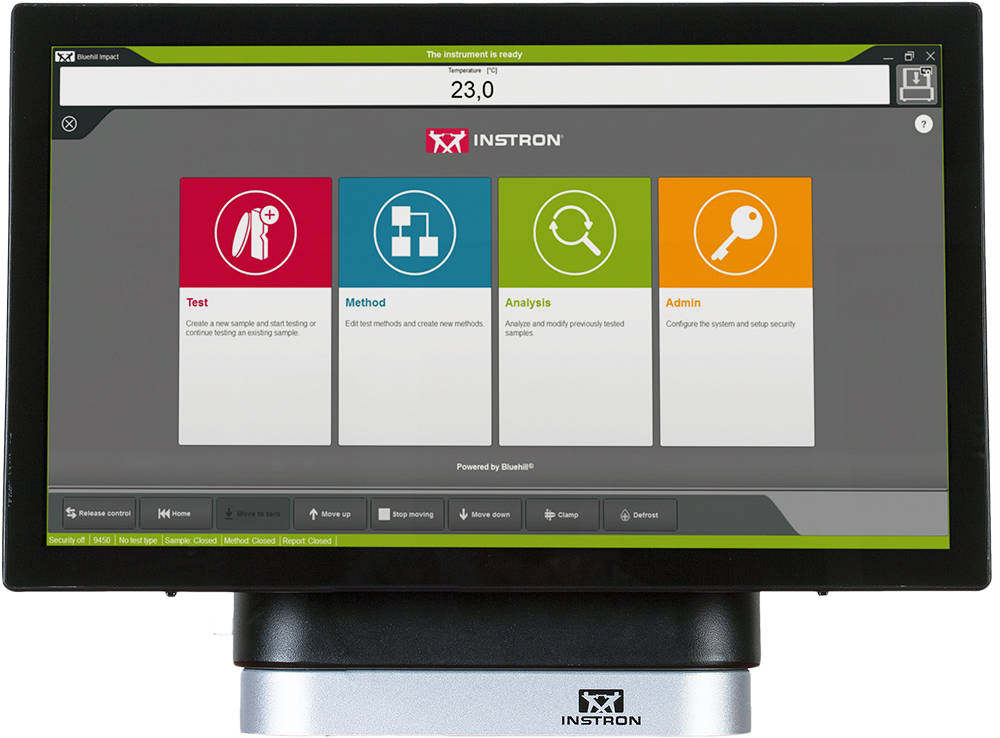
Bluehill® Impact is built from the ground up for touch interaction. The Operator Dashboard features large touchpoints to make the user experience simpler and smarter. Easy-to-understand icons and workflows make it easy to train new or experienced users, simplify operator training, and allow you to start testing even faster than ever before
- Products
- 08/01/2019
- 2.35 MB
Drop Tower impact testing for CAI
To properly understand the performance of Composites, one of the most broadly used methods is the CAI (Compression After Impact) test. Low energy impacts can be considered the most dangerous since the damage they cause can be complex and affect all plies of the structure from matrix and fiber crack to delamination. To ensure a level of high quality and compliance with safety standards, impact testing is a key in gathering knowledge as to how these materials behave and may be damaged when impacted.
- Products
- 03/17/2020
- 532.13 KB
