
ASTM F606 Testing of Externally and Internally Threaded Fasteners, Washers, Direct Tension Indicators, and Rivets


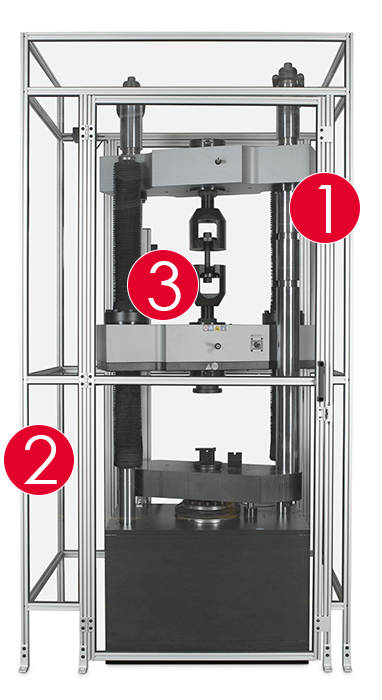
| ASTM F606 Test Setup | |
|---|---|
HDX Static Hydraulic Testing System |
|
W-5232 Floor-Standing Interlocked Enclosure |
|
W-5155 Fastener Holders |
|
Grips and Fixtures for Fastener Testing
For tensile testing of fasteners, Instron offers a comprehensive range of holders and inserts designed to accommodate standard fastener dimensions. These specialized accessories support a variety of test types - including proof tests, axial and wedge tensile tests, and cone stripping tests - on bolts, screws, studs, and nuts.
These accessories are compatible with most universal testing machines and include a full selection of flat, wedge, and countersunk test washers, fastener holders, short bolt adapters, holder reducing assemblies, and nut proof loading mandrels. These components enable accurate and repeatable performance for proof, tensile, and head strength testing in accordance with ASTM F606 and other relevant fastener testing standards.
For detailed specifications and part numbers, refer to Instron's Accessories Catalog, beginning on page 41.


6800 Series Premier Testing Systems Brochure
Instron 6800 Series Universal Testing Systems provide unparalleled accuracy and reliability. Built on a patent-pending Operator Protect system architecture with an all-new Smart-Close Air Kit and Collision Mitigation features, the 6800 Series makes materials testing simpler, smarter, and safer than ever before.

High Force Universal Testing Machines Brochure
Instron’s high force systems include electromechanical and high-capacity hydraulic testing systems for tension and compression applications. Force capacities range from 100 kN to 2000kN.

Bluehill Universal Brochure
Bluehill Universal is Instron’s advanced materials testing software, designed for intuitive touch interaction and streamlined workflows. It offers pre-loaded test methods, QuickTest for rapid setup, enhanced data exporting, and Instron Connect for direct service communication. Users of Bluehill 2 and Bluehill 3 can easily upgrade to the latest version for improved performance and usability
