
資源
»
測試類型
»
Tensile Testing Machines | An Introduction
»
Tensile Testing and Tensile Testing Machines FAQs
Tensile Testing and Tensile Testing Machines FAQs
Tensile testing machines - also known as universal testing machines - are used to test the mechanical properties of materials, components, and devices.
Universal testing machines, which include electromechanical and hydraulic systems to perform static testing, including tensile, compression, bend, peel, tear, and other mechanical tests. These tests can tell us about the mechanical properties of a material or component. How strong it is, how much it can elongate/how much it stretches, how much it can compress before breaking, and how flexible it is. They can also measure the strength of an adhesive bond.
The typical Materials & Standards used in a tensile test are:
- Ceramics - ISO 15733, ISO 15490, ISO 17561
- Composites - MIL-HDBK-17, ISO 527 (Parts 4 & 5 on FRP composites)
- Elastomers & Rubber - ASTM D412, ISO 37
- Metals - ASTM E8 (at room temperature, E21 (high temperature, BS EN 10002, ISO 6892
(at ambient temperature), ISO 783 (elevated temperature), ISO 15579 (at low temperature) - Paper - ASTM D828, ISO 1924 (Parts 1 & 2), ISO 3781
- Plastics - ISO 527, ASTM D638
- Textiles & Yarns - ASTM D76, D3822, D2256, D2653, ISO 9073 (Part 3 on nonwovens),
ISO 13934, ISO 13935 - Wood - ISO 9086, 3345, 3346
The specimen's shape is usually defined by the standard or specification being utilized,
e.g., ASTM E8 or D638. Its shape is important because you want to avoid having a
break or fracture within the area being gripped. So, standards have been developed
to specify the shape of the specimen to ensure the break will occur in the "gage
length" (2 inches are frequently used) by reducing the cross sectional area or diameter
of the specimen throughout the gage length. This has the effect of increasing the
stress in the gage length since stress is inversely proportional to the cross sectional
area under load,
 .
.
Typical Configurations can look like the 3 examples below:
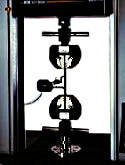
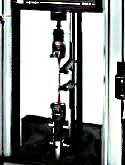
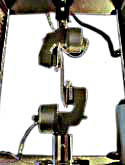
Please contact us for additional information on a specific configuration for your material and standard.
Face and grip selection is a very important factor. By not choosing the correct
set up, your specimen may slip or even break inside the gripped area ("jaw break").
This would lead to invalid results. The faces should cover the entire tab or area
to be gripped. You do not want to use serrated faces when testing materials that
are very ductile. Sometimes covering the serrated faces with masking tape will soften
the bite preventing damage to the specimen.
Vertical alignment of the specimen is an important factor to avoid side loading or bending moments created in the specimen. Mounting the specimen in the upper grip assembly first then allowing it to hang freely will help to maintain alignment for the test.
Manufacturers need to be sure that the materials they are using are suitable for their intended application. For example, tire rubber need to meet certain requirements for elasticity, and manufacturers also need to prove that the rubber will behave appropriately under a wide range of temperatures. Drug delivery systems like needles and syringes need to be tested to make sure patients receive accurate doses administered at a safe speed. The composites used to build airplane wings need to be able to flex to a certain degree without breaking. The metals used to build structures and bridges need to be strong enough to bear the anticipated weights. All the buttons on consumer electronics need to be tested before shipping out to customers.
Tensile testing machines are used as part of the R&D process for developing new materials and products, and are used extensively in QA labs to test finished goods. They are also used in universities and medical schools to teach students about materials testing.
There are many national and international standards in place to help ensure product safety and reliability. Organizations such as ASTM and ISO define testing parameters for analyzing raw materials as well as finished products, and the majority of these standards require the use of a universal testing machine. Medical devices in particular are highly regulated, and need to pass extensive testing required by the FDA in order to go to market.
Any industry that makes or uses raw materials uses universal or materials testing machines to test raw materials such as plastics, metals, elastomers, and composites. These machines are also used to test finished products such as automotive components, biomedical devices, and consumer electronics.
Common data points rendered by universal testing machines include tensile strength, compressive strength, peel, tear, and friction properties, flexural strength, shear, etc. Tests can also be performed to common standards such as ASTM D638, ASTM D412, ISO 6892, etc.
