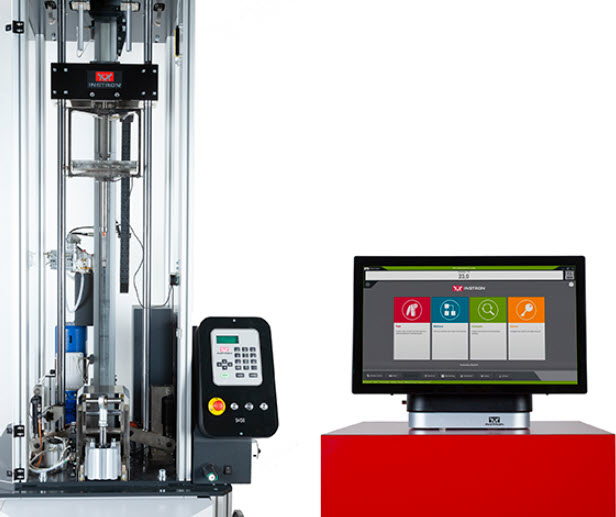
Tensile Impact Testing with Drop Towers
An Introduction
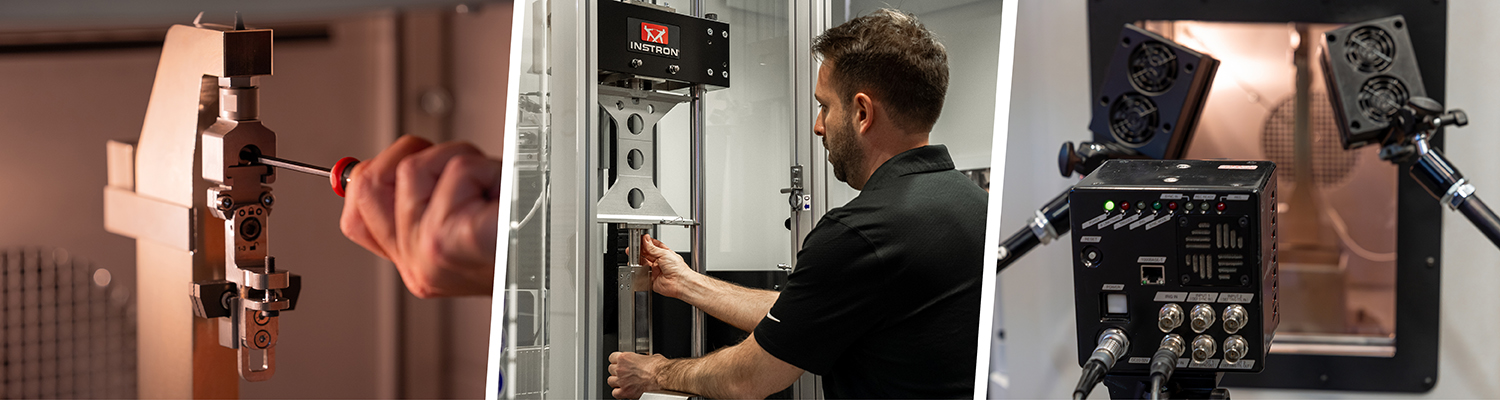
What Is the Tensile Impact Test For?
Tensile impact testing measures how a material behaves under a sudden, high-speed tensile load. This provides critical data for material scientists on tensile strength, energy absorption, elongation and failure modes. Unlike quasi-static tensile testing, which applies force slowly, tensile impact testing replicates real-world dynamic loading scenarios, such as a battery housing cracking during a crash or a film tearing during rapid deployment.
This type of testing is particularly well-suited to polymers, plastics, thin films and composite materials, which often behave differently at high strain rates than under slow, static conditions. These materials may exhibit different failure modes depending on the applied strain rate, so relying solely on static tests can lead to inaccurate modelling, costly misjudgments and damaging setbacks in product design.
Drop tower tensile impact systems enable precise control of velocity and energy input, while advanced features like high-speed imaging and Digital Image Correlation (DIC) reveal exact deformation and failure modes. The result is high-fidelity experimental data that improves confidence in simulation, safety, and compliance. Sectors involving dynamic environments like electric vehicles (EVs), aerospace and consumer electronics have particular need for this methodology.
Dynamic Tensile Impact Strength Testing vs. Static & Quasi-Static Tensile Tests
Materials science and characterization is about using the right tool for the right job. No testing method is inherently "better" than another — they can be better suited to specific applications, however.
Static and quasi-static tests are useful to understand how materials and products behave under consistent, long-term or repeated loads. In applications such as buildings or packaging materials, designers and manufacturers must know their components can stand the test of time.
Although these material testing methods establish baseline properties, they are limited in the data they can yield. Prior to the introduction of drop tests, researchers would rely on extrapolation of quasi-static results to predict behavior under dynamic conditions.
In safety-critical applications, like automotive, aerospace or protective equipment, that extrapolation often isn’t sufficient. An EV crash at 40 miles per hour, for example, applies enormous stress to the car’s structures within milliseconds. Polymers and plastics can respond very differently to this dynamic force than they would at lower impact velocities.
Drop tower systems apply controlled impact forces at those higher velocities, enabling materials scientists to observe energy absorption, strain rate sensitivity and failure behavior in conditions that closely mimic real use cases. This level of insight enables more accurate simulations, faster material validation and safer, more reliable product development.
To innovate with confidence, you need both perspectives. A drop tower doesn't replace static testing; it completes the picture.
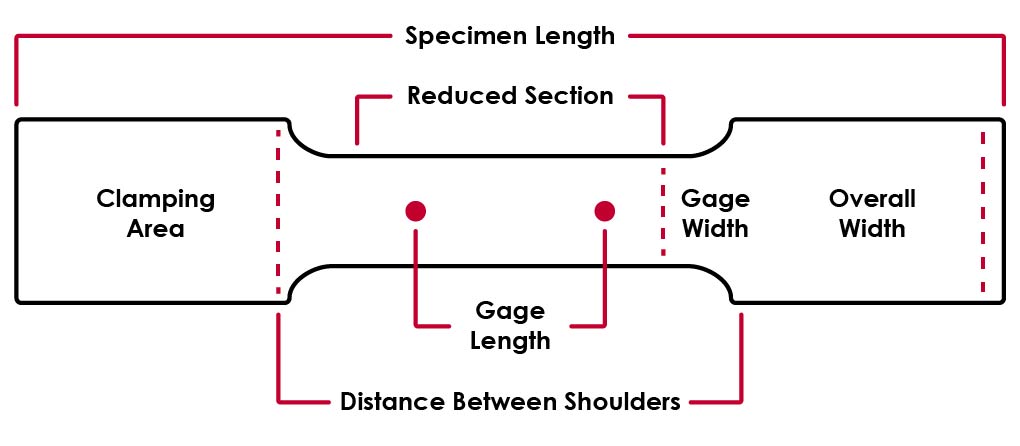
| Standard | Type | Note | L₃ mm | L/L₂ mm | b₂ mm | b₁ mm | L₀ mm | Shape |
|---|---|---|---|---|---|---|---|---|
| ISO 8256 | 1 | Preferred method a, notched | 80±2 | 30±2 | 10±0.5 | 6±0.2 | — |  |
| ISO 8256 | 2 | Preferred method b | 60±1 | 25±2 | 10±0.2 | 3±0.05 | 10±0.2 |  |
| ISO 8256 | 3 | Square middle parallel part 10mm edge length; for strain measurement with DIC systems | 80±2 | 30±2 | 15±0.5 | 10±0.5 | 10±0.2 |  |
| ISO 8256 | 4 | Preferred methods A or B | 60±1 | 25±2 | 10±0.2 | 3±0.1 | — |  |
| ISO 8256 | 5 | Rigid materials with sufficient specimen height | 80±2 | 50±0.5 | 15±0.5 | 5±0.5 | 10±0.2 |  |
| ASTM D1822 | S | Method B | 63.5 (2.5″) | L=25.4 (1″) | 9.53 or 12.7 (0.375 or 0.5″) | 3.18±0.03 | — |  |
| ASTM D1822 | L | Method B | 63.5 (2.5″) | L=L₂=25.4 (1″) | 9.53 or 12.7 (0.375 or 0.5″) | 3.18±0.03 (0.125±0.01″) | 9.53±0.05 |  |
Setting Up a Drop Tower Tensile Impact Test
Get to Know Your Instron® Drop Tower
Drop towers, also known as drop weight testers, are the most suitable instrument for performing tensile impact tests under dynamic conditions. These machines use a vertically guided falling mass, or striker, to apply a sudden, high-speed tensile load to a specimen.
A typical system for impact test testing consists of a drop tower frame, a striker or impactor, a vice to hold the sample, a force measurement system such as a piezoelectric or strain-gauge load cell, and test-specific accessories such as tensile fixture or clamping set for puncture test.
Drop towers have a broad range of energy and velocity capacities and can be configured to evaluate the impact performance of many materials, including plastics, composites, thin films and polymers, under impulsive loading conditions.
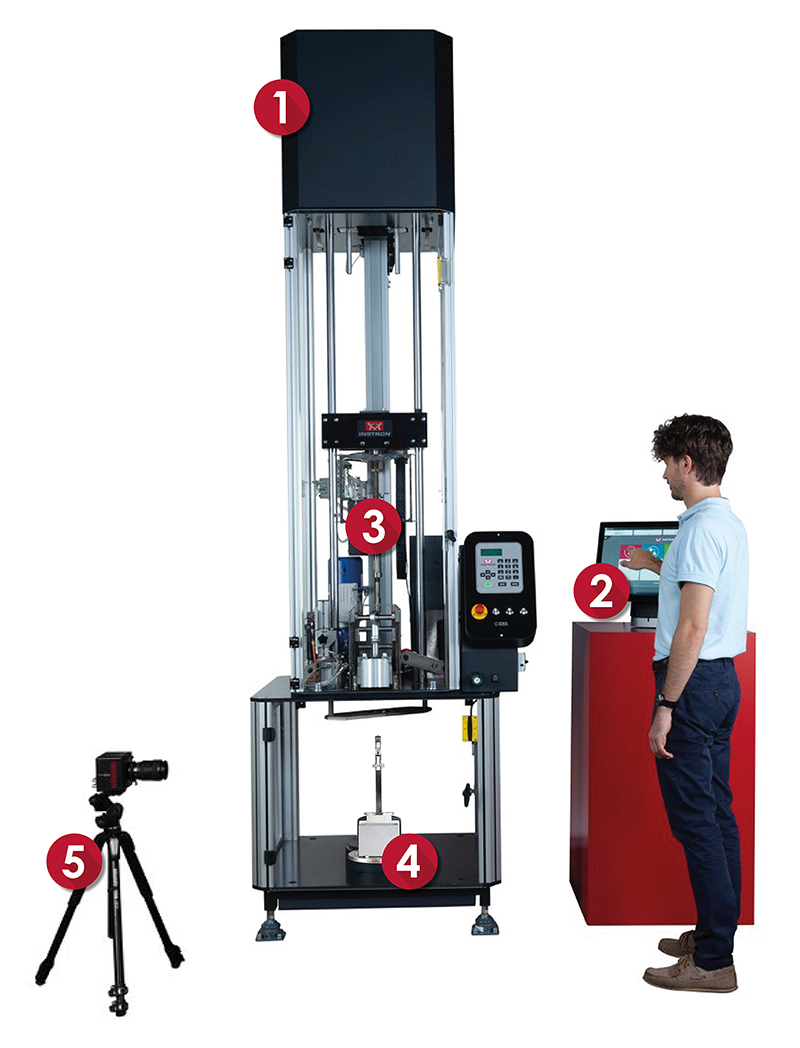
Drop Tower Tensile Impact Tester
What Materials Can Drop Towers Test?
Polymers and plastics
- Thermoplastics (e.g. polyethylene, polypropylene, polycarbonate)
- Thermosetting plastics (e.g. epoxy, phenolic resin)
- Engineering plastics (e.g. PEEK, nylon, ABS, PTFE)
- Bioplastics and biodegradable plastics (e.g. PLA, PHA)
Films and foils
- Packaging films (e.g. PET, LDPE, multilayer laminates)
- Battery separator films (e.g. microporous polyethylene or polypropylene)
- Optical or display films (e.g. LCD layers, OLED encapsulants)
- Thin metallic foils (e.g. aluminum, copper)
Composites
- Fiber-reinforced polymers, FRPs (e.g. carbon fiber, glass fiber composites, aramid fiber like Kevlar)
- Thermoplastic composites (e.g. CF/PEEK, GF/PP)
- Sandwich panels and core materials (e.g. honeycomb, foam core)
Elastomers and rubbers
- Automotive-grade rubbers (e.g. EPDM, SBR, natural rubber)
- Seals, gaskets, and flexible membranes
- Silicone and medical-grade elastomers
Textiles and technical fabrics
- Woven and non-woven fabrics
- Industrial textiles (e.g. airbags, seatbelts, ballistic fabrics)
- Geotextiles and filtration membranes
Battery and electronics materials
- Battery casing materials (e.g. composite enclosures, lightweight metal sheets)
- Adhesives
- Printed circuit board laminates and flexible electronics layers
Drop Towers in Action
Click any of the videos below to watch how our engineers get the best out of Instron’s 9400 Series drop towers.
Watch a quick run-through of tensile impact testing using a drop tower.
Get a closer look at how to prepare the fixture for tensile impact testing with the 9400 Series drop tower.
Discover how the high-speed camera integrates with the 9400 Series drop tower to capture every moment of tensile impact testing.
Discover how different materials respond under high-strain-rate conditions using our 9400 Series drop tower.
Accessories
Drop tower performance depends on the right combination of supports, tup holders, and inserts. Supports secure specimens of varying geometries, while interchangeable tup holders and weights allow precise adjustment of impact energy. The tup and its insert define the contact profile, tailored to standards or custom requirements.
For advanced applications, instrumented tups with strain gauge or piezoelectric sensors capture force-time histories, enabling deeper insight into material behavior. Together, these accessories ensure flexible, accurate, and standards-compliant testing across tensile impact, puncture, compression after impact, and other methods.
To find the best accessories for your application and see the available specifications for each one, read the drop tower accessories catalog.
Must-Have Resources
Drop tower systems offer immense capability to users to replicate dynamic conditions and obtain data that would be unavailable with different techniques. To understand their nuances and exploit your new drop tower system to the maximum, why not review our drop tower e-guide and other educational resources?