


How Do Drop Towers Improve Tensile Strength Impact Testing?
In materials development, the gap between modeled performance and experimental behavior is a constant challenge. Without accurate, high-quality input data, even the most advanced CAE models can fail to predict how materials behave under real service conditions.
Dynamic tensile impact testing using drop towers helps close that gap, giving materials scientists and engineers confidence that their simulations reflect reality.
Why Does Tensile Impact Testing Matter?
Most early-stage material characterization focuses on baseline mechanical properties such as:
- Density
- Stiffness
- Tensile strength
We typically measure these properties using static or quasi-static tensile tests, where load is applied slowly and deformation occurs over seconds or minutes.
But what happens when we load these materials suddenly?
Static vs. Dynamic Testing: What’s the Difference?
Quasi-static testing remains essential for understanding material behavior under steady or long-term loads. However, it has clear limitations when materials experience impulsive or high-speed loading.
In dynamic events:
- Deformation and failure occur in milliseconds.
- Materials often behave differently than at low strain rates.
Engineers are forced to extrapolate static data to predict impact behavior. For materials such as polymers, plastics, films, and composites, this extrapolation can be risky.
Why High Strain-Rate Data Is Critical for Material Development
In many industries, reliability under dynamic loading is non-negotiable.
- In automotive and aerospace, safety-critical components must perform predictably during crash or impact events.
- In electric vehicles, battery separator films must maintain integrity during sudden mechanical and thermal transients.
- In electronics, thin films and adhesives must survive drops, shocks, and high-speed manufacturing processes.
Standards such as UL 2580 explicitly require battery components to be characterized under dynamic conditions, not inferred from static tests.
Materials developers are also increasingly using dynamic testing to meet OEM internal specifications, which often differ from or go beyond published standards.
What Makes Dynamic Testing Challenging?
Historically, dynamic testing has been harder to access than static methods.
Key challenges include:
- High-speed failure — fracture can occur too quickly for conventional sensors to capture
- Data fidelity — insufficient sampling rates can obscure force peaks and failure mechanisms
- Instrumentation cost and complexity
Several dynamic methods and impact testing systems exist, including:
- Split Hopkinson Pressure Bar (SHPB) for very high strain rates
- Pendulum impact testing for standardized fracture assessments, such as charpy impact or Izod tests
However, these approaches don’t always provide the flexibility or instrumentation needed for tensile impact characterization across a wide range of materials.
How Does Drop Tower Tensile Impact Testing Work?
Drop tower tensile impact testing applies a controlled, high-velocity tensile load to a specimen using a guided falling striker.
In a typical setup:
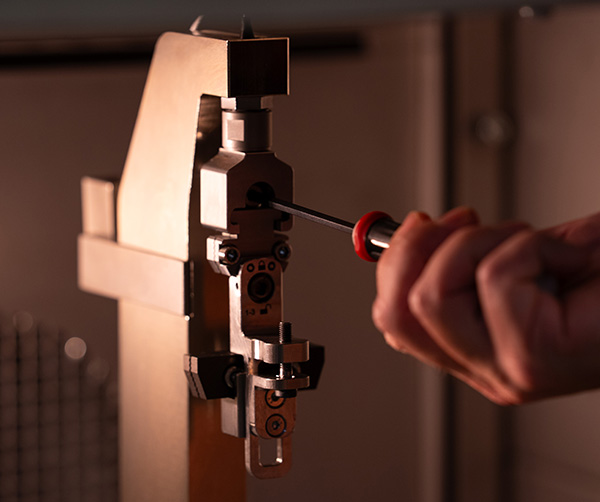
- The specimen is clamped vertically in a tensile-impact vise.
- A striker is released from a defined height to achieve the target velocity.
- An instrumented tup records the force applied during impact with either a strain gauge or piezoelectric sensor.
- Energy absorbed to failure is calculated until the specimen breaks.
This machine tensile testing method enables direct measurement of:
- Tensile impact strength
- Energy absorption
- Deformation behavior
- Failure mode
Crucially, it provides high strain-rate data, reducing reliance on extrapolation from quasi-static results.

Benefits of Drop Towers in Materials Development
Modern drop tower systems offer capabilities that were not previously available to materials labs.
High-Speed Imaging
Integrated high-speed cameras capture failure events frame by frame, even when they last just a few milliseconds.
When synchronized with force data, engineers can see:
- Crack initiation
- Transition from elastic to plastic deformation
- Final fracture progression

Digital Image Correlation (DIC)
DIC adds spatial resolution to tensile impact tests.
Rather than relying on average strain calculations, DIC enables:
- Full-field strain mapping
- Identification of localized stress concentrations
- Better understanding of anisotropic or layered materials
High-Resolution Data Acquisition
Dynamic tensile impact testing demands flexible sampling rates.
- Brittle materials may fail in under 10 ms.
- Ductile materials may deform over tens of milliseconds.
Advanced drop tower systems support broad sampling frequency ranges and high acquisition point counts, ensuring accurate force-time and energy-time curves for both behaviors.
Moving Beyond Extrapolation
Static and quasi-static testing remain essential tools — but they do not tell the full story.
Drop tower tensile impact testing provides direct experimental insight into how materials behave under realistic, high-speed loading conditions. That insight improves:
- Simulation accuracy
- Material selection decisions
- Product safety and reliability
For R&D teams working with polymers, composites, films, and other strain-rate-sensitive materials, drop towers have become a core part of modern characterization workflows.
Learn More About Instron Drop Tower Systems
Instron’s 9400 Series drop towers, including the 9450 High Energy Drop Tower, are designed to deliver accurate, repeatable tensile impact data across a wide range of materials and applications.
To explore how drop tower tensile impact testing can strengthen your materials development program, request a demo or speak with an Instron application specialist.

Subscribe to the Instron Update
Stay up to date on industry trends, testing standards, applications, tips and tricks, and so much more!
Learn how drop tower tensile impact testing provides accurate, repeatable data that strengthens your material simulations.