
Building Better Drug Delivery Devices: How Early-Stage Testing Partnerships Accelerate Progress
Summary of insights from ‘Building Strategic Partnerships for Early-Stage Drug Delivery Device Testing’ article in ONdrugDelivery magazine (Issue 182)
Written By: Nick Erickson
As the pharmaceutical landscape evolves, early-stage device testing has become a critical driver of successful drug delivery development. In ONdrugDelivery Issue 182, Landon Goldfarb explores how closer collaboration between formulation and device teams — and the right testing support — can strengthen decision-making and reduce downstream risk.
Why Early-Stage Device Testing Is Increasingly Essential
Pharmaceutical innovation is accelerating due to novel mechanisms of action and AI-powered drug discovery, leading to strong drug pipelines that have introduced formulation challenges. Many newer therapies feature high viscosities or lyophilized profiles, which can stress traditional delivery devices and require deeper evaluation far earlier in development.
At the same time, patient expectations for reliable, user-friendly self-injection devices continue to rise. This dynamic has pushed organizations to form dedicated early-stage device groups capable of assessing a wide range of delivery platforms. These teams depend on testing systems offering modularity, flexibility, and intuitive method development to keep pace with emerging device designs and formulation demands.

Find more insights into medical device testing in our biomedical knowledge base.
The Rise of ‘Deviceability’ Functions
Historically, formulation and delivery device development operated in parallel rather than in true partnership. Goldfarb notes that this gap is now narrowing: Project success is increasingly tied to choosing and validating the right delivery system early. This shift has prompted more frequent communication between formulation and device teams and helped organizations anticipate long-term pipeline needs.
Depending on company size:
- Large pharmaceutical organizations are expanding internal competencies to build robust early-stage device development functions.
- Smaller companies are becoming more strategic in selecting external partners to complement their in-house expertise.
Cross-functional alignment improves issue detection, enhances feedback loops, and helps teams understand how factors such as cold-storage requirements for biologics or ultra-low storage temperatures for mRNA therapies may influence device performance.
What Makes a Strategic Testing Partner Valuable
As early-stage device development grows more complex, organizations increasingly rely on partners who offer more than just equipment. They look for collaborators who can support:
- Early method design
- Rapid iteration and troubleshooting
- Broader evaluation of device technologies
- Long-term adaptability to evolving formulations
This shift reflects a broader industry recognition: The value of a true testing partner lies in the combination of technical capability and collaborative expertise, enabling teams to move faster and with greater confidence.

Why Instron Naturally Fits This Role
While the ONdrugDelivery article provides an industry-wide perspective, Goldfarb’s commentary ultimately underscores the qualities needed in a partner — qualities that align closely with Instron’s capabilities. Instron’s systems are engineered with the modularity, precision, and user-focused method development that early-stage device teams require. Our deep experience across formulation-device interactions puts us in a unique position to help bridge the organizational and technical gaps described in the piece.
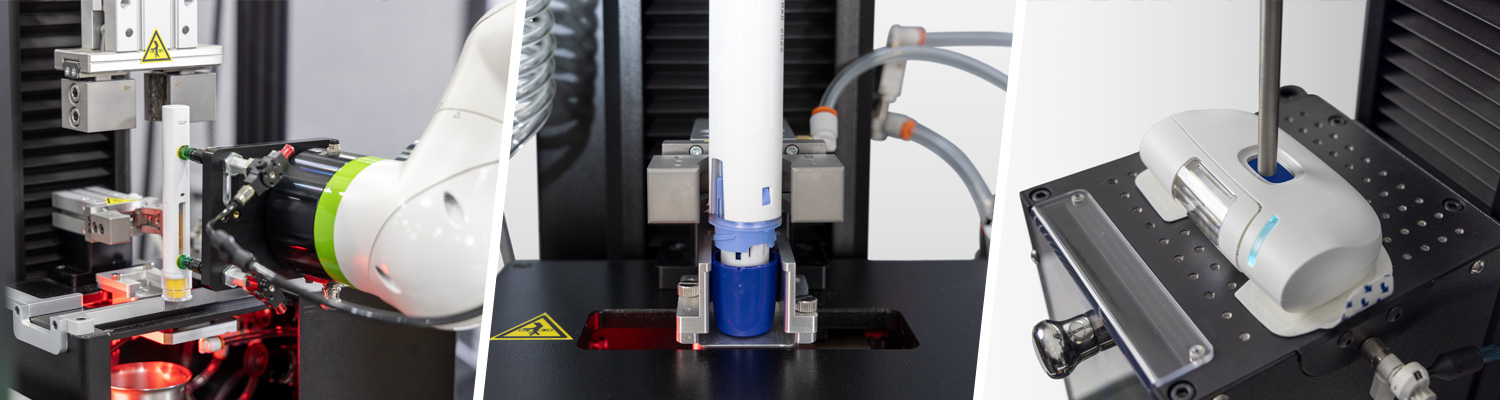
For teams working on autoinjectors and other self-administering platforms, Instron offers purpose-built solutions such as the Autoinjector Testing System, which enables consistent, automated evaluation of device performance across evolving formulations and testing conditions.
Conclusion
The article makes clear that the future of drug delivery relies on early, cross-functional collaboration supported by testing partners who understand the interplay between formulation and device performance. While this need is industry-wide, Instron’s blend of technical systems, domain expertise, and collaborative approach positions it as a natural strategic partner for organizations seeking to strengthen their early-stage device development programs.
Read Goldfarb's full article, Building Strategic Partnerships for Early-Stage Drug Delivery Device Testing, at ONdrugDELIVERY.com.
