
ISO 527-3 Tensile Properties of Films and Sheets
Written by Dan Caesar
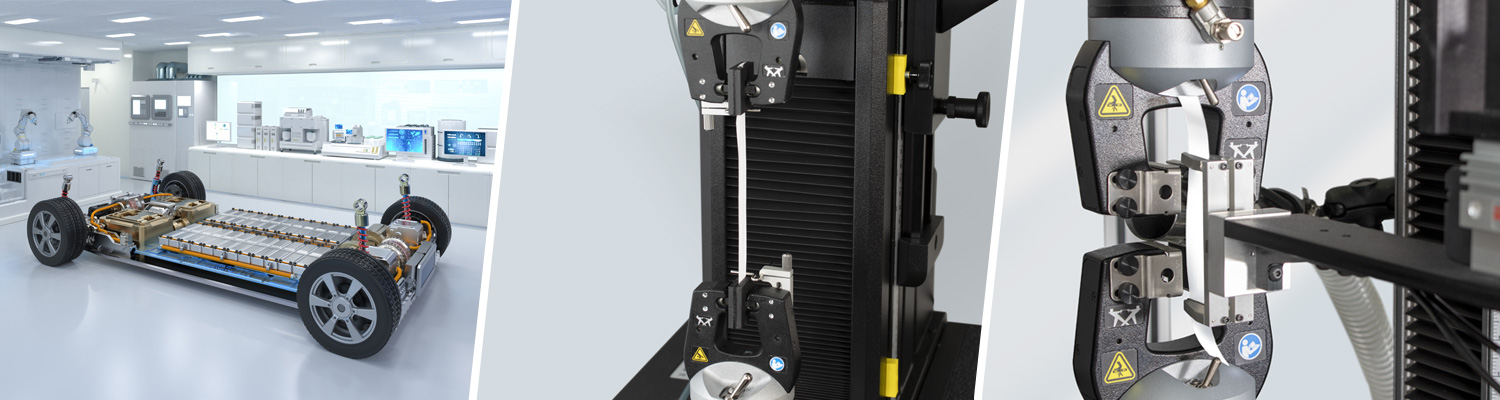
ISO 527-3 is an international standard used to determine the tensile properties of plastic film or sheeting. Plastic films are used extensively in the packaging industry and as components of more complex products, such as electric vehicle batteries. Material properties reported for this standard are tensile strength, yield point, and strain.
Film or sheeting is defined to be a plastic test specimen with a thickness less than 1 mm. Plastics with a thickness greater than 1 mm should be tested per ISO 527-2. The equivalent ASTM standard to ISO 527-3 is ASTM D882.


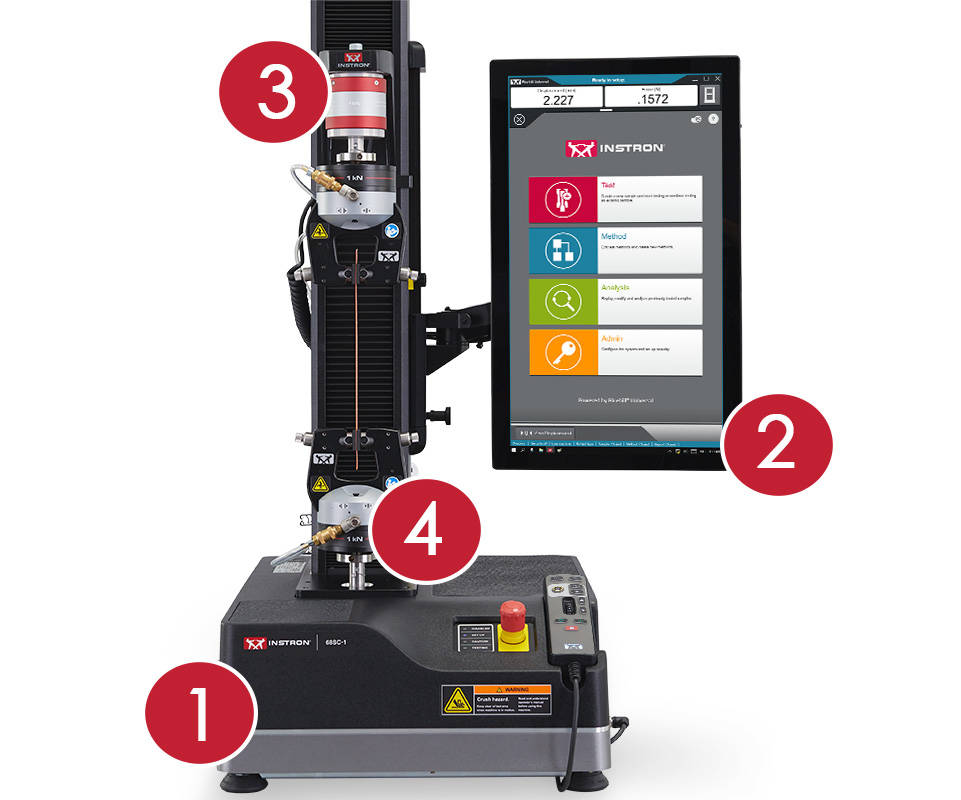
| ISO 527-3 Test Setup | |
|---|---|
| 6800 Series Universal Testing System | |
| Bluehill Universal Software | |
| 2580 Series Load Cell | |
| Pneumatic Side-Action Grips | |

SPECIMEN ALIGNMENT
Tensile testing of thin films and foils presents more challenges than the testing of rigid specimens. The majority of thin films and foils used in EV battery manufacturing have a thickness of no more than 15 microns, making it extremely easy to damage them during the specimen insertion process. Correctly aligning such delicate specimens is a major pain point for many testing labs, and the use of a precision specimen loader device is recommended. These devices use a detachable alignment clip and linear rail to guide the specimens into the grips, and are available in multiple sizes to accommodate a wide range of specimen dimensions.
STRAIN MEASUREMENT
Extensometers enable us to provide the most accurate strain measurement. Non-contacting video extensometry is the best solution for thin film testing, as typical clip-on extensometers weigh down the specimen causing premature failure. Instron's Advanced Video Extensometer (AVE3) can measure strain as accurately as a clip-on extensometer without physically contacting the specimen.
RESULTS AND THROUGHPUT
Instron's Bluehill Universal testing software makes it easy to report calculations in compliance with the standard. Customers who choose the plastics method suite will receive a pre-configured test method for ISO 527-3 testing, complete with specific test parameters and calculations to help ensure compliance.
For labs with high-volume testing needs, several modifications to the tensile machine setup can be made to speed up the testing process and increase throughput, up to and including fully automated test systems. Fully automated systems such as Instron's AT3 are designed to incorporate specimen measurement, specimen loading, testing, and removal, and are able to run for hours without operator interaction. These systems help to reduce variability due to human error and can be left running after a shift ends to continue getting results when operators go home.

6800 Series Premier Testing Systems Brochure
Instron 6800 Series Universal Testing Systems provide unparalleled accuracy and reliability. Built on a patent-pending Operator Protect system architecture with an all-new Smart-Close Air Kit and Collision Mitigation features, the 6800 Series makes materials testing simpler, smarter, and safer than ever before.

Bluehill Universal Brochure
Bluehill Universal is Instron’s advanced materials testing software, designed for intuitive touch interaction and streamlined workflows. It offers pre-loaded test methods, QuickTest for rapid setup, enhanced data exporting, and Instron Connect for direct service communication. Users of Bluehill 2 and Bluehill 3 can easily upgrade to the latest version for improved performance and usability

Precision Specimen Loader Data Sheet
The precision specimen loader (catalog no. 2710-240, 241, 242, 243, 244) provides a safe, ergonomic, and convenient way to load thin film specimens into Instron 2712-052 grips. Thin film specimens are small and delicate, making them a challenge for operators to align within the grips. These specimens are often damaged due to operators repeatedly inserting and removing them from the grips in order to achieve correct alignment. This affects throughput and repeatability and increases safety risks to operators spending additional time within the test space.

3400 Series Universal Testing Systems Brochure
Instron 3400 Series universal testing systems for tensile, compression, bend, and other material property tests.

2712-04x Series Pneumatic Side Action Grips Data Sheet
Instron’s 2712‑04x Series pneumatic grips deliver reliable, self‑centering gripping for a wide range of materials with options from 1 to 10 kN. Designed for safety and efficiency, they feature tool‑free jaw face changes, adjustable air‑controlled gripping force, robust enclosed mechanisms, and ergonomic components that improve alignment, usability, and operator protection.
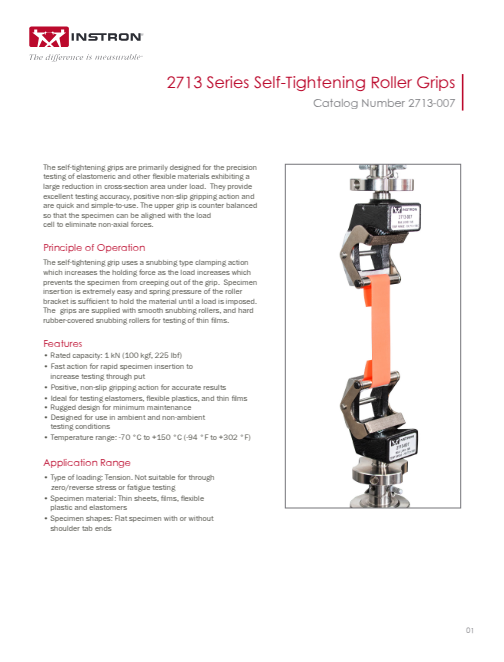
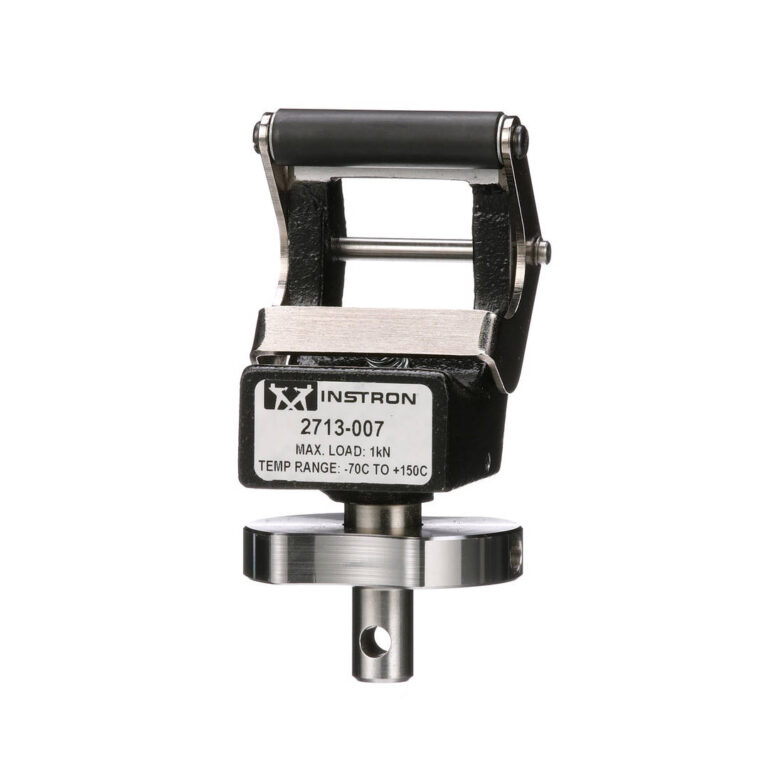
2713 Self Tightening Roller Grips
The self-tightening grips are primarily designed for the precision testing of elastomeric and other flexible materials exhibiting a large reduction in cross-section area under load. They provide excellent testing accuracy, positive non-slip gripping action and are quick and simple-to-use. The upper grip is counter balanced so that the specimen can be aligned with the load cell to eliminate non-axial forces.

AVE 2 Non-Contacting Video Extensometer
The second generation Advanced Video Extensometer (AVE 2) utilizes patented measurement technology in the fastest, most accurate non-contacting strain measurement device commercially available.
