

Why Accurate Fatigue Testing Is Essential for Additively Manufactured Automotive Parts
Reliable test data helps to address defects and ensure durability under real‑world component performance
Written By: Rebecca Reiff-Musgrove
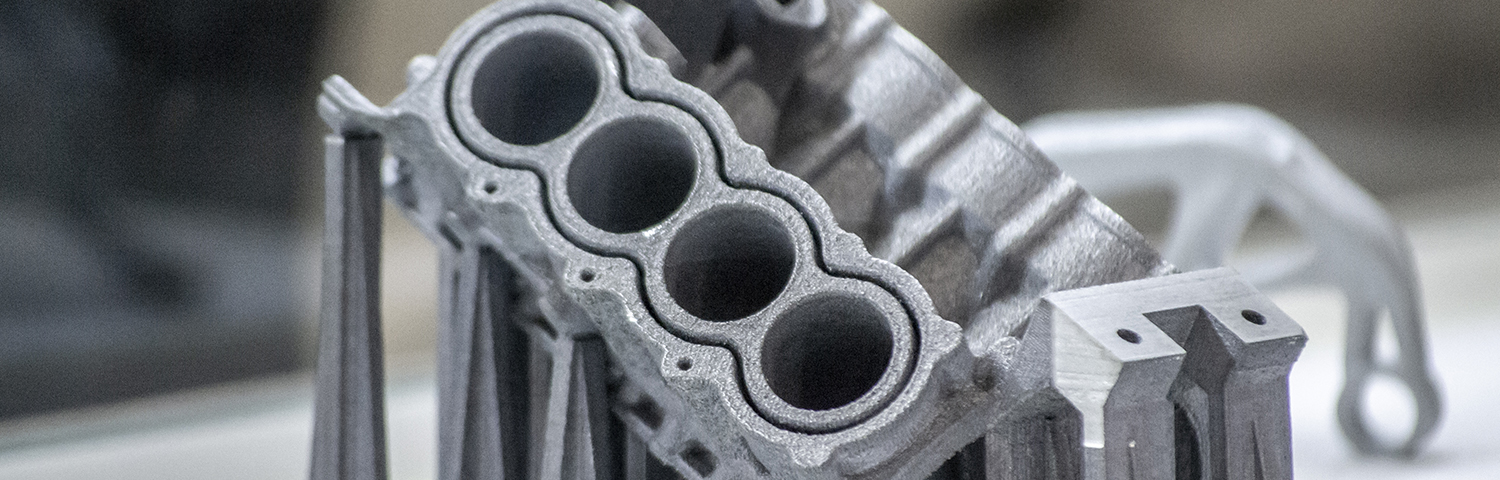
Additive manufacturing (AM) is rapidly moving into functional automotive applications. Lightweight brackets, housings, tooling, thermal components, and structural parts are increasingly being produced using additive processes.
In the automotive industry, fatigue failure remains one of the most common root causes of in-service component failure. Parts are subjected to millions of load cycles, such as vibrations or thermal cycling. Although these loads are often well below a material’s ultimate strength, they can still lead to crack initiation and progressive damage over time. For automotive parts, understanding fatigue performance is essential for qualification and validation.
Why Fatigue Is Especially Critical for Additively Manufactured Automotive Parts
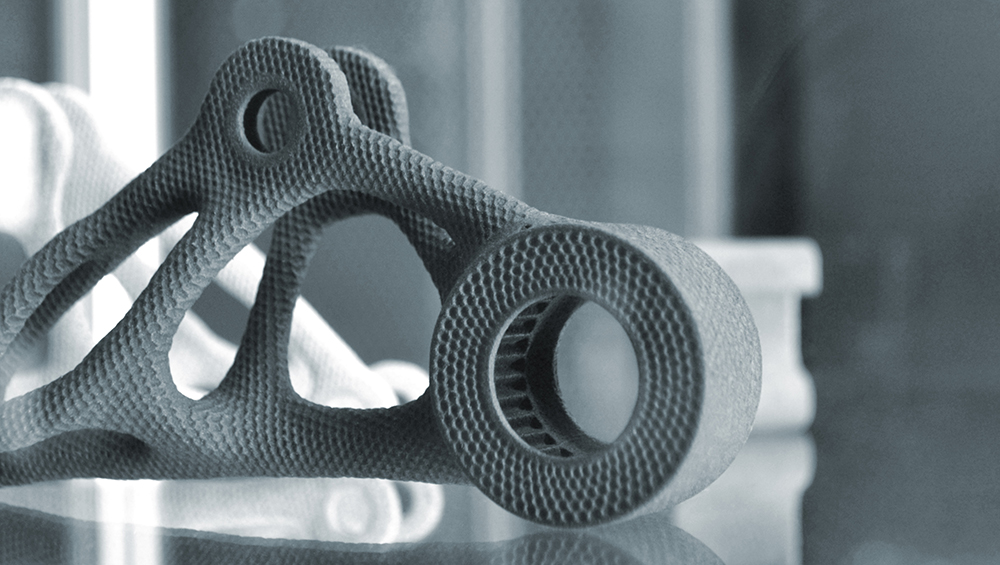
Additive manufacturing introduces several features that can significantly reduce fatigue strength compared with traditional materials. Internal porosity and lack-of-fusion defects act as stress concentrators, while high surface roughness in the as-built condition promotes early crack initiation.
Fatigue performance can be further degraded by residual stresses caused by rapid thermal cycling during the build process, as well as by directional (anisotropic) material properties inherent to layer-by-layer manufacturing. As a result, fatigue testing is often the limiting factor when qualifying additively manufactured parts for automotive use.
Impact of Process-Driven Variability on Fatigue Data
One of the defining challenges of fatigue testing in additive manufacturing is variability. Unlike traditional wrought or cast materials, additively manufactured parts are built from thousands of incremental melt pools or layers. Small changes in process parameters such as laser power, scan strategy, filament deposition, powder quality, or local thermal history can have a disproportionate effect on fatigue performance.
Studies on additively manufactured polymer specimens have demonstrated that relatively small variations in specimen geometry or stiffness can result in order-of-magnitude differences in fatigue life, sometimes even manifesting as entirely distinct fatigue populations. Without careful test design and measurement, these effects risk being misinterpreted as inherent material scatter rather than a combination of process variability and stress calculation uncertainty.
This often leads to greater scatter in fatigue data and differences between nominally identical parts. Fatigue test systems must offer excellent repeatability, alignment, and control stability to ensure that observed differences are truly material or process-driven, not test-induced.
Surface Condition and Post-Processing Effects
Fatigue programs frequently compare as-built versus machined gauge sections, or different surface and heat treatments, due to the dominant impact of surface defects on fatigue crack initiation. Accurate fatigue testing allows engineers to quantify the benefit of post-processing steps and make informed cost-versus-performance trade-offs in automotive production.
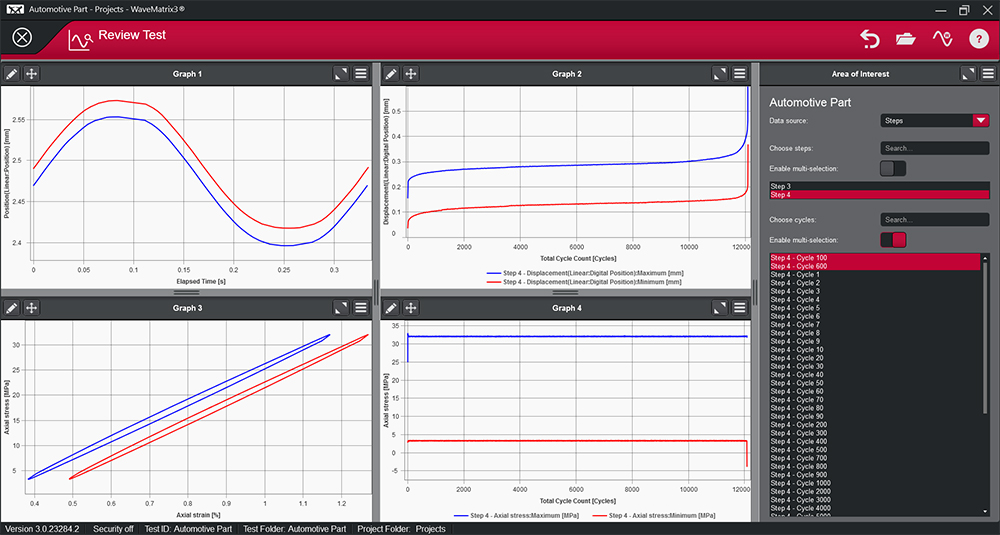
When comparing different surface effects, relying solely on nominal geometry or assumed dimensions can result in significant data scatter due to uncertainty in measurement and print accuracy. Fatigue systems that can monitor additional metrics throughout the test, such as dynamic stiffness, allow test engineers to correct for these effects for more accurate data analysis.
Anisotropy and Alignment
Because additively manufactured materials are inherently anisotropic, fatigue performance often depends strongly on build orientation. Components loaded parallel to the build layers may behave very differently from those loaded through the build direction. Even small misalignments can introduce unintended bending stresses, which can disproportionately affect fatigue results in highly anisotropic materials.
Fatigue test setups must therefore accommodate specimens built in multiple orientations and provide precise alignment control. This is particularly important when testing sub-size specimens or thin-walled features commonly found in automotive additive manufacturing designs.
Specimen Size, Geometry Constraints, and Representative Testing
Additive manufacturing materials, especially metal powders, are expensive, and build volumes can be limited. As a result, automotive fatigue testing is often performed on sub-size specimens or non-standard geometries — or directly on representative features and components — rather than standard dog bone specimens. Additionally, parts can often exhibit geometry-driven fatigue behavior due to stress concentrations, lattice structures, thin walls, or integrated features, meaning that simple coupon tests may not fully capture in-service performance.
These constraints place additional demands on fatigue testing equipment, including high data resolution and specialized gripping solutions for both sub-size and non-standard specimens. Flexible test systems that can evolve from fatigue on simple specimens to realistic loading conditions on complex automotive components are essential for generating meaningful, application-relevant fatigue data.
How Instron Supports Fatigue Testing for Additively Manufactured Automotive Parts
Instron® has extensive experience supporting both automotive and additive manufacturing applications. Our fatigue testing solutions are designed to address the unique challenges of additively manufactured materials from early material screening to full-component durability testing.
Instron systems enable:
- Accurate high-cycle fatigue data with monitoring throughout the test
- Reliable testing of sub-size coupons as well as full automotive components
- Precise alignment and control for anisotropic and defect-sensitive materials
Backed by expert application support, Instron helps automotive engineers generate fatigue data they trust to confidently qualify additively manufactured parts.
Conclusion
As additive manufacturing continues its transition into functional automotive components, fatigue testing is no longer optional. The unique characteristics of additively manufactured materials demand careful test design, precise control, and high-quality data to ensure durability under real-world cyclic loading.
By combining the right fatigue testing strategy with robust, repeatable test systems, automotive engineers can confidently interpret fatigue performance, avoid misleading conclusions, and unlock the full potential of additive manufacturing without compromising safety, reliability, or performance.

Subscribe to the Instron Update
Stay up to date on industry trends, testing standards, applications, tips and tricks, and so much more!
About the Author

Rebecca Reiff-Musgrove
Rebecca Reiff-Musgrove is Business Development Manager for ElectroPuls® at Instron. Her background includes an MSci from the University of Cambridge with a focus on the surface properties of additively manufactured parts, as well as previous roles in materials testing for the additive manufacturing industry. At Instron, she has held a range of technical and commercial roles, giving her a grounded understanding of both the technology and the customer challenges it addresses.