

Decision Rules in Calibration: Why the Rule Matters, Even When Simple Acceptance Is Appropriate

Calibration certificates are often read in simple terms: pass or fail, in tolerance or out of tolerance. When a laboratory makes that kind of statement of conformity, the basis for the conclusion matters.
For many calibrations, that level of reporting is entirely appropriate. However, when a statement of conformity is provided, the laboratory needs a defined method for deciding whether the result meets the specified requirement. That method is the decision rule.
What Is a Decision Rule?
A decision rule defines how a measured result is evaluated against a specification, including how measurement uncertainty is taken into account. In other words, the conformity statement is based not only on the measurement result itself, but also on the rule used to interpret that result against the applicable limit.
In practical terms, it is the basis for the conformity statement reported on a calibration certificate. It is not just an administrative detail. It is part of the reporting framework used to support consistent and technically sound interpretation of results, especially when measurement uncertainty may affect whether a result should be considered conforming or non-conforming.
ISO/IEC 17025 requires laboratories to define the decision rule used when reporting a statement of conformity. Under clause 7.8.6, where the rule is not already inherent in the requested specification or standard, it must also be communicated to and agreed with the customer.
When Decision Rules Matter Most
Decision rules matter specifically when a laboratory makes a statement of conformity, such as pass, fail, in tolerance, or out of tolerance.
That distinction is important. A calibration certificate may report measured values and associated uncertainty without making a pass/fail determination. In that case, the laboratory is reporting measurement results, not making a conformity decision.
When a conformity statement is included, however, the decision rule becomes an essential part of how that conclusion is reached and understood.
This is also where it helps to separate calibration from verification. Calibration establishes the measurement relationship and reports the result. Verification, or conformity assessment, applies criteria to determine whether the item meets a specified requirement.
Why Simple Acceptance Is Common in Calibration
In many calibrations, the decision rule used is simple acceptance, and it is entirely appropriate for many applications.
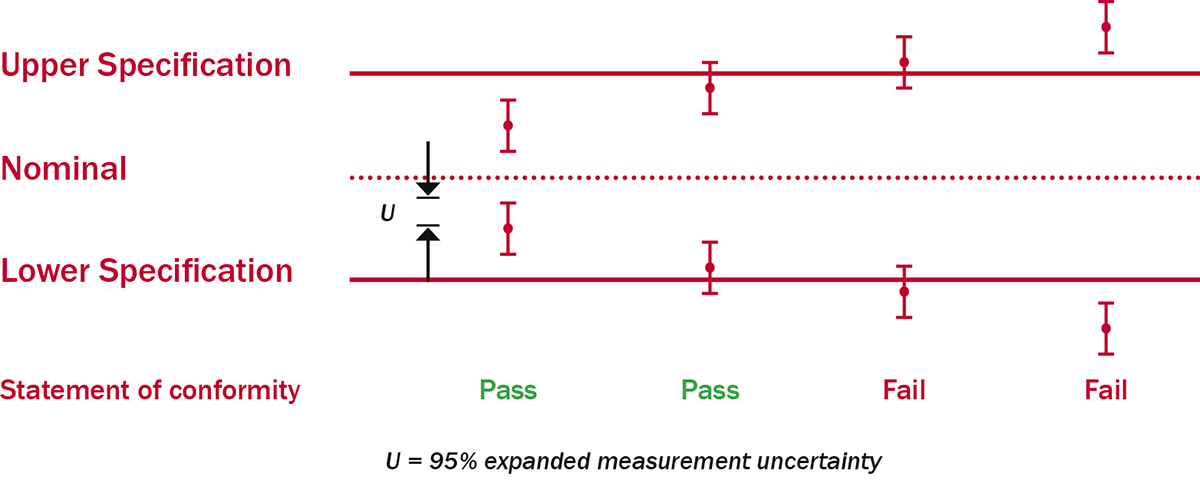
Under simple acceptance, the acceptance limit is the same as the tolerance limit. Put simply, the tolerance limit is the specification boundary for the item being calibrated, and the acceptance limit is the boundary used to decide pass or fail. Under simple acceptance, those two boundaries are the same.
For an upper limit, results below that limit are accepted and results above it are rejected. For two-sided tolerances, the same principle applies at both limits. In this approach, the acceptance limit is not shifted inward to account for uncertainty through guard banding.
This approach remains common because it provides a clear and practical basis for conformity reporting. It supports straightforward pass/fail communication and aligns with the needs of many customers, particularly where a simple conformity statement is sufficient for the intended use of the equipment.
Why the Rule Still Matters
Even where simple acceptance is appropriate, the decision rule still matters because conformity is not determined by the measured value alone.
Measurement uncertainty can affect how a result should be interpreted, particularly when the measured value is close to the tolerance limit. A reported value may fall within tolerance while the associated uncertainty makes it possible for the true value to be beyond that limit. In such cases, the conformity statement depends not only on the measurement result, but also on the decision rule applied to interpret it.
This is why the rule matters even when the outcome appears straightforward. The reported conclusion is not simply a reflection of the observed value — it is the result of a defined method of assessment.
Understanding the Risk Behind the Decision
Simple acceptance is often practical, but it is also a shared-risk approach.
Near a tolerance boundary, there is always some risk of an incorrect conformity decision because the true value is never known with absolute certainty. A result close to the limit may be accepted even though the item is actually non-conforming, or rejected even though it is actually conforming. Different decision rules manage that risk in different ways.
That is why the choice of decision rule should reflect the application, the significance of the risk, and any applicable customer or regulatory requirements.
When a Different Decision Rule May Be Needed
Simple acceptance is common, but it is not the only recognized approach.
Where tighter control of false accept or false reject risk is needed, a laboratory may apply a different decision rule. A common example is a guard banded decision rule, where the acceptance limit is set inside the tolerance limit by a defined amount. This makes the conformity decision more conservative by reducing the likelihood of accepting a non-conforming item, although it can also increase the likelihood of rejecting an item that is actually conforming.
Instron® also supports other recognized approaches when required by the application, customer specification, or governing standard. These include probability-based methods such as Unconditional Probability of False Accept and Conditional Probability of False Accept, as well as approaches based on ISO Guide 98-4, including Prior Verification PFA and Prior & Post Verification PFA. In practical terms, these methods are used when uncertainty near the tolerance limit needs to be handled in a more explicit way than a simple pass/fail determination.
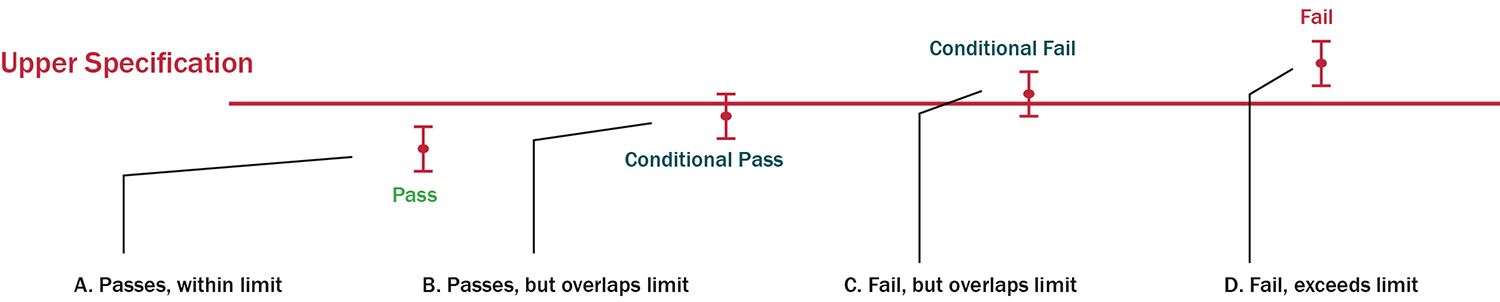
In some applications, laboratories may also use non-binary approaches that allow outcomes beyond a simple pass or fail. These may include results such as conditional pass or conditional fail, depending on the decision rule applied and the level of risk considered acceptable. This kind of framing is already reflected in Instron’s approved decision-rules material.
These approaches are not automatically required. Their use depends on the application, the level of acceptable risk, customer requirements, or the requirements of a governing specification or standard.
Why the Decision Rule Affects Interpretation, Not the Calibration Itself
The decision rule does not change the actual calibration process. It changes how the results of that process are interpreted and reported when a statement of conformity is issued. The measured values, tolerances, and uncertainty remain the underlying technical information. The decision rule provides the framework used to determine whether those results support a pass, a fail, or another form of conformity statement.
This distinction is important. Calibration and conformity assessment are related, but they are not the same activity.
Why Customers Should Understand the Rule Used
For many customers, a standard pass/fail statement is sufficient, and simple acceptance remains an appropriate basis for calibration.
Even so, understanding the rule behind that statement improves transparency and supports informed interpretation of the certificate. Where a conformity statement is provided, the basis for that statement should be clear.
Where certificates include measured values, tolerances, and uncertainty, customers may also apply their own internal assessment approach if their application requires it. The underlying measurement data does not change, but the interpretation may differ depending on the decision rule applied. In that case, the customer’s internal assessment is separate from the laboratory’s reported conformity statement.
Supporting Confidence in Calibration Results
For customers, the value of calibration is not just in receiving a certificate. It is in having confidence that the reported result is clear, technically sound, and appropriate for the intended use.
That is why decision rules matter. In many calibrations, simple acceptance provides the clear conformity statement customers expect. Where a different approach is needed, the basis for that decision should be clearly defined, documented, and aligned with the reporting requirement.
Instron supports that objective by providing calibration results that are transparent, traceable, and suitable for the intended application. The value of calibration lies not only in the measurement data itself, but also in how clearly the basis of any conformity statement is communicated.

Subscribe to the Instron Update
Stay up to date on industry trends, testing standards, applications, tips and tricks, and so much more!