
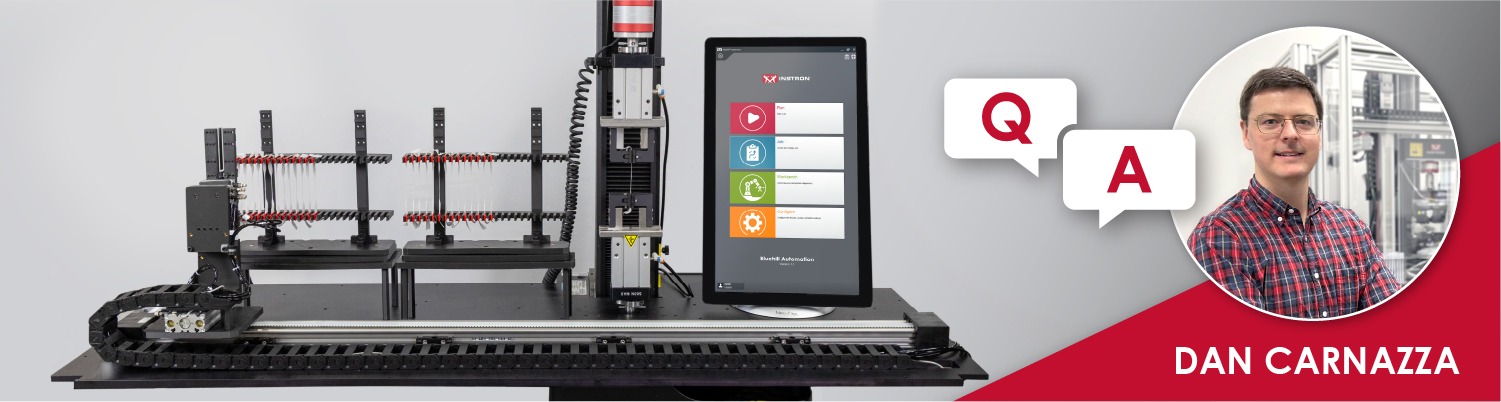
Introducing the AT1 Automation System for Thin Film and Elastomer Testing
Q&A with Dan Carnazza, Senior Mechanical Engineer for Automation at Instron
Ensuring consistent product quality starts with reliable, efficient testing. To explore these challenges and the technology designed to overcome them, we sat down with Dan Carnazza, one of the lead developers behind Instron’s new AT1 automation solution for thin film and elastomer testing. In this Q&A, Carnazza shares insights on the engineering considerations, the benefits of automation in quality environments, and what users can expect when upgrading from manual testing.
The Challenge with Testing Thin Films and Elastomers
What makes thin films and elastomers uniquely challenging to test compared to more rigid materials?
Manual alignment and positioning of thin films and elastomers can be difficult because these materials are often extremely flexible and sensitive to how they’re handled. Even small differences in how an operator grips or centers the specimen can lead to variations in the data. This makes manual testing more prone to operator influenced inconsistencies compared to rigid materials that are easier to position repeatably.
What gaps or limitations did Instron see in the traditional testing workflow that motivated the development of the AT1 automated testing system?
Many quality labs perform relatively simple tests, but the available automation options tend to be large, complex, and require a higher initial investment than the application really demands. With the AT1, our goal was to fill that gap — giving labs a way to automate basic film and elastomer tests, reduce operator driven variation, and improve repeatability without needing the footprint or sophistication of a robot-driven automation system.
Intro to the AT1
Where does the AT1 fit within Instron's broader portfolio?
The AT1 is designed as a compact, benchtop automation system that fits easily into existing lab environments. Operators can load between 50 – 75 film or elastomer specimens at once, streamlining batch sample testing. The specimen rack and gripper system were engineered for flexibility, enabling quick changes between gauge lengths from 20 mm to 100 mm. This positions the AT1 as a mid-tier solution — more automated and consistent than manual testing, but simpler and more streamlined than our robot-driven automation platforms.

How does the AT1 maintain accuracy when dealing with extremely delicate or highly deformable samples?
The AT1 uses a removable specimen rack with precision alignment features that ensure each sample is positioned consistently. Because operators load specimens on the bench rather than inside the machine, it’s easier to align them properly, and the guided design helps maintain that alignment once the rack is reinserted. This minimizes handling errors and supports more uniform, accurate results.
Were there any specific design considerations or innovations you’re particularly proud of in the AT1?
One of the biggest challenges in automation is avoiding unnecessary complexity, and I’m proud that we were able to deliver a system that’s genuinely simple to operate without sacrificing capability.
I’m also excited about the integration with Instron’s new Bluehill Automation software. It simplifies automation programming significantly, allowing customers to modify workflows or set up new test configurations — like adding a new specimen rack — without needing an Instron technician. That level of usability is a major step forward.

Performance & Real‑World Benefits
What measurable improvements — such as precision, throughput, or repeatability — can users expect to see after implementing the AT1?
Similar to our other automation systems, the AT1 allows operators to load a batch of specimens and let the system handle the rest. Because every specimen is gripped and aligned in the exact same way, users can expect a noticeable reduction in result‑to‑result variation. At the same time, automation frees operators from repetitive loading tasks, giving them more time to focus on other priorities in the lab.
How does the AT1 help reduce operator variability or common sources of error in thin film and elastomer testing?
Specimen alignment is critical in thin film testing — small angular or positional differences can significantly affect results. The AT1 removes this variability by ensuring each specimen is placed in the same orientation and loaded identically. For customers interested in learning more about addressing variability issues, I’d recommend reading our white paper on specimen alignment for thin films and foils, which illustrates why consistency is so important.
User Experience & Integration
What does the learning curve look like for users transitioning from manual testing to the AT1?
The AT1 uses our Bluehill® Automation platform, which will feel very familiar to anyone who has worked with Bluehill Universal. The interface follows the same design principles — simple, intuitive, and customizable. Historically, automation programming could be complex, but Bluehill Automation streamlines the process, giving customers the confidence to create or adjust workflows themselves. Even configuring a new specimen rack can be done without external support.
How does the AT1 integrate with existing lab workflows, instrumentation, or data management tools?
Our data processing architecture supports everything from SQL-based data exports to fully customized LIMS integrations. This allows labs to connect test results directly into their existing data storage, reporting, and analysis systems, ensuring the AT1 fits cleanly into established workflows.
What are some of the built‑in safeguards or smart features designed to help technicians run tests more confidently and consistently?
The system supports customizable Lab Manager and Operator accounts. Lab Managers can control access and restrict certain functions — such as editing test methods — while Operator accounts can be limited to essential actions like starting or stopping automated tests. This structure helps ensure consistency and reduces the chance of unintended changes.

Final Thoughts
Consistency, efficiency, and ease of use are critical for quality testing — especially when working with flexible materials that are difficult to handle manually. The new AT1 automated testing system fills an important space in Instron’s automation portfolio: offering meaningful improvements in repeatability and workflow simplicity without the footprint or complexity of larger, more complex systems.
It’s designed for teams performing basic tests who want the advantages of automation but need a solution that’s compact, straightforward, and accessible from a budget standpoint.
To learn more about the AT1 system’s capabilities and how it can elevate your testing workflow, download the product datasheet, and explore the full specifications — or contact us to learn more.

Subscribe to the Instron Update
Stay up to date on industry trends, testing standards, applications, tips and tricks, and so much more!

Ready to Automate Your Testing Workflow?
Whether you’re starting small or planning a fully automated test line, Instron offers solutions that grow with your needs. Explore our complete automation portfolio to find the systems that best support your application.