Instron

Thank You for Submitting a Return Material Authorization Request

Services

Thank you for submitting your request.

Our team at [email protected] will review your RMA shortly. If additional information is needed, we will reach out to you directly.

Once the review is complete, you will receive your RMA number within 48 hours, along with detailed instructions for shipping your equipment to our repair department.

Please do not ship equipment without an RMA # as Instron is not liable for lost or missing items.


Instron Remote Technical Service RTS

Return Material Authorization (RMA) Request

Return Material Authorization Request

Services

Use this form to initiate a Return Material Authorization (RMA) request with Instron. This process allows you to return equipment for service, repair, or evaluation. Once submitted, your request will be reviewed by our support team. If additional information is required, we will contact you directly. Upon approval, you will receive an RMA number and detailed instructions for shipping your equipment to our repair facility.

Please ensure all required fields are completed accurately to avoid delays in processing.

System Move and Relocation Services

Services

Relocating your testing system shouldn’t mean lost productivity or compromised accuracy. With decades of experience and a global team, Instron ensures your move is handled with precision and efficiency — so you can stay focused on what matters most.

Request a System Move or Relocation

To request a system move or relocation, please complete the form below. We typically respond to online inquiries within 1–2 business days. Looking for a quicker reply? Visit our locations page to find the nearest office and connect with us directly.

PRE- AND POST-MOVE SERVICES

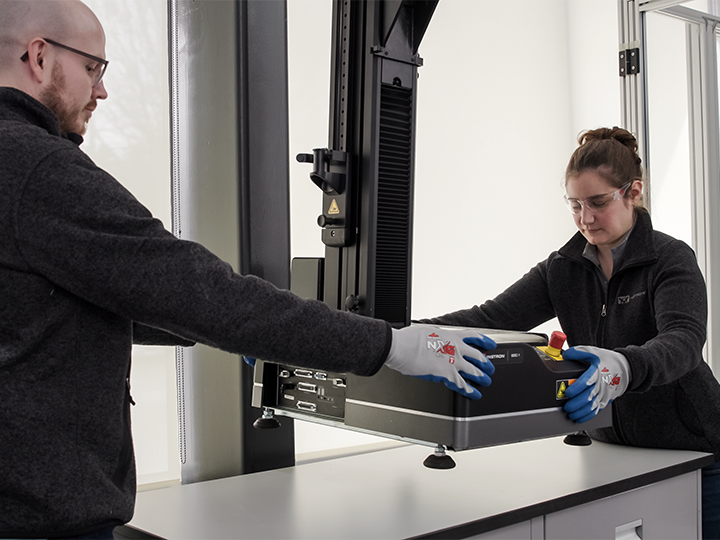
Relocating your Instron system involves more than simply moving equipment — it’s about protecting accuracy, mitigating risk, and ensuring compliance. Per ASTM and ISO standards, universal testing machines and transducers must be calibrated after any move. Instron offers post-move calibration services, required to maintain compliance and measurement accuracy.

In addition to post-move calibration, Instron offers additional services tailored to your needs. From simple moves to complex relocations, we’re here to support you with services including:

  • Pre-Move Calibration — establishes a performance baseline before relocation, helping to identify any existing issues and providing confidence in post-move results.
  • Deinstallation — safe removal of components and preparation for handling
  • Packaging & Shipping — coordination of packing and shipping through trusted third-party moving companies
  • Reinstallation — system leveling, reconnection, system bootup, and software checks
  • IQOQ Validation — revalidation or new documentation to support compliance

Whether you require calibration only or a complete turnkey solution, Instron offers flexible service packages to meet the specific requirements of your relocation project.

Calibration and verification services by Instron

INSTRON CALIBRATION SERVICES

To ensure optimal performance and compliance with industry standards, we strongly recommend conducting both pre- and post-move calibrations on your testing system. Relocating equipment — especially systems involving crosshead movement — can impact alignment and measurement accuracy. Verifying speed, displacement, and transducer calibration before and after the move helps maintain precision and reliability in your testing results. Instron’s global calibration laboratory is accredited to ISO/IEC 17025 by NVLAP under Lab Code 200301-0, a signatory of ILAC MRA.

IQOQ validation services

RELOCATING YOUR SYSTEM AND IQOQ

Relocating a testing system can raise questions about compliance. While pre- and post-move calibration are always recommended, revalidating the system's IQOQ depends on your internal quality system. Instron recommends that when moving a system with IQOQ, you carry out an internal risk assessment to evaluate the effects of the machine move and determine based on that, and your internal quality policies, if revalidation is required.

IQOQ Support Services

Services

Our field service teams provide validation and documentation services to support IQOQ processes designed to ensure that your Instron testing equipment performs to its intended purposes and produces valid results per 21 CFR 820.72 and ISO 13845. At the conclusion of our services we provide a Completion Certificate for Installation and Operational Qualification that will be signed by the Instron Field Service Engineer who performed the validations.

IQ/OQ validation should be considered for all new static, MT torsion, dynamic (linear and biaxial), melt flow, and custom (autoinjector) testing equipment installations, relocations, and upgrades.

Installation Qualification
Operational Qualification
Performance Qualification

Installation Qualification (IQ)

An installation qualification process is designed to establish that the system has been installed correctly. It will consider and document:

  • Installation conditions
  • Operation of safety features
  • Provided system manuals and documentation
  • Environmental conditions

Appropriate services and utilities manuals should be used to provide system requirements when applicable. Pre-installation and installation documentation will ensure that installation was performed correctly.

Operational Qualification (OQ)

An operational qualification process is designed to verify the proper operation of the testing system and its ability to produce valid results. A typical validation plan includes the following:

  • Transducer verification (per Instron's standard verification/calibration procedures, certificates are provided for each transducer).
  • Speed and displacement verification (per Instron's procedures; certificates are provided for both verifications).
  • Software functionality check

Performance Qualification (PQ)

Performance qualification is complex and requires identification of the specific types of tests and calculations to be performed by the system in your test environment. Instron's support of PQ processes is typically limited to the validation of results reported by Instron software, but consultation services can be provided to assist customers with their PQ processes.

Strain and Extensometers


Services


Strain and Extensometers

Types of Calibration and Verification


Services


Types of Calibration and Verification

Temperature Verification


Services


Temperature Verification

Implementation Assistance


Services


Implementation Assistance

Updating or Upgrading Your Instron System and Software


Services


Updating or Upgrading Your Instron System and Software

Calibration of Materials Testing Systems​

Calibration of Materials Testing Systems​

Services

For more than 40 years, Instron® has been providing calibration of the highest quality, offering you a wide range of on-site and factory calibration services for your materials testing systems. All calibrations we provide are traceable to the International System of Units (SI) through a National Metrological Institute (NMI). ​
Slide 3 Calibration Labs and Accreditations

Calibration Labs and Accreditations​

Instron's global calibration labs provide cutting-edge calibration services with capabilities that are continuously expanding.

View a copy of our NVLAP Lab Code 200301-0 Scope of Accreditation

Compliance to global calibration standards

Compliance to Global Calibration Standards

Our services are designed to ensure that your materials testing systems meet or exceed relevant calibration standards.

Our global presence, range of capabilities, experience, and low-measurement uncertainties make us a global calibration leader for materials testing solutions.

Types of calibrations

On-site calibration services

On-Site Calibration Services​

Instron offers a wide range of on-site calibration services.

These accredited calibration services are completed in your laboratory by our factory-trained Field Service Engineers.

Slide 3 Factory Calibration Equipment

Factory Calibration Services​

These services take place at Instron’s factory-based calibration laboratories, which are accredited by an International Laboratory Accreditation Cooperation (ILAC) Signatory accreditation body, NVLAP under Lab Code 200301-0.

Request a factory calibration

Types of calibrations

Calibration lab

Maintaining Data Accuracy, Integrity, and Traceability

Our calibration laboratories are accredited to ISO/IEC 17025 by NVLAP under lab code 200301-1, a signatory of ILAC MRA.

This accreditation covers field and factory-based calibrations globally.

Installation & Relocation

Installation & Relocation

Services

Instron Installation & Relocation Services​

New, relocated or upgraded testing systems require support for site preparation, installation, training, and calibration. To address this, we have a full range of installation services to address your needs.

Our Installation Training services are typically included when you purchase an Instron® system to assure successful handover to your staff and the start-up of testing operations. Additionally, calibration, IQOQ and Instron Connect services are available to address specific installation and relocation requirements.

5989-electromechanical-universal-testing-machine-800x600

Calibration Cycle and Preventative Maintenance

We will review your current calibration and preventative maintenance cycle. If you purchase calibration services along with the system installation, these services will be performed at the same time.

Read More About Our Calibration Services

Read More About Our Preventative Maintenance Services

5989-electromechanical-universal-testing-machine-800x600

Configuration of Your Instron System​

Your Service Engineer will work with you to discuss site requirements for installation, site preparation, physical installation, accredited calibration requirements, and necessary staff training.​

5989-electromechanical-universal-testing-machine-800x600

Installation Training

Training at the time of installation and/or relocation will include the basic operation of the machine and software fundamentals. Our more complex software solutions include in-depth programming training which can be scheduled close to or at the time of installation.

Find Out More About Our Training Courses

Site Preparation Guidance and Services​

Before a new machine installation or relocation, a Service Representative will be in contact with you to discuss the preparation of your site and provide guidance. Some of the elements they will discuss with you include:

  • Guidance on foundations and flooring
  • Suitability of benches, electrical and pneumatic supply requirements
  • Access assessment if the equipment is being placed at a distance from the delivery point (e.g., door heights and corridor widths)
  • Special attention to instruments requiring sensitive movement
  • For larger servohydraulic-operated testing systems requiring hydraulic supplies with specialized cooling requirements we can provide hydraulic pipe-work services and guidance on best practices to minimize environmental and energy impact
  • Support services and documentation to address calibration and IQOQ validation requirements
  • Guidance regarding unpacking, off-loading, movement, positioning and levelling of equipment

Alignment Test

Alignment Test

Service and Support for your Instron Testing Solution

Services

Alignment Test

Our Field Service and Calibration Engineers work directly with ASTM and Nadcap to understand the requirements for materials testing system alignment. We have developed and established alignment calibration services complying with the guidelines and calculations detailed within ASTM E1012, Nadcap AC7122, and Nadcap AC7101 standards.

What Is Alignment?

The alignment test ensures that your test frame and grips are properly aligned. Accurate alignment ensures uniform stress in the specimen's test section, which is important when testing brittle and high modulus materials.

Why Do I Need Alignment?

The alignment of your testing system can change due to:

  • Changing your grips
  • Fitting new or replacement fixtures
  • Repositioning the fixed crosshead
  • Wear or damage to your fixtures or testing system components

Consequently, the importance of accurate alignment is being recognized by accreditation bodies and major aerospace corporations.

Related Literature: Alignment Test | Instron Professional Services

Force Calibration

Services

Force Calibration

Instron’s force calibration services not only meet industry and international regulatory standards but also routinely exceed them. As the leading provider of high-accuracy instruments and the first materials testing company to use strain gauge load cell technology, we take pride in knowing that our calibrations are of the highest quality.

Learn more about Force Calibration - download now

Benefits of Instron’s Force Calibration Service​

Instron’s accredited calibrations cover a wider range of forces than other providers, enabling the usage of test systems to both lower and higher forces without the need for changing transducers or purchasing new ones. Additionally, our enhanced or extended force calibration service provides a +/-0.5% accuracy at installation and +/-1.0% at subsequent calibration dates, all the way down to the system’s lowest specification limit. ​

force-calibration.jpg

Force Calibration Standards​

ASTM E4 and ISO 7500-1 are the two internationally recognized standard methods for calibrating the force measuring capability of materials testing machines. Calibrating equipment to either of these standards is a low-risk way to assure that your force transducers have been calibrated properly and to reduce the risk of providing inaccurate results from the instrument.​

Melt Flow, HDT Vicat, and Capillary Rheometer Calibrations

Services

melt-flow-calibration.jpg

Melt Flow Calibration​

Instron provides CEAST Melt Flow Tester calibration complying with ISO 1133-1, ISO 1133-2 and ASTM D1238, including 1 temperature.

  • Additional temperatures can be added at an additional cost.
  • Calibration performed by a factory-trained Field Service Engineer, who can make system adjustments if required.

Read More on CEAST Melt Flow Calibrations

Read More on CEAST Melt Flow Systems

HDT Vicat Calibration

  • CEAST HDT tester calibration complies with ISO 75 and ASTM D648, including 1 temperature ramp 120°/hour (up to required working temperature).
  • CEAST Vicat (VST) calibration complies with ISO 306 and ASTM D1525, including 1 temperature ramp 120°/hour and 1 temperature ramp 50°/hour (both up to required working temperature).
  • Calibration of the system’s mass from 2 grams up to 4095 grams.
  • Calibration performed by a factory-trained Field Service Engineer, who can make system adjustments if required.

Read More on CEAST HDT VICAT Calibrations

Read More on CEAST HDT VICAT Systems

hdt-2.jpg
capillary.jpg

Capillary Rheometer Verification​

Instron provides CEAST Capillary Rheometer performance verification, maintenance and adjustment to CEAST manufacturing specifications.

Read More on CEAST Capillary Rheometer Systems

Temperature Calibration

Services

Temperature Calibration​

Instron has developed a number of temperature calibration procedures that meet the most common laboratory and manufacturing requirements. These procedures are fully compliant with ISO/IEC 17025 and provide assurance that your test data is valid, and your processes are properly controlled.​

Why Should I Calibrate Temperature?​
Performing a test or running a process at the incorrect temperature is a frequent source of inaccurate results. Variability of temperature either in accuracy or uniformity is significant and is often an unrecognized contributor to reduced quality in products and inconsistency in test data. ​

You should consider calibrating temperature if any of the following applies to you:

  • You need to know the accuracy of the temperature.​
  • You need to know how the temperature may vary over the course of a test procedure.​
  • You need to know how uniform the temperature is throughout the volume of the temperature chamber.​

Related Literature: Temperature Calibration | Instron Professional Services

Strain Calibration

Services

Strain Calibration

Instron has been a leading provider in measuring and calibrating strain and is an active participant in the development of ASTM E83, ISO 9513 and ISO 5893 strain measurement standards
Learn more about strain calibration from Instron professional services

Why Calibrate Your Strain Reading?
Calibration of your strain measurement devices improves the effectiveness of your equipment which leads to greater confidence in your testing results.​

You should calibrate your instrument’s strain measuring device if any of the following apply to you:​

  • Strain is critical to your testing needs and is reported in the test results.​
  • Strain readings must be precise and repeatable.​
  • The material or component under test is strain rate sensitive.
  • Even if strain is not a critical parameter, if it is being measured and the data is being used in any way, calibrating strain is a good testing practice to ensure readings are repeatable and accurate.

Speed and Displacement Verification

Services

Speed and Displacement Verification​

Instron has long been a leader in measuring and verifying speed and displacement and is an active participant in developing the ASTM speed and displacement verification standards. These services ensure that testing parameters are being met and that associated results are being calculated accurately.
Learn more about speed and displacement verification from Instron professional services

As the original system manufacturer, Instron’s Field Service Engineers have access to all documentation, factory-specified spare parts and tools required to maintain your equipment at its peak performance.

Speed and Displacement Verification Standards​

For displacement verification, we can verify your testing instrument to ASTM E2309 or ISO 9513:2012/Cor 1:2013 – Annex H standards, and for speed verification, we can verify to ASTM E2658 standard. ​

speed-displacement-1.jpg
onsite-calibration-services.jpg

Why Do I Need To Verify Speed And Displacement?​

You should calibrate your machine’s displacement measuring system if any of the following apply to you: ​

  • Displacement is critical to your testing needs and is reported in the test results. ​
  • Use of an extensometer is impractical or impossible, and using crosshead displacement is an acceptable alternative.​
  • Crosshead or actuator displacement is used to characterize the displacement of a specimen or component.​
  • LVDTs commonly found in servohydraulic systems are often not linear throughout their range. ​

If any of the following apply to you, then verifying the speed-accuracy of your system is highly recommended:​

  • The material or component under test is strain rate or speed-sensitive.​
  • You are required to report test speed with your results.​
  • Your test method calls for a specific speed.​
  • Even if speed or displacement are not critical parameters, it is a good testing practice to ensure that the speed is constant, stable, and repeatable.​

Extended Warranty

Services

Extended Warranty

Instron universal testing systems are designed to deliver precise and reliable results, but neglecting to address potential issues that arise over time can pose significant risks to your operations. Investing in Instron’s extended warranty agreement is a proactive measure to help protect and create a routine of regular maintenance and care for your new investment.

System Availability

Extended warranties are available on the 6800 and 3400 series universal testing systems.

6800-3400-series-universal-testing-systems.jpg

Extended Warranty Agreements

Instron’s extended warranty agreements help mitigate your risk by combining:

  • On-site repairs including parts, labor, and travel.
  • Priority on-site and remote response.
  • Annual preventative maintenance visit, including installation of software updates if available.
  • Instron Connect, our support solution that includes four technologies for you to connect with Instron to request support, access calibration certificates and service history, and troubleshoot your system’s issues.

Download Instron's extended warranty brochure.

Instron® Connect

Services

INSTRON CONNECT

instron-connect-icons01.png

01

Industry-Leading Technical Support

Instron® Connect allows our Technical Support team to provide unparalleled support and guidance. Our investments in secure connectivity allow us to directly read system diagnostics information, assist you with software questions via remote screen share, and put our eyes in your lab for hardware issues through our augmented reality video support platform.

instron-connect-icons02.png

02

Enhance Your Capability

Improve your Instron system’s productivity with the InSkill AI troubleshooting tool which draws on a wealth of proprietary technical expertise to rapidly diagnose issues and provide solutions.

instron-connect-icons03.png

03

Obtain Information Fast

Access your Instron system’s calibration certificates, service history, and service agreement information through the Instron Connect Portal or InSkill AI mobile app to provide security for audit and lab evaluations.

Instron Connect includes a number of technologies that create a secure connection between the testing systems at your facility and Instron. Our problem-solving tools harness innovative technology to rapidly troubleshoot issues and answer your technical questions, increasing productivity, reducing risk and minimizing downtime.

lnstron’s unrivaled applications expertise and best-in-class service establishes us as the leader in customer satisfaction with the best ownership experience. Instron Connect is available as part of Bluehill® Universal, but it can also be used with other Instron software packages (Windows® 7 or higher required).

Industry Leading Technical Support

ipad-with-inskill4_.jpg

Instron Connect provides users with unrivaled support and guidance, by investing in secure connectivity we can read your system's diagnostics information directly, assist you with software questions via remote screen share and put our eyes in your lab for hardware issues through our augmented reality video support platform.

ic_portal-2mb-1.png

As Technical Support is integrated with Instron Connect, simply submit requests through the Instron Connect Portal, Instron Connect Software, or InSkill AI mobile app to accelerate response times.

ipad-with-inskill3_.png

By utilizing the InSkill AI troubleshooting tool and SightCall AR support tool, you are less likely to repeat calls about the same issue.

instron-connect-support.jpg

With cloud-based technology, Instron Support is able to easily locate your equipment records in our system, allowing us to provide our premier service and resolve your issue faster.

Enhance Your Capability & Minimize Downtime

ipad-with-inskill4.jpg

Improve your operation productivity and get results faster with the InSkill AI mobile app, including a troubleshooting tool to help rapidly diagnose issues and provide solutions.

19-11-07_68sc-1_3145_a.jpg

Receive support through remote screen sharing with voice-over IP via the Instron Connect Software.

instron-rts-sightcall-1.jpg

The SightCall Augmented Reality (AR) support tool brings Instron’s Technical Support team’s eyes into your lab, increasing first-time remote repair rates and eliminating the need for on-site visits.

instron.png

Instron Connect incorporates a powerful communication platform that brings our support engineers even closer to your organization and laboratory.

Obtain Information Fast

picture2-1.png

Access your Instron system's service history and service agreement through either the InSkill AI mobile app or the Instron Connect Customer Portal, saving you time and paperwork.

picture4.png

Maintain your lab's certification with automated notifications and easy access to your system's calibration status and certificates, to provide security for audit and lab evaluations.

19-11-04_68tm-5_1737.jpg

Stay current with the latest software and firmware updates to keep your Instron system running in optimal condition. Fast, reliable, direct software downloads and file sharing are available through the Instron Connect software.

You can combine your Instron Connect agreement with other services, such as Calibration and Preventative Maintenance.

Calibration Lab and Accreditations

Services

Calibration Lab and Accreditations

Instron's global calibration laboratory provides cutting-edge calibration services for materials testing systems with capabilities that are continuously expanding.

Our calibration laboratories are accredited to ISO/IEC 17025 by the National Voluntary Laboratory Accreditation Program (NVLAP) under Lab Code 200301-0, a signatory of the International Laboratory Accredited Cooperation Mutual Recognition Arrangement (ILAC MRA). This accreditation covers both the factory and field calibrations carried out globally.

View Our NVLAP Lab Code 200301-0 Scope of Accreditation

More Information on the Types of Calibrations We Offer

Slide 3 Calibration Labs and Accreditations

What Is Accreditation?

Laboratory accreditation is an independent, third-party evaluation of a laboratory’s competence to perform calibrations within its Scope of Accreditation. An integral part of the accreditation process is the technical evaluation of the laboratory’s capability, which includes confirmation that the laboratory provides measurement results traceable to recognized National Measuring Institutes (NMI), such as the NPL in the UK, NIST in the USA, and PTB in Germany.​

Although there are a number of organizations that approve calibration laboratories, only the bodies that are members of ILAC are recognized as having an international standing.​

Calibration vs. Verification

Calibration and verification are commonly used terms across many scientific disciplines and industries with varied, yet similar, meanings. In addition, the connotation of the two terms has changed and evolved over time. So closely related, these terms are often used interchangeably by mistake. ​

slide-9-accreditation.jpg

The process of calibration is the comparison of the customer’s device to a reference standard the Field Service Engineer uses. For force, it would be the customer’s load force weighing system (load cell and electronics) against the Field Service Engineer’s working standard. For displacement, the process is the comparison of the customer’s displacement measuring system to the Field Service Engineer’s working standard. We do a comparison of the two devices and determine the difference between them, to achieve a measurement result (commonly referred to as the error). A calibration does not make any assessment of Pass or Fail.

Calibration and Verification by Instron Professionals

Verification takes the measurement result (the error) from the calibration and checks it against the standard to see if it meets the standard’s requirements. In other words, verification classes the machine based upon the error identified and other criteria from the calibration. The verification determines if the device being calibrated meets the requirements and makes a statement of conformance, Pass or Fail.

Instron Calibration Lab Dead Weight Stack

Largest Commercial Deadweight Test Stand In North America

Instron’s Calibration Lab houses the largest commercial deadweight test stand in North America. We have invested in a certified deadweight stack to ensure that our calibration services provide the greatest possible accuracy. ​

Because of this commitment to accuracy, Instron’s calibration services not only meet internationally accepted standards but also routinely exceed them.

Calibration Certificates

We believe that providing calibration certificates in a digitally encrypted format provides you with all the benefits and flexibility of electronic files as well as confidence in the integrity of such documentation. Many calibration organizations may offer electronic/digital calibration certificates, but few offer digitally encrypted calibration certificates.​

What Are Digitally Encrypted Calibration Certificates?

Digitally encrypted calibration certificates are electronic files that have an encrypted algorithm embedded and hidden within the file. If such files are altered, a message is displayed within the document to warn the viewer.​

Instron calibration laboratories only provide digitally encrypted calibration certificates. When a calibration certificate is approved, we apply a digital signature, which looks like a normal signature. If the document was to be altered, the signature block would display a warning message to indicate a change has taken place since the digital signing.​

calibration_certificate.jpg

Repair Service and Parts

Services

When systems are unavailable costs rise, productivity drops, and your customer commitments can be put at risk. Instron recommends preventative maintenance services to minimize downtime and costs. However, when repairs are necessary, our experienced inhouse repair group, backed by dedicated replacement part inventories, is ready to quickly restore the operation of your testing system.​

We will support your system for as long as it is technically and economically feasible. When appropriate, we can recommend and install upgrades to extend the useful life of your testing equipment, significantly lower repair costs, and add new functionality to maximize return on your investment.​

factory-repair

Factory Repair and Refurbishment

If your testing system or accessories cannot be repaired at your site, we can perform the repair in one of our factories.

Our dedicated Factory Repair Team has years of experience with your equipment and is familiar with all aspects of your testing system.

Request a Factory Repair

5989-electromechanical-universal-testing-machine-800x600-1-768x576

On-Site Repair

Our trained Field Service Engineers are available to travel to your facility to repair your testing system.

These services can be purchased as part of a Comprehensive Service Agreement to minimize costs.

Request an On-Site Visit

5989-electromechanical-universal-testing-machine-800x600-1-768x576

Replacement Parts

We stock a wide range of parts to expedite the repair of your system.

We offer new and factory refurbished components that have been reworked and tested to guarantee functionality within factory specifications. ​

Calibration and IQOQ After Hardware Repairs

Calibration
After the repair has been completed, we recommend that you re-calibrate your system if the electronics associated with your data signal have changed. However, whether you require re-calibration is dependent on your internal quality management system.
Learn More About Calibration

IQOQ
IQOQ validation is required for compliance with certain regulatory standards. If your system is governed by an IQOQ validation, you will need to evaluate whether any revalidation is necessary after a repair has been completed.
Learn More About IQOQ

5989-electromechanical-universal-testing-machine-800x600-1-768x576

System and Software Updates & Upgrades​

Services

Professional Installations

Professional installation is essential to ensure that your Instron system delivers precision and performance from day one.

Our factory-trained Field Service Engineers provide:

  • Pre-installation site assessment and preparation guidance.
  • On-site installation, calibration, and verification to factory specifications.
  • Operator training to help your team get started quickly.
  • Compliance with applicable safety and industry standards.

Professional installation helps prevent costly downtime, protects your warranty, and ensures you start testing with confidence.

Our installation training services are typically included when you purchase an Instron® system to assure successful handover to your staff and the start-up of testing operations. Additionally, calibration, IQOQ, and Instron Connect services are available to address specific installation requirements.

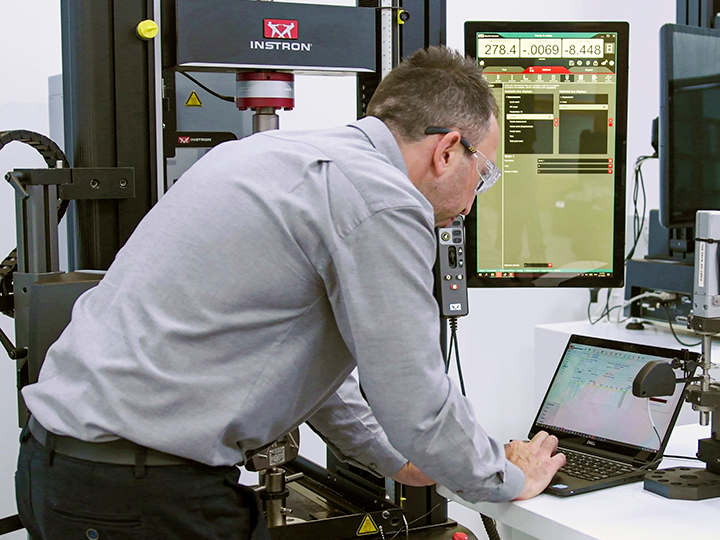
A close-up view of an Instron testing machine crosshead with the company logo displayed prominently on the front.
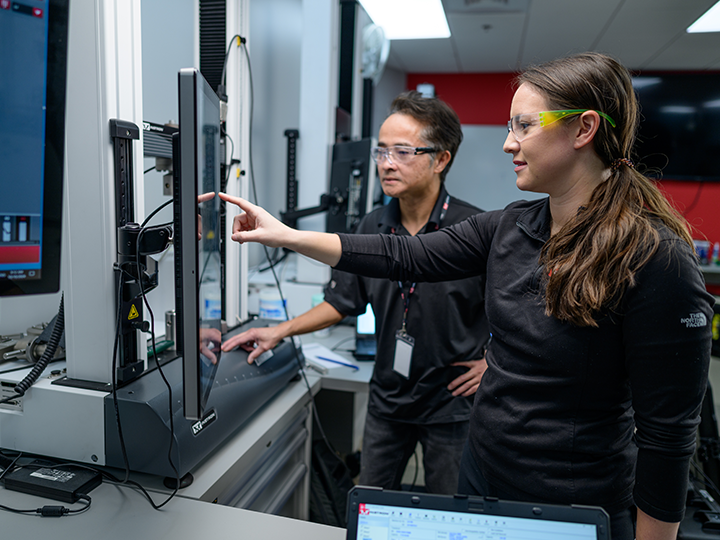
A Service Support Agent wearing a headset and gesturing while sitting in front of a large desktop monitor.

Site Preparation Guidance and Services

Before a new machine installation, a Service Representative will contact you to discuss the preparation of your site and provide guidance.

Some of the elements they will discuss with you include:

  • Guidance on foundations and flooring
  • Suitability of benches, electrical and pneumatic supply requirements
  • Access assessment if the equipment is being placed at a distance from the delivery point (e.g., door heights and corridor widths)
  • Special attention to instruments requiring sensitive movement
  • For larger servo-hydraulic-operated testing systems requiring hydraulic supplies with specialized cooling requirements, we can provide hydraulic pipe-work services and guidance on best practices to minimize environmental and energy impact
  • Support services and documentation to address calibration and IQOQ validation requirements
  • Guidance regarding unpacking, off-loading, movement, positioning, and levelling of equipment

Additional Installation Services

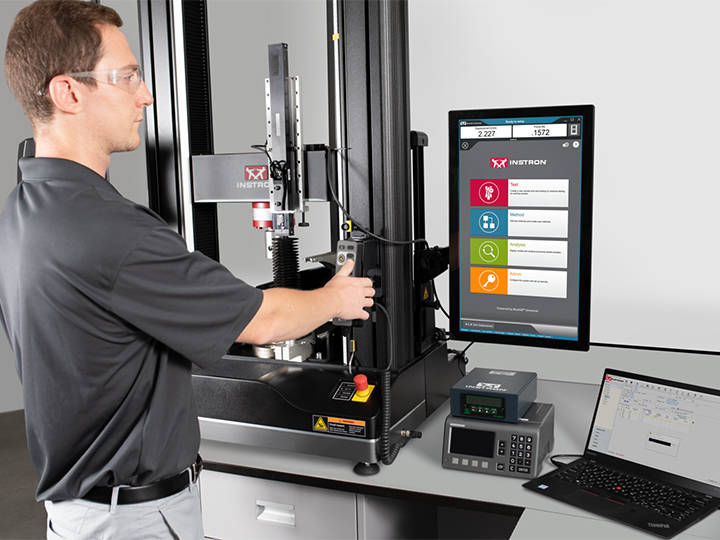
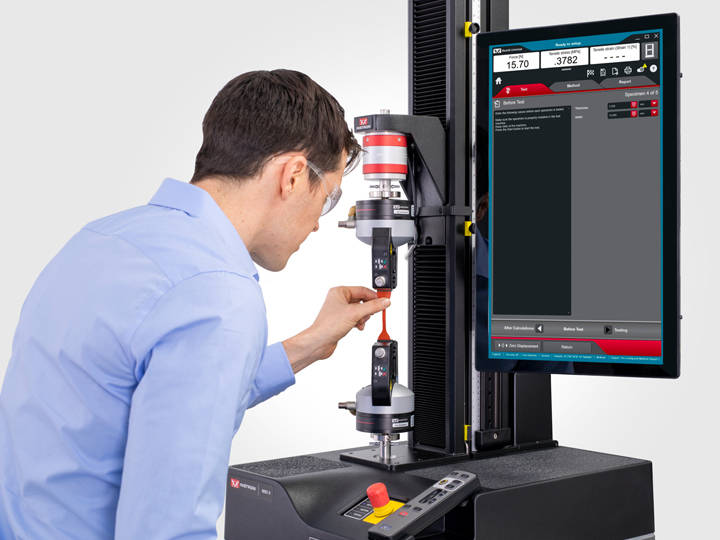
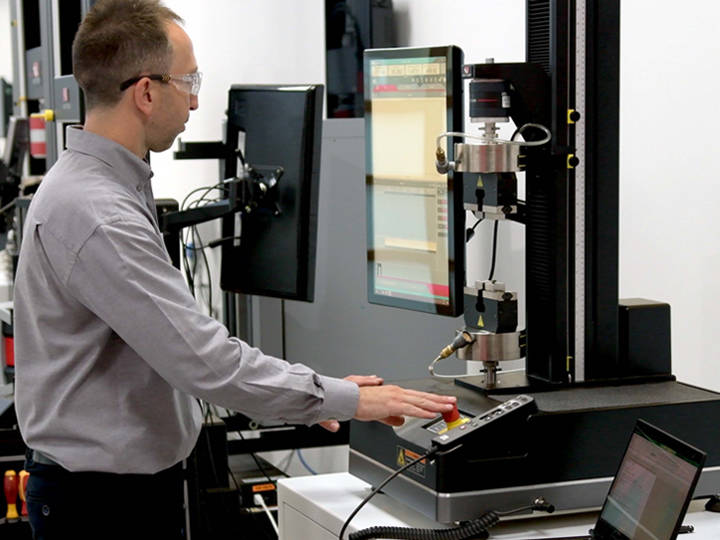
A technician operating an Instron universal testing machine, adjusting controls and positioning a cylindrical test specimen.

Calibration and Preventative Maintenance

We will review your current calibration and preventative maintenance cycle. If you purchase calibration services along with the system installation, these services will be performed at the same time.

ITW-Instron-MA-10-10-24--095

Installation Training

Training at the time of installation will include the basic operation of the machine and software fundamentals. Our more complex software solutions include in-depth programming training that can be scheduled close to or at the time of installation.

Updating or Upgrading Your Instron System and Software

Modernize the test systems in your laboratory and take advantage of the latest technological advances in electronics and software. Instron upgrades allow users of Instron and non-Instron testing equipment to upgrade or retrofit testing frames with the industry’s most advanced electronics and software.

In addition to major system software upgrades, we frequently release updates for current Instron software packages. Bluehill Universal software updates are available for all customers with a current Instron Connect agreement. Software updates go beyond addressing reported issues, often adding significant functionality and ease-of-use improvements.

A person operating an electronic testing machine, placing a circuit board into the fixture for evaluation.

Calibration and IQOQ After Software Upgrades or Updates

Calibration and Verification by Instron Professionals

Calibration

Based on our software verification and validation testing during product development, we believe that software upgrades have no effect on the values of transducer calibration and data collected by the testing system. If your internal standards or compliance to other regulatory bodies (including those outside of ISO or ASTM) require you to recalibrate your testing instrument after a software change, we recommend a more comprehensive validation.

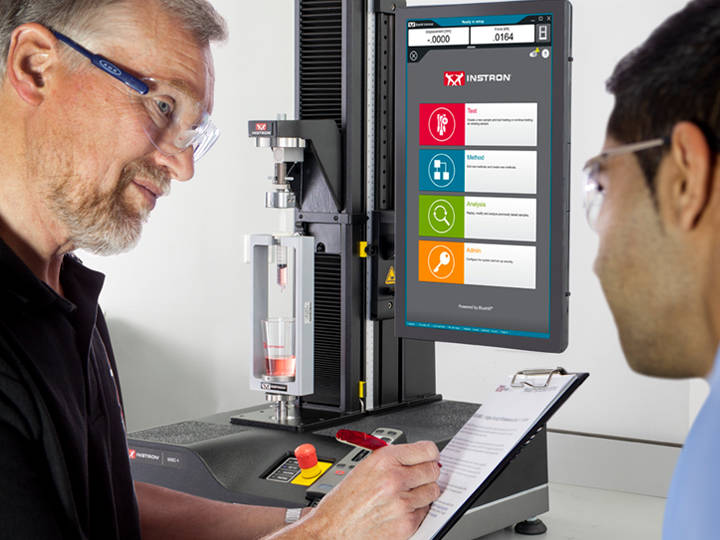
A person writing on a printed checklist form attached to a clipboard using a red pen.

IQOQ

IQOQ validation is required for compliance with certain regulatory standards. If your system is governed by an IQOQ validation, you will need to evaluate whether any
revalidation is necessary after a software update or upgrade. This evaluation will likely include an analysis of what items have changed in the software and a risk assessment of how those changes affect your internal testing. If it is determined that a redo of the Instron IQOQ is required, please contact your local Service Team.

Contact your local Service Team

Contact your local Instron Service Team to find out more about our installation, upgrades and updates services

Hardness

Services

Hardness Calibration

Instron can provide accredited hardness calibrations to the following standards:

  • E-10 Standard Test Method for Brinell Hardness of Metallic Material
  • E-18 Standard Test Method for Rockwell Hardness and Rockwell Superficial Hardness of Metallic Material
  • E-92 Standard Test Method for Vickers Hardness of Metallic Material 1kgf to 120kgf
  • E-110 Indentation Hardness of Metallic Material by Portable Hardness Testers
  • E-384 Standard Test Method for Microhardness of Materials 1gf to 1kfg

Learn More About Hardness Machines

uh4000_hardness-tester.webp

Impact Calibration

Impact Calibration

Service and Support for your Instron Testing Solution

Services

Impact Calibration

Why Calibrate Your Impact Testing Machine?
When you use an impact tester to determine the breaking energy of specimens, you need to have confidence that the data is sound. An Instron impact calibration will give you a statement of how well your impact testing system is performing.

Pendulum Impact Testers (Metal & Plastics)

Instron's pendulum impact calibrations are carried out against the appropriate international standard using traceable equipment and a fully trained and accredited calibration staff. Such calibrations provide a high integrity independent calibration report that fully meets ISO 9000 and ISO 17025 needs.

Read more about our Pendulum Calibration Service

As the original system manufacturer, Instron’s Field Service Engineers have access to all documentation, factory-specified spare parts and tools required to maintain your equipment at its peak performance.

impact-calibration.jpg

Drop Tower Impact Testers

Instron Professional Services are now able to provide NVLAP accredited calibrations for Strain Gauged TUPs, from 1kN up to 100kN under lab code 200301-0.

This calibration is carried out directly on your Drop Tower testing instrument, enabling you to be back up and testing in few hours, minimizing the downtime of your equipment.

Read more about our On-Site Drop Tower Calibration Service

More information on our other CEAST Calibration Services

Preventive Maintenance

Preventive Maintenance

Services

Preventative Maintenance

Instron preventative maintenance visits are scheduled at a time that suits your business and include a pre-defined set of maintenance activities designed to maximize your system’s uptime and performance, therefore extending the life of your system.

As the original system manufacturer, Instron’s Field Service Engineers have access to all documentation, factory-specified spare parts and tools required to maintain your equipment at its peak performance.

preventative-maintenance02.jpg

Preventative Maintenance for Servohydraulic Systems

preventative-maintenance01.jpg

Preventative Maintenance for Universal Testing Systems

preventative-maintenance03.jpg

Preventative Maintenance for ElectroPuls Systems

Protect Your Investment With Instron Service Agreements

Preventative maintenance, when combined with calibration and Instron Connect, will protect your investment and provide you with confidence in your testing results.

Instron offers a range of different service agreement options, where you can combine preventative maintenance, calibration and Instron Connect into a single plan.

Extended Warranty

Investing in Instron’s extended warranty agreement is a proactive measure to help protect and create a routine of regular maintenance for your new investment.

Extended warranty agreements are available to purchase on our 6800 and 3400 series of universal testing systems and are designed to mitigate risk by providing proactive maintenance, prioritized support, and cost predictability.

protect-investment-bg.jpg

Creep Calibration

Creep Calibration

Service and Support for your Instron Testing Solution

Services

Creep Machine Calibration

Instron Calibration Laboratories are accredited to calibrate and verify creep machines to the internationally recognized ISO7500-1 and ISO7500-2 standards.

These are the verification standards specified for those customers undertaking testing to ISO 204, the uni-axial creep testing in tension specification.

When You Need to Verify Creep

When you use a creep testing system, you need to have confidence that the data is sound. An Instron verification of your machine gives you a statement of how well your system is performing to particular performance requirements and has current calibration certification to show proof of compliance. Instron creep calibrations are carried out against ISO standards using traceable equipment and a fully trained and approved calibration staff. Such calibrations provide a high integrity independent calibration report that meets ISO 9000 and ISO/IEC 17025 demands.

This verification is most important when the machine is first installed or when a major part is replaced. It is also highly recommended to be performed as part of a creep machine’s periodic maintenance program. To ensure compliance with your testing and quality plans, creep verification needs to be undertaken prior to the commencement of a creep test if the predicted test life exceeds the date of expiry of the verification certificate.

Which Standard to Use
ISO 7500-1

This standard applies to testing machines with a force measuring system comprised of a load cell plus conditioning and indicator.

ISO 7500-2

This standard applies to testing machines of the following types:

  • Deadweight machines with or without guides
  • Overslung or underslung lever machines
  • Jockey weight machines, either with overslung or underslung lever
  • Any combination of the types mentioned above

All of our calibration certificates provide comprehensive uncertainty of measurement data as needed for any testing laboratory required to comply with ISO/IEC 17025.

Instron’s Comprehensive Service

The verification shall only be carried out if the machine is in good working order. The Instron Service Engineer will perform a general inspection of the testing machine prior to calibrating the applied load, ensuring that the system is not affected adversely by significant wear of knife edges, supporting points, bearings, grips, or pull rod guides. This inspection will include:

  • Checks for looseness on column mounting and fixed crossheads
  • Checks that the lever system can swing freely over its operating range
  • Checks that the machine is not adversely affected by environmental conditions, such as vibrations or local temperature variations
  • Checks that as far as possible, the line of action of force runs through the center of the knife-edges or ball seatings of the load train
  • Checks that the structure and gripping systems will permit the force to be applied axially

Having confirmed these points, the load applied by the testing machine can be verified. Some providers’ calibration equipment and methods may only be able to handle certain versions or capacities. Instron undertakes to cover all variations of machines offering a “design and manufacture service”  for any additional jigs or fixtures that may be required.

Types of Calibrations

Types of Calibrations

Services

Types of Calibrations

Discover the types of calibrations that we offer for materials testing systems:​

Force calibration

Force Calibration

Instron’s accredited force calibration service covers a wider range of forces than other providers, enabling the usage of test systems for both lower and higher forces without the need for changing transducers or purchasing new ones.

5989-electromechanical-universal-testing-machine-800x600

Speed & Displacement Calibration​

Instron has long been a leader in measuring and verifying speed and displacement and is an active participant in developing the ASTM speed and displacement verification standards. These services ensure that testing parameters are being met and that associated results are being calculated accurately.​

5989-electromechanical-universal-testing-machine-800x600

Strain Calibration

Instron has been a leading provider in measuring and calibrating strain and is an active participant in the development of ASTM E83, ISO 9513 and ISO 5893 strain measurement standards.​

5989-electromechanical-universal-testing-machine-800x600

Temperature Calibration

Instron has developed a number of temperature calibration procedures that meet the most common laboratory and manufacturing requirements. These procedures are fully compliant with ISO/IEC 17025 and provide assurance that your test data is valid and your processes are properly controlled.​

5989-electromechanical-universal-testing-machine-800x600

Alignment Test

Our Field Service and Calibration Engineers work directly with ASTM and Nadcap to understand the requirements for materials testing system alignment. We have developed and established alignment assessment services complying with the guidelines and calculations detailed within ASTM E1012 and Nadcap standards. ​

5989-electromechanical-universal-testing-machine-800x600

Impact Calibration

Instron can perform accredited on-site calibration on pendulum and drop tower impact testers.​​


5989-electromechanical-universal-testing-machine-800x600

Melt Flow, HDT Vicat, and Capillary Rheometer Calibrations

Instron can provide calibration and verification services for Melt Flow, HDT Vicat, and Capillary Rheometer Systems. ​​

uh4000_hardness-tester

Hardness Calibration​

Instron’s global calibration laboratory is accredited to provide hardness calibration.​

Calibration and Verification

Services

Calibration and Verification

Glosario de Organizaciones de Normalización


Services


Glosario de Organizaciones de Normalización

Organización Descripción
NVLAP

National Voluntary Laboratory Accreditation Program 
El NVLAP es un laboratorio de acreditación administrado por el  NIST en U.S.A. que proporciona una evaluación imparcial y reconocimiento de prestaciones, así como asesoramiento técnico de expertos para mejorar el funcionamiento del laboratorio.

UKAS United Kingdom Accreditation Service
El principal laboratorio de acreditación del Reino Unido. 
A2LA American Association for Laboratory Accreditation 
Laboratorio de acreditacioón en  U.S.A.
NACLA

National Cooperation for Laboratory Accreditation 
El objetivo principal del NACLA es evaluar los laboratorios de acreditación y garantizar el reconocimiento de estos laboratorios de acreditación que deben estar en conformidad con los procedimientos del NACLA y de las normas internacionales de relevancia de estos organismos. 

ILAC

International Laboratory Accreditation Cooperation 
El ILAC es el principal acuerdo internacional para el desarrollo de los procedimientos a seguir por los laboratorios de acreditación, como herramienta de promoción comercial de dichos laboratorios, asesoramiento en el desarrollo de sistemas de acreditación y el reconocimeinto de las competencias del laboratorio.

ISO

International Organization for Standardization 
ISO es una red de institutos nacionales y de normalización de 146 países, en base a un miembro por país y con su sede central en Genova, Suiza, desde donde se coordina dicha red. ISO es una organización no gubernamental. organization.

IEC

International Electro-technical Commission 
Es la organización principal a nivel mundial que genera y publica las normas internacionales para tecnologías basadas en la electrónica y la electricidad.

ASTM

American Society for Testing and Materials
Una de las mayores organizaciones para el desarrollo de normas del mundo. Mantiene actualizadas muchas normas reconocidas internacionalemente relacionadas con el ensayo de materiales.

NIST National Institute of Standards and Technology 
Gestiona las normas nacionales de U.S.A.
NPL National Physical Laboratory 
Gestiona las normas nacionales del Reino Unido.
ISO/IEC 17025

ISO/IEC 17025  es una norma de reciente implantación emitida por la International Organization for Standradization y por la International Electromechanical Comission. Conocida como ISO 17025, reemplaza el documento ISO/IEC guía 25 y otras normas antiguas como la EN45001 y la ANSI/NCSL-Z540.

Se trata de una norma internacional, mundialmente aceptada, que especifíca los requisitos a cumplir de los laboratorios de calibración y ensayo. 

Además de establecer el sistema de calidad, documentación y requerimientos para el personal exige:

  • Que se calcule el valor de incertidumbre en cada medida obtenida
  • Que la incertidumbre sea tenida en cuenta en los procedimientos de ensayo y en los límites del mismo.
  • Que el valor de incertidumbre aparezca junto a los resultados en el cerificado de calibración.

Informar del valor de incertidumbre permite definir la calidad del sistema de medida y ayuda a comprender el origen de la dispersión de los resultados cuando son comparados los datos obtenidos en diferentes laboratorios. La relación de especificaciones-incertidumbre de la calibración permite a los usuarios de los equipos a medir su confianza con las prestaciones de los productos.

ISO17025 es la única y más importante norma de metrología para el ensayo y medición de productos. Practicamente todos los organismos nacionales de normalización y de acreditación del mundo la han implementado. Cada vez más empresas la requieren y muchas industrias la han incorporado dentro de normas específicas de su sector, tal como la norma QS900o de los fabricantes de la industria del automóvil.

* Este texto es cortesía de la web Agilent.

Glossaire des Organismes de Normalisation


Services


Glossaire des Organismes de Normalisation

Organization Description

NVLAP

National Voluntary Laboratory Accreditation Program 
Agence d'accréditation de laboratoires administrée par le NIST aux Etats-Unis, le NVLAP fournit des évaluations impartiales et la reconnaissance de performances, ainsi que des conseils et l'expertise techniques pour améliorer les performances de son laboratoire.
UKAS United Kingdom Accreditation Service
Agence d'accréditation nationale du Royaume Uni
A2LA American Association for Laboratory Accreditation 
Agence d'accréditation de laboratoire aux Etats-Unis
NACLA National Cooperation for Laboratory Accreditation 
La mission première du NACLA est l'évaluation des organismes d'accréditation américains et de leur octroyer ainsi la reconnaissance.
ILAC International Laboratory Accreditation Cooperation 
L'ILAC est la principale organisation internationale pour le developpement des pratiques et procédures d'accréditation de laboratoires, la promotion de l'accréditation comme outil d'échange commercial, l'assistance dans le développement de systèmes d'accrédiation et la reconnaissance des installations compétentes en matière d'essais.
ISO International Organization for Standardization 
ISO est un réseau d'organismes de standardisation nationaux appartenant à 146 pays, sur la base d'un membre par pays, avec son secrétariat général situé à Genève, en Suisse, qui est chargé de coordonner les actions. ISO est une organisation non gouvernementale
IEC International Electro-technical Commission 

Organisation globale qui définit et publie les normes internationales relatives à l'électronique et l'électricité
ASTM American Society for Testing and Materials
Une des plus importantes organisations bénévoles mondiales pour le développement de normes. Maintient de nombreuses normes internationales du monde des essais de matériaux
NIST National Institute of Standards and Technology 
Maintient les normes nationales des Etats Unis
NPL National Physical Laboratory 
Maintient les normes nationales du Royaume Uni
ISO/IEC 17025 ISO/IEC 17025 est une norme introduite récemment par l'ISO et la Commission Internationale Electrotechnique.“ISO17025”, telle que reconnue aujourd'hui, remplace un certains nombre de normes plus anciennes comme ISO/IEC Guide 25, EN45001 et ANSI/NCSL-Z540.

C'est une norme mondiale pour les compétences techniques pour l'étalonnageet les laboratoires d'essai.

En plus de l'établissement d'un système qualité, de la documentation et de la définition des exigences pour le spersonnel, elle conseille les laboratoires d'étalonnage pour :

  • analyzer l'incertitude de chaque mesure
  • inclure l'incertitude dans les procédures et/ou les limtes d'essai
  • Apporter des incertitudes dans les certificats et les résultats

Définir une incertitude permet de définir la précision d'une mesure et permet de comprendre et de comparer les résultats de plusieurs laboratoires. Le ration caractéristique/incertitude d'étalonnage permet aux utilisateurs d'un équipement de mesurer leur confiance dans les performances d'un produit.

ISO17025 est la seule et unique norme de métrologie pour les produits de mesure et d'essai. Quasiment tous les organismes de normalisation et d'accréditation mondiaux l'ont adoptée. Un nombre de plus en plus important de sociétés l'exigent et certaines industries l'ont intégrée dans les normes spécifiques à leur secteur industriel (par exemple, la norme QS9000 des constructeurs automobile).*
* Le texte ci dessus est rédigé avec l'aimable autorisation du site internet d'Agilent.

Glossario di Organismi di Normazione


Services


Glossario di Organismi di Normazione

Organizazione Descrizione

NVLAP

Programma Nazionale Volontario per L’Accreditamento del Laboratorio
Un agenzia di accreditamento di laboratorio ha gestito tramite il NIST negli Stati Uniti l’NVLAP che fornisce una valutazione obiettiva da parte di terzi e il riconoscimento delle prestazioni, così come la guida di esperti per migliorare le prestazioni del laboratorio.
UKAS Servizio di Accreditamento del Regno Unito
Agenzia principale di accreditamento del laboratori del Regno Unito
A2LA Associazione Nazionale per L'Accreditamento del Loboratori Americani
Agenzia principale di accreditamento del laboratori del U.S.
NACLA Cooperazione Nazionale per l'Accreditamento di Laboratori
La missione principale del NACLA è quella di valutare gli organismi di accreditamento dei laboratori degli Stati Uniti (ABs) e dare il riconoscimento a quei ABs che sono conformi alle procedure NACLA e alle relative norme internazionali per ABs competenti
ILAC Cooperazione Internazionale per l'Accreditamento di Laboratori
ILAC è principale forum internazionale del mondo per lo sviluppo di pratiche e procedure di accreditamento dei laboratori, la promozione di accreditamento del laboratorio come strumento di facilitazione degli scambi, l'assistenza di sistemi di accreditamento di sviluppo, e il riconoscimento dei centri competenti di test.
ISO Organizzazione Internazionale per la Standardizzazione
ISO è una rete di istituti di standard nazionali di 146 paesi, sulla base di un membro per ogni paese, con un segretariato centrale a Ginevra, in Svizzera, che coordina il sistema. L'ISO è una organizzazione non governativa.
IEC Commissione Internazionale Elettrotecnica
La principale organizzazione mondiale che prepara e pubblica gli standard internazionali per tutte le tecnologie elettriche, elettroniche e affini.
ASTM Associazione Americana per Prove e Materiali
Una delle più grandi organizzazioni volontarie per lo sviluppo degli standard in tutto il mondo. Mantiene molti standard riconosciuti internazionalmente relativi alla sperimentazione dei materiali.
NIST Istituto National degli Standard e della Tecnologia
Mantiene gli standard nazionali degli Stati Uniti.
NPL Laboratorio Nationale Fisica
Mantiene gli standard nazionali del Regno Unito
ISO/IEC 17025 ISO / IEC 17025 è uno standard introdotto recentemente dalla Organizzazione Internazionale per la Standardizzazione e dalla Commissione elettrotecnica internazionale. "ISO17025", come è noto, sostituisce una serie di standard più vecchi e guide tra cui ISO / IEC Guide 25, EN45001 e ANSI/NCSL-Z540.

Si tratta di uno standard mondiale per la competenza tecnica dei laboratori di taratura e collaudo.

Oltre a stabilire un sistema di qualità, documentazione e requisiti del personale, dirige laboratori di taratura per:

  • analizzare l'incertezza di ogni misura
  • incorporare l'incertezza nella procedura delle prove e / o i limiti di prova
  • fornire le incertezze con il certificato di taratura e dei risultati

Documentare l’incertezza qualifica la precisione della misurazione e aiuta a comprendere quando si confrontano i risultati dei diversi laboratori. Il rapporto tra la specifica e l’incertezza della taratura è un modo per gli utenti di apparecchiature di valutare la loro fiducia nelle prestazioni di un prodotto.

ISO17025 è il più importante standard di metrologia per prove e per prodotti di misurazione. Quasi tutti gli organismi nazionali di normalizzazione e le agenzie di accreditamento di tutto il mondo lo hanno adottato. Un numero crescente di aziende lo richiedono e alcune industrie hanno addirittura incorporato standard specifici (per esempio, le case automobilistiche 'QS9000) *
* Il testo è per gentile concessione del sito web di Agilent

Standard Organizations

Services

Organization Description

NVLAP

National Voluntary Laboratory Accreditation Program 
A laboratory accrediting agency administered by NIST in the U.S. NVLAP provides an unbiased third party evaluation and recognition of performance, as well as expert technical guidance to upgrade laboratory performance.
UKAS United Kingdom Accreditation Service
The UK's primary laboratory accrediting agency
A2LA American Association for Laboratory Accreditation 
A laboratory accrediting agency in the U.S.
NACLA National Cooperation for Laboratory Accreditation 
NACLA's primary mission is to evaluate U.S. laboratory accreditation bodies (ABs) and to grant recognition to those ABs found to be in compliance with NACLA procedures and the relevant international standards for competent ABs
ILAC International Laboratory Accreditation Cooperation 
ILAC is the world's principal international forum for the development of laboratory accreditation practices and procedures, the promotion of laboratory accreditation as a trade facilitation tool, the assistance of developing accreditation systems, and the recognition of competent test facilities.
ISO International Organization for Standardization 
ISO is a network of the national standards institutes of 146 countries, on the basis of one member per country, with a Central Secretariat in Geneva, Switzerland, that coordinates the system. ISO is a non-governmental organization.
IEC International Electro-technical Commission 
The leading global organization that prepares and publishes international standards for all electrical, electronic and related technologies.
ASTM American Society for Testing and Materials
One of the largest voluntary standards development organizations in the world. Maintains many internationally recognized standards related to materials testing.
NIST National Institute of Standards and Technology 
Maintains the United States' national standards.
NPL National Physical Laboratory 
Maintains the U.K.'s national standards
ISO/IEC 17025
ISO/IEC 17025 is a recently introduced standard from the International Organization for Standardization and the International Electrotechnical Commission. “ISO17025”, as it has become known, replaces a number of older standards and guides including ISO/IEC Guide 25, EN45001 and ANSI/NCSL-Z540.

It is a global standard for the technical competence of calibration and testing laboratories.

In addition to establishing a quality system, documentation, and personnel requirements, it directs calibration labs to:
  • analyze the uncertainty of each measurement
  • incorporate the uncertainty into the test procedure and/or test limits
  • provide the uncertainties with the calibration certificate and results
Reporting the uncertainty qualifies the accuracy of the measurement and aids understanding when results from different labs are compared. The ratio of specification-to-calibration uncertainty is one way that equipment users gauge their confidence in a product's performance.

ISO17025 is the single most important metrology standard for test and measurement products. Nearly all national standards bodies and accreditation agencies around the world have adopted it. A growing number of companies require it and some industries have even incorporated it into sector-specific standards (for example, the automobile manufacturers' QS9000).*
*The above text is courtesy of Agilent's web site