Prefilled Syringe Testing to ISO 11040
What Is ISO 11040?
ISO 11040 is the internationally recognized standard governing the design, materials, and functional performance of prefilled syringes and their subcomponents. It is used primarily within the pharmaceutical and medical device industries and is critical for ensuring that syringes perform reliably and safely in clinical settings — though it also applies beyond strictly medical applications, as prefilled syringe delivery systems are often used for non-medical compounds such as hyaluronic acid, where the same performance and safety requirements remain relevant.
ISO 11040 evaluations are performed throughout the manufacturing process to minimize the risk of defective equipment reaching end users. Failure of any subcomponent can have significant consequences: An improper seal can cause oxidation of the drug and reduce shelf life, while structural damage to the syringe barrel can lead to device failure during use — putting both patients and clinicians at risk. Labs that manufacture syringes must also maintain compliance with 21 CFR Part 11 for electronic records and audit trail requirements.
Structure of the ISO 11040 Standard
ISO 11040 is composed of eight parts, covering subcomponents and finished device performance across two primary device categories:
Parts 1–3: Dental Cartridges
Parts 1, 2, and 3 address the subcomponents of cartridges used for local anesthetic delivery in dental settings, including dimensions, materials, and closures.
Parts 4–6: Prefilled Syringe Subcomponents
Parts 4, 5, and 6 address the subcomponents of prefilled syringes: glass barrels, plastic barrels, and plunger stoppers, respectively. These parts specify dimensional tolerances, material requirements, and functional performance criteria for each component individually.
Part 7: Packaging for Pre-Sterilized Fill and Finish Applications
Part 7 addresses the packaging systems typically used for pre-sterilized fill and finish applications. "Fill and finish" refers to the process of preparing syringes for their end use — a stage that is frequently a bottleneck in the pharmaceutical supply chain.
Part 8: Finished Syringe Requirements and Test Methods (Updated 2026)
Part 8 evaluates the prefilled syringe as a complete combination product rather than assessing individual subcomponents. It covers durability of the syringe barrel, functional performance (break loose and glide forces, needle penetration forces), and evaluation of device closures and safety features. Many test methods in Parts 4 and 6 are analogous to those in Part 8.
The 2026 revision of ISO 11040-8 — which replaces the 2016 first edition — introduces several meaningful updates for quality and R&D teams. Key changes include a significantly expanded definition of intended use that must now inform all test procedures, the codification of Break Loose and Extrusion Force testing as a standalone Annex A with explicit guidance on data capture rates and speed parameters, and the consolidation of Liquid Leakage and Burst Resistance testing into a new Annex C. Most notably, the 2026 revision introduces a new Administration Time test method (Annex D), which measures the time required to fully dispense a dose under a defined force profile — particularly relevant for biologics and high-viscosity drug formulations. For most labs, transitioning from the 2016 version will primarily require software method updates rather than hardware changes.
For a full breakdown of what's new, read our detailed guide to the ISO 11040-8:2026 revision.
Test Equipment for ISO 11040
Testing to this single standard can require up to 12 unique test procedures, each with different fixturing and system parameters. Maximizing test efficiency while ensuring operator safety is a significant challenge for many labs.
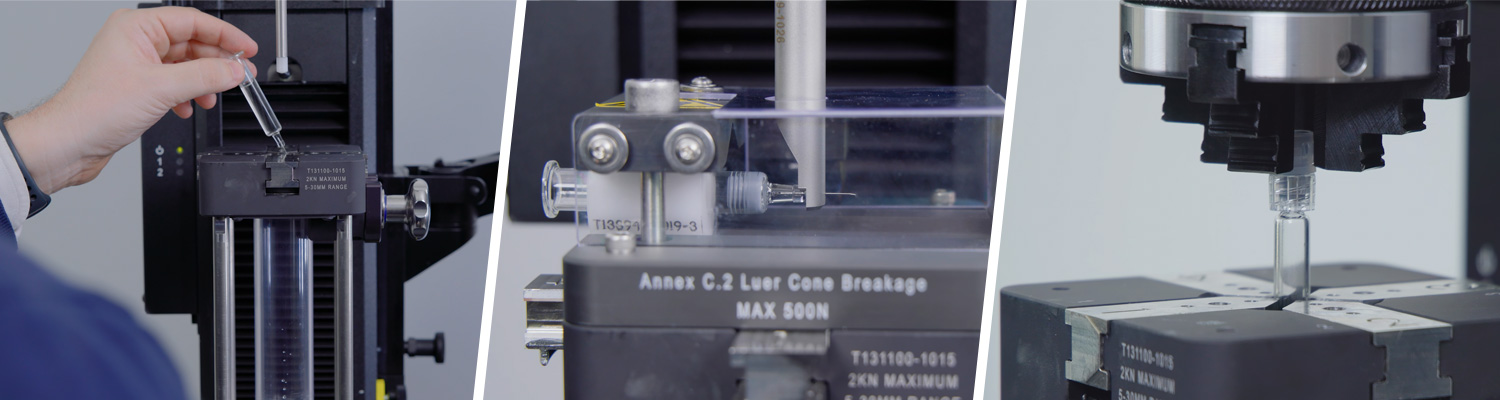
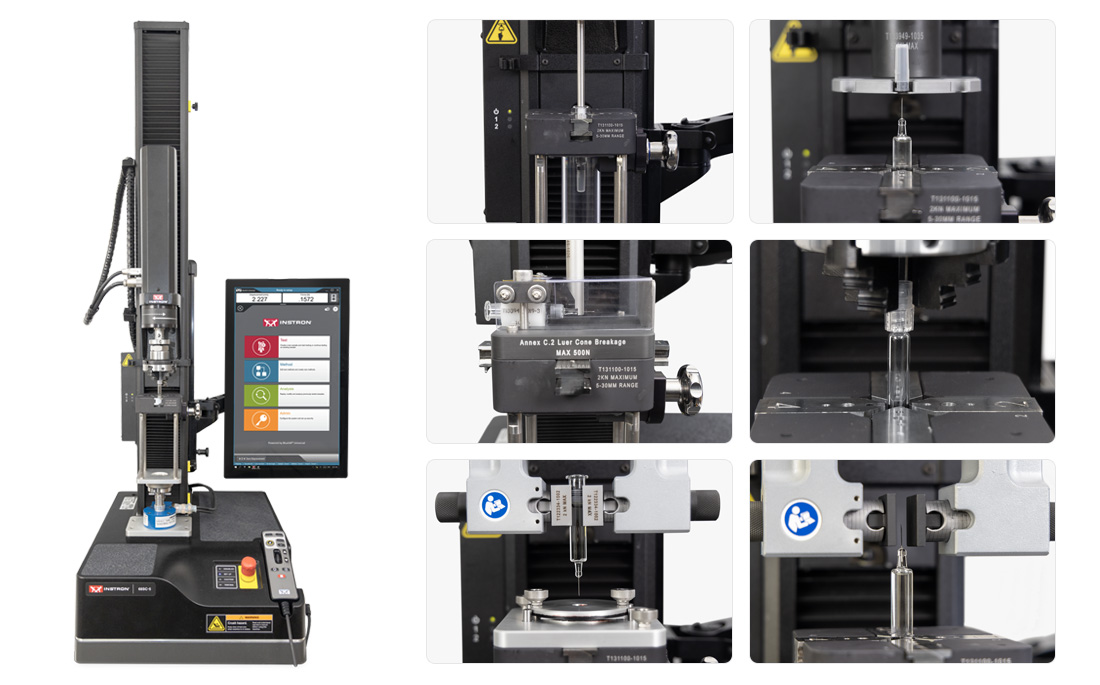
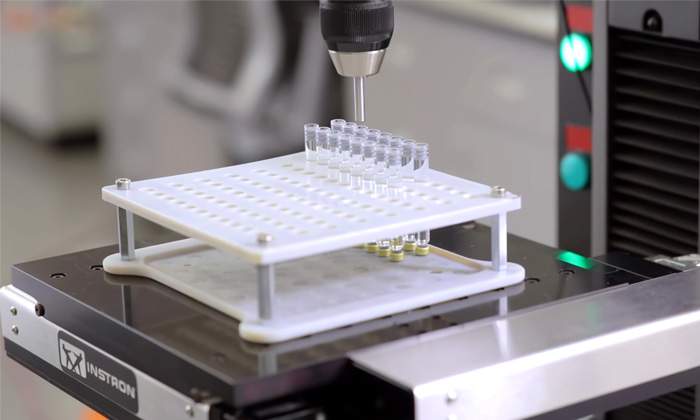
Instron recommends the 68SC-1 universal testing system paired with Bluehill® Universal software as the foundation for ISO 11040 testing. For labs testing to multiple ISO 11040 methods, Instron's ISO 11040 modular fixture can be reconfigured to accommodate a wide range of syringe test types using a single base fixture — eliminating the need for separate dedicated fixtures for each procedure and significantly reducing setup time when switching between tests. Given the hazards associated with glass breakage during syringe testing, integrated protective shields are also strongly recommended as part of any ISO 11040 test setup.
Device closure evaluation — including torque testing for luer lock connections — requires biaxial testing capability. In these cases, the 68SC1 system can be augmented with the Torsion Add-On 3.0, enabling a standard axial universal testing machine to perform combined axial and torsional testing.
For labs subject to 21 CFR Part 11, Bluehill Central's Traceability module provides the electronic records and audit trail functionality required to maintain compliance across all ISO 11040 test data.
Automation Options for ISO 11040 Testing
Automation can significantly improve throughput and repeatability across a broad range of ISO 11040 test methods — spanning both finished syringe devices and individual syringe components.
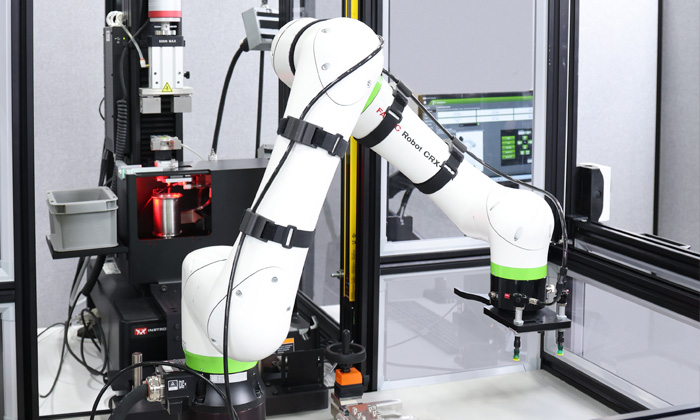
For finished syringe testing, such as break loose and extrusion force or administration time evaluation, a collaborative robot (cobot) paired with a universal testing system can significantly improve lab throughput by automating specimen insertion and removal — essentially functioning as a pick-and-place operation that reduces operator influence and variability. The repeatability of automated specimen insertion also improves device alignment, which is a significant contributor to data spread. Sample racking can be customized to accommodate the full range of prefilled syringe capacities. The cobot is controlled by Bluehill Automation, which is fully integrated with Bluehill Universal — meaning test methods for new devices can be configured quickly and existing workflows carry over seamlessly between manual and automated testing.
For syringe component testing — such as glass barrel, plastic barrel, or plunger stopper evaluation under Parts 4–6 — Instron's AT2 Automated XY Stage offers a high-throughput automation solution. The AT2 enables unattended testing of multiple specimens in sequence, improving lab efficiency and reducing operator variability for high-volume component testing programs.
Compliance Note
Frequently Asked Questions (FAQs)
ISO 11040 focuses on prefilled syringes and their subcomponents, while ISO 11608 addresses needle-based injection systems more broadly, including autoinjectors and pen injectors. The two standards are complementary — devices that incorporate prefilled syringes within a larger injection system may need to be evaluated against both standards depending on their intended use.

Explore Instron Solutions for ISO 11040 Prefilled Syringe Testing
From the testing system to the fixture to the software, Instron has the solutions pharmaceutical and medical device teams need to validate prefilled syringe performance to ISO 11040.

Fixtures and automation designed for prefilled syringe testing, including break loose and glide force, needle penetration force, and cap removal applications.
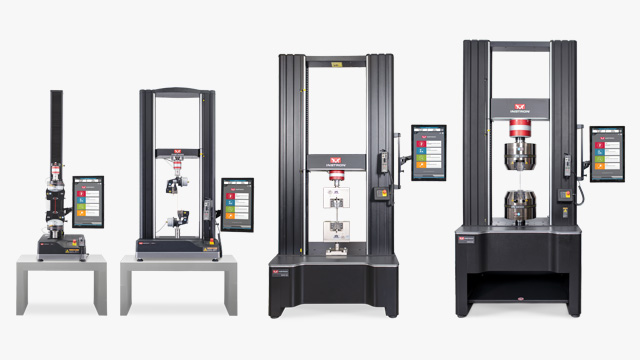
Configurable load frames with the force measurement accuracy, speed control, and accessory compatibility required for the full scope of ISO 11040 mechanical test methods.
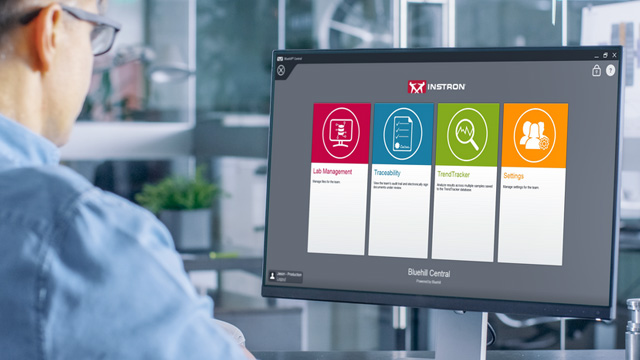
Centralized lab management software with a dedicated Traceability module for meeting 21 CFR Part 11 electronic records and audit trail requirements across all ISO 11040 test data.
or

Talk to an Instron Expert
Get application-specific guidance on testing prefilled syringes to ISO 11040.
About the Author
Landon Goldfarb
Landon Goldfarb is Lead Product Manager at Instron, where he oversees the static testing product management team — collaborating closely with customers and engineering to drive customer-backed innovation across Instron's full static testing portfolio. With deep expertise in highly regulated industries, Landon and his team partner with organizations across a wide range of markets to advance their testing programs — from general quality control to advanced R&D — bringing particular depth and experience to pharmaceutical and medical device customers worldwide.
A trusted industry voice, he contributes to standards development and shares actionable insights through technical publications and conference presentations — championing best practices and advancing the science of medical device testing on a global stage.