Socket Style

Socket Style

Socket Style Torsion Grips

These socket style adapters allow the connection of any 0.5 inch drive socket or accessory directly to the torque cell and/or output shaft on the MT series frames. Smaller drive sockets can be connected through the use of reducing adapters.

English and Metric sockets sets are available in a large range of sizes that allow the testing of fasteners or finished products that have a hex type connection. These adapters are useful for testing the running torque of locking and non-locking fasteners, proof testing of fasteners with torsional loading, or checking the torsional resistance of ratchet, torque wrench, or other type of tool.

Principe de fonctionnement

The Socket Style grip adapters are threaded into or bolted to the output shaft and/or torque cell on the MT series frames. A jam nut is used to fix the threaded adapter in place and maintain it tight for bi-directional testing.

The socket is then pressed onto the adapter and is retained by a spring loaded ball just like any commercial ratchet. Two sockets can be used for testing bolt and nut specimens, or just one socket can be used to tighten or loosen fasteners in parts that must be held in a custom fixture.

Domaine d'application

  • Types of Loading: torsion Specimen
  • Material: various 
  • Specimen Types: round, finished products

Accessoires

Mechanical Wedge Lever Action Grips

Mechanical Wedge Lever Action Grips

Mechanical Wedge Action Grips (Lever Operated)

T-Grip Holders are available in load capacities from 22.2 to 150 kN (5,000 to 33,750 lbf.) These economical and versatile assemblies are designed for simplified specimen insertion and removal, a feature that saves time and reduces operator fatigue, increasing productivity in repetitive testing operations.

Engineered to be adaptable to both hydraulic and electromechanical UTM's, most T-Grip Jaw Holders are available with an open front style that assists with simple insertion and removal of test specimens. 

An assortment of interchangeable jaws will fit in the T-Grip holders, which allows for the acceptance of a range of sizes in both flat and round specimens. To increase the ease of operation, the locking mechanism of the lower holder keeps the grip jaws open so that one-handed specimen insertion is possible. 

The upper and lower grip bodies are structurally the same. Each grip body has a pocket that holds a pair of grip jaws and utilizes a wedge design. This wedge design causes the grips to further tighten as load on the specimen is applied, reducing occurrences of slippage.

Principe de fonctionnement

T-Grip Holders are available with two types of actuation, lever/spring or screw type.

All capacities of T-Grips are offered with lever/spring actuation, which uses a lever to raise and lower the jaws in the grip pocket and a spring to provide the initial clamping force on the specimen. When loading a specimen, the operator locks the bottom jaw open, then opens the upper jaw and places the top half of the specimen inside. Once the specimen is clamped securely within the upper jaw, the operator positions the bottom half of the specimen into the lower grip jaws and unlocks the jaws, providing clamping force and securing the specimen so that the test may be conducted. 

In the screw type actuation (offered in the 20,000 pound capacity model), a mechanical screw actuator, which is operated manually by turning a handle, opens and closes the grip jaws. This screw actuation provides a more secure initial gripping force and is ideal for hard materials testing where occurrences of slippage are prevalent.

Domaine d'application

  • Type of Loading: static tension 
  • Specimen Material: wires, plastics, metals, elastomers 
  • Specimen Types: flat or round specimens

Accessoires

Machines de Fatigue entièrement électriques ElectroPuls

Machines de Fatigue entièrement électriques ElectroPuls

Loadframe accessories for Electropuls systems include a high stiffness support table and safety guards.

Accessories

3 and 4 Point Fatigue Flexure Fixtures

3 and 4 Point Fatigue Flexure Fixtures

3 and 4 Point Fatigue Flexure Fixtures

The flexure fixture allows a variety of flexural and fracture toughness bond tests to be performed, including determination of flexural modulus, flexural strength and flexural yield strength. 

Easy to install, the 3 point fixture can be modified with an optional conversion kit to provide a 4 point bending conversion. 

Lower anvils are adjustable to accommodate specimens of different spans. Deflection of the specimen can be measured either through crosshead displacement, or for more precise measurement use the mid span direct measurement deflectometer plunger with clip on extensometer.
T

Principe de fonctionnement

The specimen is supported on two precision machined (free to rotate or stationary) anvils of a defined radius. The force is applied either centrally (3 point) or at a defined distance either side of the center (4 point). The support beam is graduated lengthways in metric units for accurate positioning of the anvils, equally spaced to the center line.

This feature also applies to the 4 point loading beam and anvils.

Domaine d'application

  • Type of loading: static flexure, cyclic flexure tests. 
  • Specimen material: plastics, metals, alloys, composites, ceramics and other materials. 
  • Specimen shapes: strip, bar, components.

Accessoires

Air Cushion Isolators

Air Cushion Isolators

Air cushion isolators for 8800 Series

Air cushion isolators provide an effective method for reducing the transmission of vibration to and from a servo-hydraulic test system.

Principe de fonctionnement

Air cushion isolators are attached to the machine between the loadframe and the floor. The isolator is effectively a balloon which is inflated with compressed air to provide vibration absorption. Air cushion isolators are effective at frequencies above 15 Hz.

Domaine d'application

  • Reduction of transmitted vibration from servo-hydraulic test systems

Accessoires

Paper and board

Paper and board

Paper and paper board testing is important to the pulp and paper industry because of the demands placed upon it for a wide range of applications. 

In printing, for example, paper is handled from either cut sheets or rolls (webs) and the tensile strength and elongation properties must meet stringent customer requirements. In packaging, testing of corrugated paper is performed to measure the resistance of edgewise compression.

Principe de fonctionnement

TAPPI standards are applied for standard testing practices. Edgewise compression strength is tested per T-472 using special fixturing. Tensile breaking strength per T-404 is performed by using a set of Screw or Pneumatic side action grips with appropriate faces.

Domaine d'application

  • Testing method: Tensile, compression, puncture 
  • Specimen type: Paper (dry and wet), corrugated board (dry and wet)

Accessoires

Item NameTesting StandardsCat#
TAPPI T541 Internal Bond Strength of Paperboard. Z-Direction Tensile.TAPPI T541S1-11814

Chuck Style

Chuck Style

Chuck Style Torsion Grips

These universal drill-type chuck grips can be used to hold round, hex or triangular specimens. The standard sets are available in both a keyless and keyed style that can hold a range of specimen sizes. 

Keyless operation lets you rapidly grip and release specimens. A comfortable, sure-grip sleeve allows you to hand-tighten the chucks. 

Keyed operation provides fast, easy tightening as well as quick, nonstick release.

Principe de fonctionnement

The Chuck Style grips are threaded into or bolted to the output shaft and/or torque cell of MT series frames. 

The chuck grips spin closed to clamp specimens during torsion testing. The jaws of these grips extend well beyond the chuck nose to accept a broad range of wires, cables, and cylindrical specimens. Both keyed and keyless chucks are available for gripping a variety of specimen diameters and include adapters for mounting to an MT series frame.

Domaine d'application

  • Types of Loading: torsion 
  • Specimen Material: various 
  • Specimen Types: round, hex, triangular

Accessoires

Axial-Torsion Wedge Grips

Axial-Torsion Wedge Grips

Axial-Torsion Wedge Grips

The application of both axial and torsional forces simultaneously under fatigue conditions requires special grip design. These grips utilize a wedge-action gripping technique making them suitable for flat specimens as well as cylindrical.

Principe de fonctionnement

The major grip components are the grip driver, wedge grip head, grip attachment flange and jaw faces.

The grip driver applies the clamping force to the grip head by moving it relative to the jaw faces.This causes the the jaw faces to clamping the specimen. 

The grip drive also incorporates 3 sets of anti-rotation sliders that transfer any applied torque from the actuator to the grip and specimen. The jaw faces are either serrated or V-grooved to accommodate flat or cylindrical specimens.

Domaine d'application

  • Axial/Torsion tests on flat or cylindrical specimens

Accessoires

8800 Series

8800 Series

8800 Series Digital Controller Strain Conditioners

In order to input the signal from an optional extensometer or other strain transducer, it is necessary to have a strain channel fitted to the 8800 controller.The strain channel provides excitation and signal conditioning for strain gauge and LVDT devices and can also accept high level 0-10V analog input signals.

Two versions are available, one for monitoring only and one for monitoring and control.Required for strain input to FastTrack 8800 controllers from optional strain measurement transducers

Principe de fonctionnement

The strain channel provides excitation and signal conditioning for strain gauge and LVDT devices and can also accept high level 0-10V analog input signals.

Two versions are available, one for monitoring only and one for monitoring and control.

Domaine d'application

In order to input the signal from an optional extensometer or other strain transducer, it is necessary to have a strain channel fitted to the 8800 controller.

Accessoires

Hydraulic Wedge Action Grips

Hydraulic Wedge Action Grips

Hydraulic Wedge Action Grips

Hydraulic wedge action grips feature an open front design, which facilitates easy loading of large specimens. This series can accommodate round specimens up to 90 mm (3.54 in) in diameter and flat specimens up to 90 mm (3.54 in) thick with capacities ranging from 300kN (67,500 lbf) to 2000kN (450,000 lbf).

Specially suited for industrial environments where dust and metal chips may be present, these grips have protective dust covers that fit easily over the faces to shield the moving surfaces. Optional adapter plates furnish an efficient method for mounting secondary load strings for lower capacity testing or other fixturing without removing the larger grip. 

Principe de fonctionnement

These grips are hydraulically operated via a manually rotated knob on the front of the grip. The grip body does not move during closing or opening. Hydraulic supply is typically from the main machine frame via a grip sub-manifold. Jaws are separable inserts held in a jaw carrier which are easy to install with no need to re-grease when changing jaw faces. Grip bodies have grease fittings to allow easy re-greasing of the carrier when needed. W-5380 and W-5390 feature magnetic seating.

Domaine d'application

  • Type of loading: tension, *Not suitable for through-zero/ reverse stress or fatigue testing 
  • Specimen material: metals 
  • Specimen shapes: flat, round

Accessoires

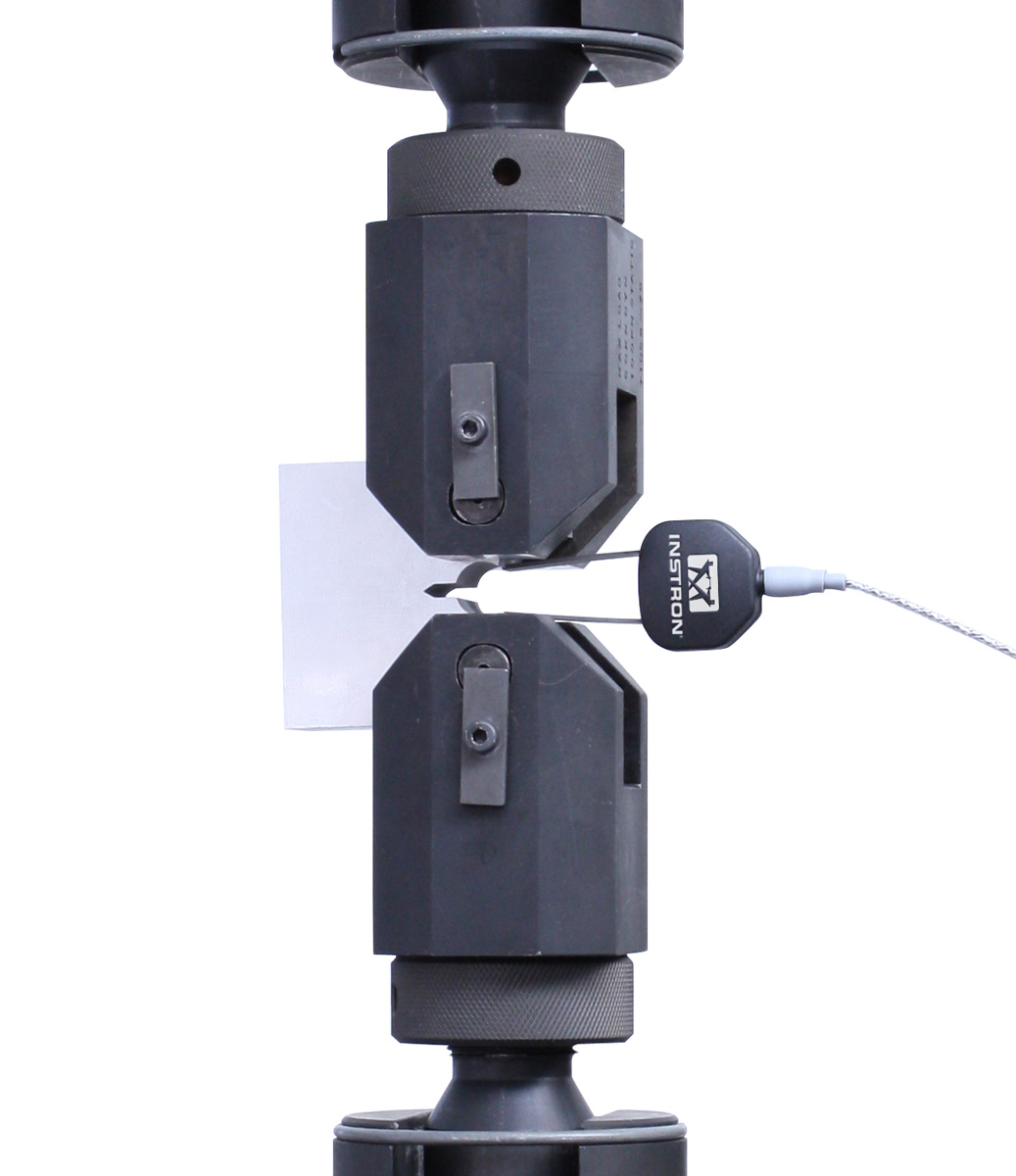
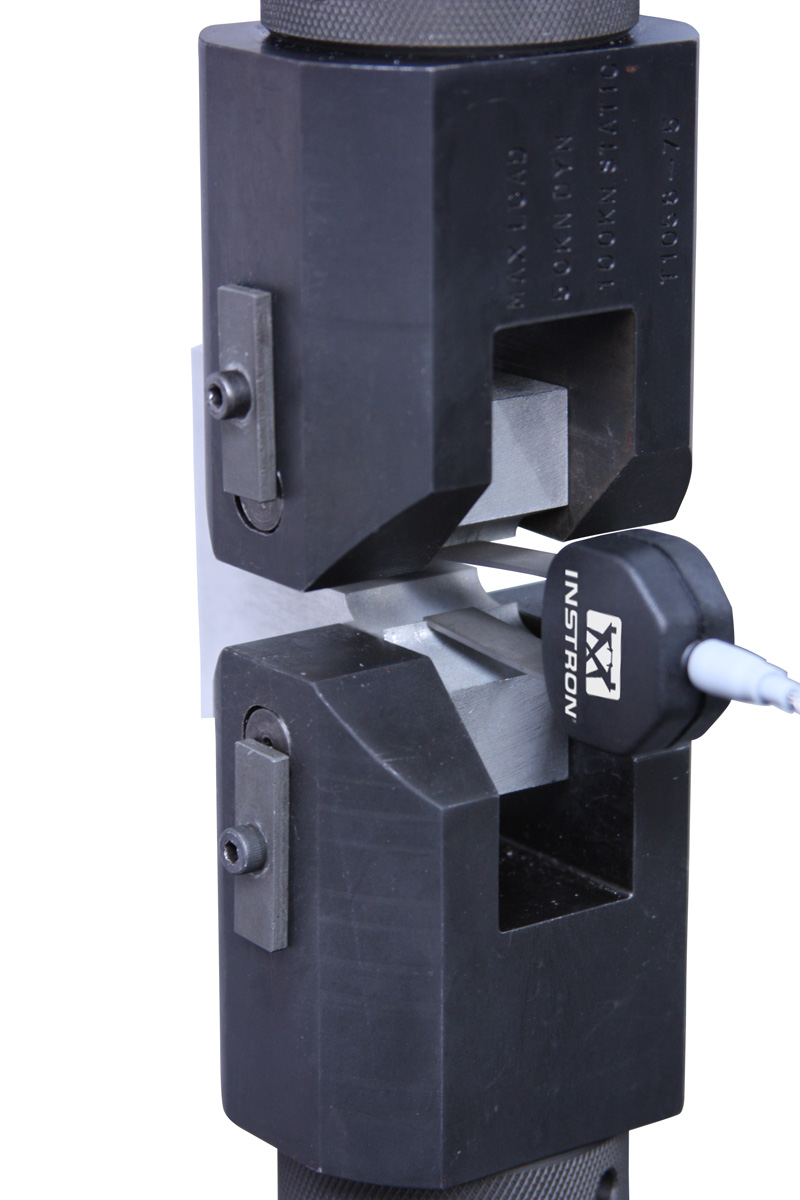
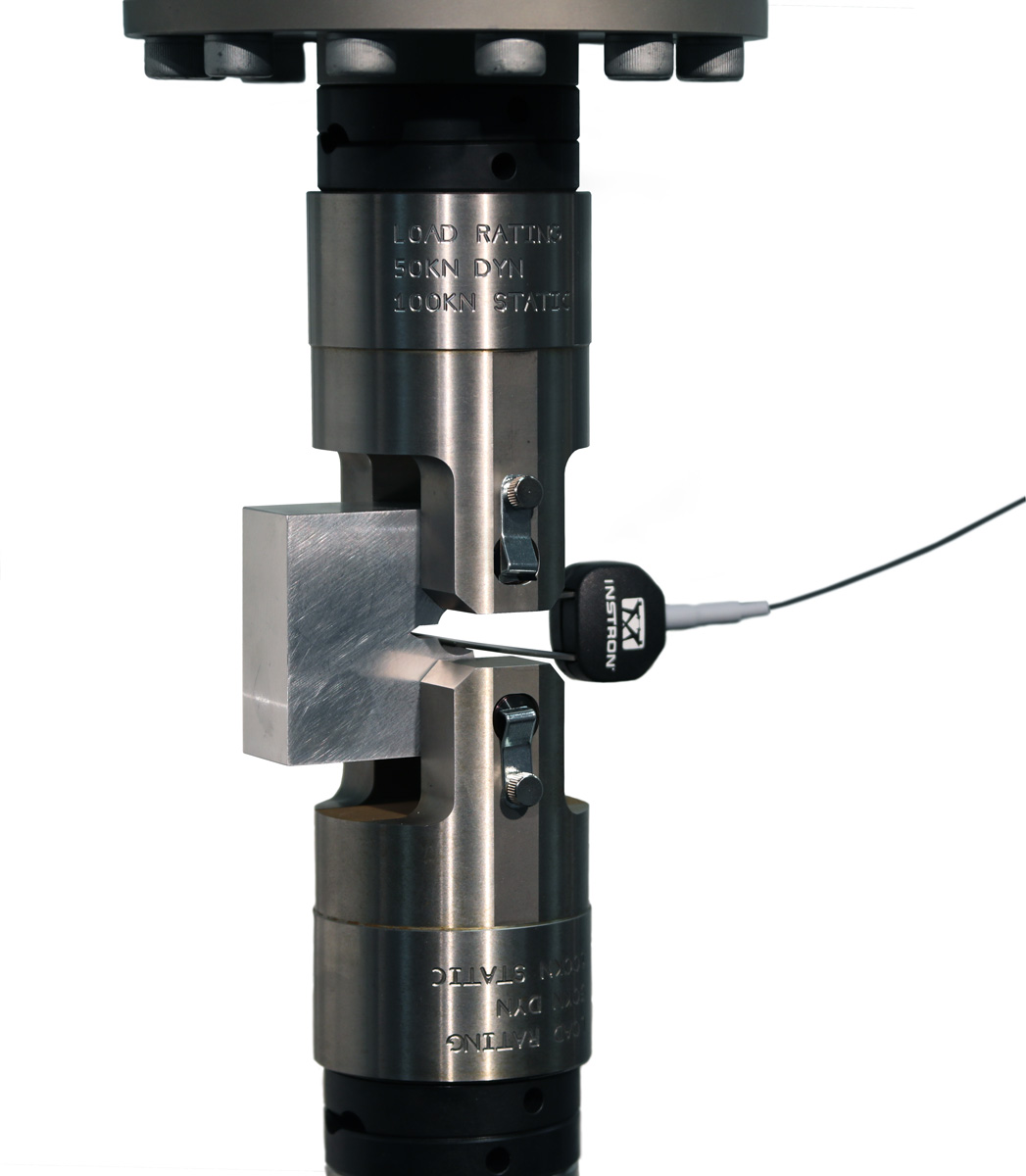
Jauges de déplacement d’ouverture de Crack (COD)

Les jauges de déplacement d'ouverture de Crack (COD) sont conçues pour les essais de ténacité à la rupture (cycliques et statiques) selon les normes BS 7448, ASTM E399, ASTM E561, ASTM E1290, ASTM 1820, ISO 1820 et ISO 12135 en mesurant le déplacement entre deux faces d'un crack dans un matériau sous charge appliquée. Ces données sont utilisées pour évaluer la ténacité à la rupture et la résistance à la propagation des cracks.

Crack Opening Displacement Gauge

Crack Opening Displacement Gauge

Jauges de déplacement d'ouverture de crack
Série 2670
Les jauges de déplacement d'ouverture de crack de la Série 2670 sont compatibles avec toutes les géométries d'échantillons courantes, y compris CT, SEB, fissure centrale et en forme d'arc. Chaque modèle offre une linéarité de premier ordre, tout en étant suffisamment robuste pour résister à la libération d'énergie élevée courante dans nombre de ces applications, et peut être utilisé à des températures élevées et inférieures à la température ambiante (de -200 °C à +200 °C, de -328 °F à +392 °F).
Ces jauges sont conformes aux exigences de la norme ASTM E399-09 :
Longueur initiale course maximale numéro de catalogue
5 mm (0,20 po) 2 mm (0,08 po) 2670-130
10 mm (0,39 po) 4 mm (0,16 po) 2670-132

Plus d'informations

Dispositifs pour tests alimentaires

Les accessoires d’Instron pour les essais alimentaires couvrent un large éventail de méthodes d’essai normalisées, notamment la compression, la perforation, le cisaillement et l’extrusion. Une variété d’enclumes, de sondes, d’accessoires de cisaillement et d’accessoires d’extrusion sont disponibles pour la R&D, l’assurance qualité et les essais de contrôle des processus. Chaque accessoire est fabriqué avec des matériaux durables et résistants à la corrosion. Tous les accessoires peuvent être montés avec un bac d’égouttement pour aider à garder la zone d’essai propre lors de l’évaluation de la texture des aliments humides ou facilement fracturés.

2830-005 Puncture Probes
2830-005 Puncture Probes 2830-005 Puncture Probes (Flat)

Ensemble de sondes de perforation
Numéro de catalogue 2830-005

Un ensemble de neuf sondes cylindriques à extrémité plate pour les essais de perforation, dont une sonde pour dénoyauter les cerises. Ces sondes sont fabriquées en acier à outils nickelé pour une combinaison de résistance et de résistance à la corrosion.

Longueur totale Diamètre Type d’extrémité
152 mm (6 po) 1,59 mm (0,0625 po) Plate
152 mm (6 po) 3,18 mm (0,125 po) Plate
152 mm (6 po) 4,76 mm (0,1875 po) Plate
152 mm (6 po) 6,35 mm (0,25 po) Plate
152 mm (6 po) 7,94 mm (0,3125 po) Plate
152 mm (6 po) 9,53 mm (0,375 po) Plate
152 mm (6 po) 11,28 mm (0,444 po) Plate
152 mm (6 po) 12,7 mm (0,5 po) Plate
152 mm (6 po) 10,16 mm (0,4 po) Dénoyauteur de cerises

Plus d’infos

2930-015 Magness-Taylor Probes Extension

Sondes de perforation Magness-Taylor
Numéro de catalogue 2830-015

Un ensemble de sondes Magness-Taylor pour les essais de texture des fruits et légumes. L’ensemble comprend des sondes standard de 7,9 mm et 11,1 mm de diamètre avec des pointes hémisphériques. Chaque sonde a une rainure usinée à 8,8 mm (0,34 po) de l’extrémité pour indiquer la profondeur de pénétration.

Longueur totale Diamètre Rayon Type d’extrémité
125 mm (5 po) 7,9 mm (0,31 po) 4,95 mm (0,19 po) Ronde
125 mm (5 po) 11,1 mm (0,44 po) 8,8 mm (0,35 po) Ronde

Plus d’infos

S5410A Ball-End Probe

Sondes à extrémité sphérique
Numéro de catalogue S5410A

Un ensemble de cinq sondes à extrémité sphérique en acier inoxydable pour la résistance à la corrosion.

Longueur totale Diamètre Type d’extrémité
150 mm (6 po) 2 mm (0,08 po) Sphérique
150 mm (6 po) 4 mm (0,16 po) Sphérique
150 mm (6 po) 6 mm (0,24 po) Sphérique
150 mm (6 po) 8 mm (0,31 po) Sphérique
150 mm (6 po) 10 mm (0,39 po) Sphérique

Plus d’infos

Three Jaw Chuck
Three Jaw Chuck Three Jaw Chuck With Probe

Mandrin à trois mors
Numéro de catalogue 2830-036

Un mandrin à trois mors est nécessaire pour monter les sondes sur le capteur de force. Le mandrin peut contenir des tiges de sonde jusqu’à 13 mm de diamètre. La conception sans clé simplifie le montage et le changement des sondes.

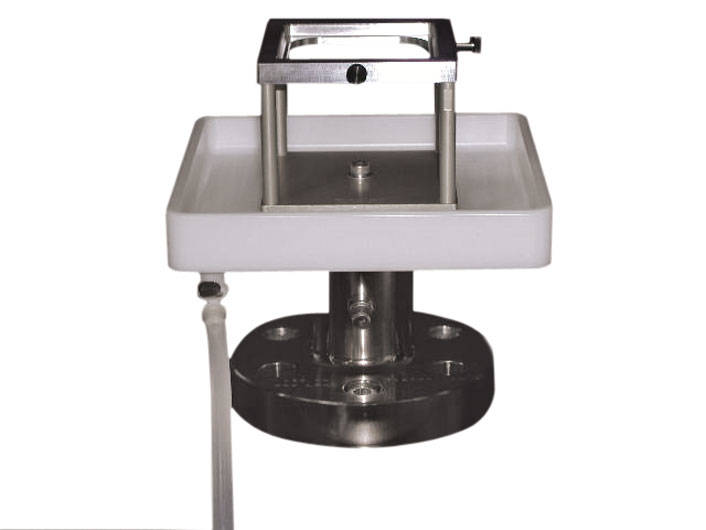
Food Drip Tray Under Test
Food Drip Tray Under Test S5400A Food Fixture Drip Tray

Bac de récupération pour accessoires pour produits alimentaires

Le bac d’égouttement pour accessoires alimentaires est utilisé pour garder la zone d’essai propre lors de l’essai d’aliments humides ou facilement fracturés.

Description Numéro de catalogue
Bac d’égouttement pour accessoires alimentaires S5400A
Cadre de support pour accessoires alimentaires S4427A
Ensemble de plaques de support d’échantillon ; Comprend :

  1. Plaque sans trou
  2. Plaque avec un trou traversant de 15,9 mm (0,625 po) de diamètre avec un fraisage en forme de cuvette de 12,7 mm (0,5 po) de rayon
  3. Plaque avec un diamètre de 22 mm (0,866 po) se rétrécissant vers un trou de 15,9 mm (0,625 po)
  4. Plaque avec un diamètre de 70 mm (2,8 po) se rétrécissant vers un trou de 15,9 mm (0,625 po)
S5401A

Contactez-nous pour plus d’informations

Kramer Shear Cell
Kramer Shear Cell

Accessoires supplémentaires pour les essais alimentaires

Instron propose une gamme d’accessoires pour les essais de texture des aliments, notamment un accessoire de cisaillement de la viande Warner-Bratzler (numéro de catalogue S5406A), une cellule de cisaillement Kramer à cinq lames (numéro de catalogue S5403A), une cellule alimentaire d’extrusion arrière (numéro de catalogue S5405A) et une enclume de compression (numéro de catalogue S5402A). Notre groupe de solutions d’ingénierie est également disponible pour prendre en charge le développement d’accessoires personnalisés afin de répondre aux exigences spécifiques des applications.