Tension Testing of Cables and Wires
Electrical cables and wires are core components of any electronic system. Wired accessories, such as headphones and charging cables, are essential to both the device and the user. Today's automotive assemblies, especially in electric vehicles, contain significantly more electrical wires and cable harness components, used to transmit power and the signals that control powertrain operations, on-board diagnostics, dashboard controls, and more.
As a result, it has become increasingly important for OEMs to understand the reliability of cables and wires under different operating conditions. Damage to these components causes a greater risk of product failure, especially in vehicles. The assembly of cable harnesses and wires can also introduce risk of damage from handling and packaging. Environmental conditions can degrade cable insulation, exposing the copper conductors and potentially causing functional failures.
Recommended Testing Solutions
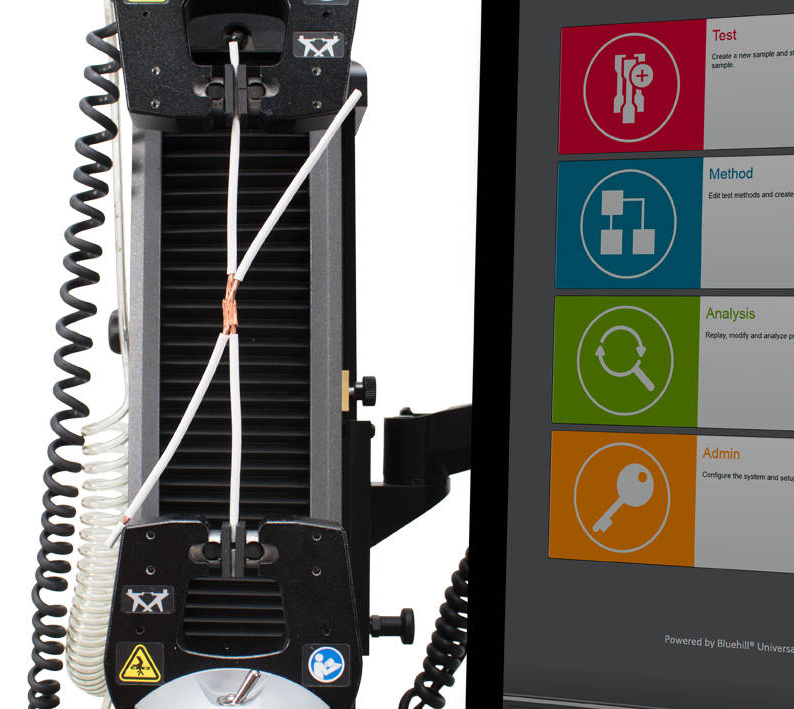
Tensile testing is one of the recommended mechanical test methods for analyzing the reliability of cables and wires, and can be performed on Instron 6800 Series and 3400 Series Universal Testing Systems.
Instron® offers a wide variety of gripping solutions designed to hold cables of different sizes, and pneumatic grips are commonly recommended for wires and harnesses. Environmental chambers can be set up with Instron universal testing systems and Bluehill® Universal Software, with pre-heat and pre-cool features available to simulate real operating conditions during testing.
Extensometers can be used to measure strain and Young's modulus, while Bluehill Universal Software reports tensile strength, giving OEMs clear data on the force required to break a cable. For unique specimens, Instron's Custom Solutions Group develops custom fixtures and accessories based on your sample constraints and requirements.

Talk to an Instron Expert
Not sure which grips or accessories fit your cable and wire testing needs? Tell us about your application and we will help you find the right solution — no guesswork required.
Talk to an Applications Engineer
Tell us about your testing needs, and we'll help you configure the right frame, load cell, grips, and software for your lab. Please complete the form below, and we'll respond within 1-2 business days. For a faster response, call +1-800-473-7838 or +1 781 828 2500 if you are outside of the US.