How Baowu Group Solved Variable-Frequency Fatigue Testing with ElectroPuls™
Facing new testing demands from the rise of new energy vehicles, Baowu Group's Central Research Institute needed a solution for fatigue testing under variable amplitude, frequency, and temperature — conditions traditional servohydraulic and electromagnetic resonance machines couldn't handle. The Instron ElectroPuls E10000 combined high-frequency capability with programmable variable-amplitude testing in a compact, low-maintenance system, giving Baowu's team a versatile tool for materials ranging from steel to lightweight plastics.

About
Baosteel and WISCO — leaders of China's steel industry — merged in September 2016 to form Baowu Iron & Steel Group, now the largest steel group in China. Baowu is pursuing three transformation strategies: from steel to materials, from manufacturing to service, and from a leader in China to a leader in the world's steel industry.
Location
China
Website
To comply with its three transformation strategies, the Mechanics Laboratory of Baowu's Central Research Institute (Technical Center) has made significant efforts in the field of industrial materials — particularly new energy materials — through mechanical properties evaluation and test method development for raw steel materials.
Research and development of materials and applications must keep pace with real-world demands. Consider what happens when a vehicle accelerates: the driving mechanism speeds up, reaches a stable running rate, then brakes and decelerates. This cyclic behavior exposes materials to loading frequencies that shift from high, to low, to constant. One typical application is the steel used in the electrical machinery of new energy vehicles. Traditional fatigue tests using constant amplitude and frequency can no longer address the technical challenges posed by these newer materials — changes in environment, speed, amplitude, and frequency have become central topics in new energy automotive materials research.

"Long-term mechanical performance studies of materials under variable frequency and amplitude will be the future trend," said Dr. Fang. "However, in China, we still follow test standard GB/T 15248-2008, Low Cycle Fatigue Test of Metal Materials Under Axial Constant Amplitude, which clearly can't meet the test requirements of these new materials. There's already an international standard — ISO 12110-1:2013, Metallic Materials — Fatigue Testing — Variable Amplitude Fatigue Testing — Part 1: General Principles, Test Method and Reporting Requirements — for testing this kind of material, but a corresponding Chinese standard hasn't been released yet."
With the rise of new energy vehicles and support from the Chinese government, many well-known vehicle manufacturers — including Tesla, Volkswagen, and General Motors — have already established their own materials fatigue test standards. New concepts such as variable amplitude, variable frequency, and variable temperature testing place new demands on global material suppliers. For materials suppliers including Baowu Steel, finding the right test solutions quickly has become a pressing new challenge.

"Long-term mechanical properties of materials under variable frequencies and amplitude will be a trend in the future. For a traditional servohydraulic machine, its frequency range is too small, maintenance costs are high, and there's a lot of noise while a test is running. If we want to test the fatigue of ultra-thin steels, traditional electromagnetic resonance high-frequency fatigue testing machines are also difficult to control. Both challenges urge us to find new solutions."
Dr. Jian Fang
Chief Engineer of Mechanical Testing, Central Research Institute, Baowu Group
Finding a New Testing Solution
Since this is an emerging challenge, breaking through traditional test methods to find efficient solutions is critical. As chief technician, Dr. Fang brings extensive experience testing metal materials — and in his view, while there are many ways to run fatigue tests, few devices can measure accurately under variable amplitude, frequency, and temperature simultaneously.
Electro-hydraulic servo fatigue testing machines are commonly used for materials fatigue testing under variable amplitude, frequency, and temperature, but their frequency capacity is limited to only a few dozen hertz — insufficient for high-frequency testing needs, and inefficient. Electromagnetic resonance high-frequency fatigue testing machines can handle high-frequency testing, but lack the ability to test under variable frequency and amplitude — a particular challenge when testing lightweight materials.
"On one hand, traditional electro-hydraulic servo fatigue machines are inefficient, since the hydraulic pump station is costly to maintain and generates a lot of noise," Dr. Fang explained. "On the other hand, traditional electromagnetic resonance high-frequency fatigue testing machines are difficult to control when running fatigue tests on some ultra-thin, consumer-grade steels. These challenges pushed us to find new solutions to fatigue testing."
Dynamic and static electronic fatigue testing machines cost little to maintain and can test under variable amplitude and frequency, combining the high-frequency capability of electromagnetic resonance machines with the programmable variable amplitude and frequency of low cycle fatigue testing machines. This makes them well suited to mechanical testing of ultra-thin and lightweight materials. They also occupy a small footprint, are easy to maintain, and require no cooling water or hydraulic oil — running instead on a single-phase power supply with low power consumption. Dr. Fang was immediately drawn to the well-designed, versatile dynamic and static electronic testing machine from Instron at an industry exhibition.
Testing for What's Next, Not Just What's Known
"For traditional fatigue tests, we often chose frequencies as high as possible, hoping to reach the fatigue limit in a short period," said Dr. Fang. "But fatigue testing for new materials has changed — we're now curious what will happen to the fatigue properties of steel under variable amplitude or variable frequency conditions."
"All of these tests can be run using the Instron E10000, and the results have been well received by our customers," Dr. Fang said. "In addition to metallic materials, we also use the E10000 to test food-grade lightweight materials and plastics. In summary, from low-speed static testing to high-frequency closed-loop dynamic testing, the ElectroPuls static and dynamic testing machine can fulfill all of our test requirements."
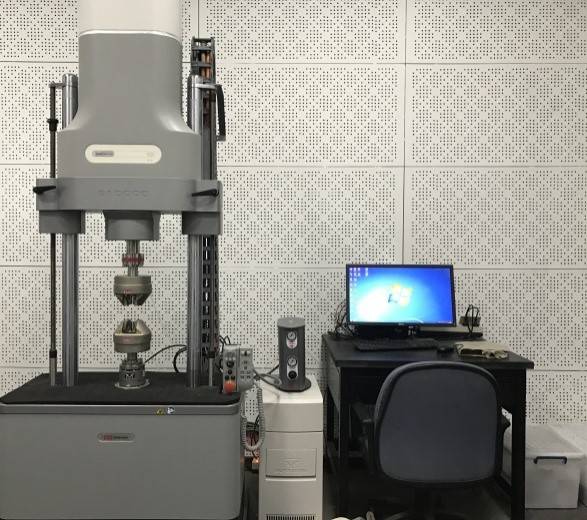
Dr. Fang also emphasized that a significant advantage of working with Instron is that accessories can be shared across the product line — load cells, fixtures, and extensometers can all be configured across the same series of instruments, saving customers time and cost. "For example, the Instron AVE extensometer can be used across our lab, from a 1-ton static machine to a 25-ton dynamic machine," said Dr. Fang.
Although the Instron E10000 had been installed and in use for less than a year at the time of writing, Baowu's technicians had already accumulated significant experience in variable amplitude and frequency fatigue testing using the system. As the new energy industry continues to grow, Instron's ElectroPuls static and dynamic testing machines are expected to find an even wider range of applications.

Talk to an Instron Expert.
Not sure if the ElectroPuls E10000 fits your variable-frequency or fatigue testing needs? Tell us about your application and we will help you find the right solution.
Talk to an Applications Engineer
Tell us about your testing needs, and we'll help you configure the right frame, load cell, grips, and software for your lab. Please complete the form below, and we'll respond within 1-2 business days. For a faster response, call +1-800-473-7838 or +1 781 828 2500 if you are outside of the US.