How Siemens Uses Machine Learning and ElectroPuls to Predict Fatigue in 3D-Printed Parts
Using real-world fatigue data from an Instron ElectroPuls E10000 system, Siemens Digital Industries Software developed a machine learning method that predicts fatigue performance in 3D-printed metal components that have never been physically tested — reducing the time and number of tests needed to characterize additively manufactured parts.

About
Siemens AG is a German multinational company focused on industrial automation, building automation, rail transport, and health technology. It is the largest engineering company in Europe and a global market leader in industrial AI, automation, and industrial software.
Location
Munich, Germany
Website
Additive manufacturing (AM), also known as 3D printing, describes a number of manufacturing techniques that build three-dimensional parts layer by layer, using only the material that makes up the final component. AM processes not only allow for highly complex, structurally efficient parts, but also greatly reduce the waste material associated with subtractive techniques such as machining from a larger material volume.
Siemens has taken data from a test campaign carried out on an ElectroPuls E10000 fatigue testing machine, optimized for fatigue testing of additively manufactured products. This data was used to assess the challenges associated with AM for metal alloys and to offer a solution to some of those challenges through Siemens Digital Industries Software.
Why Predicting Fatigue in 3D-Printed Parts Is So Difficult
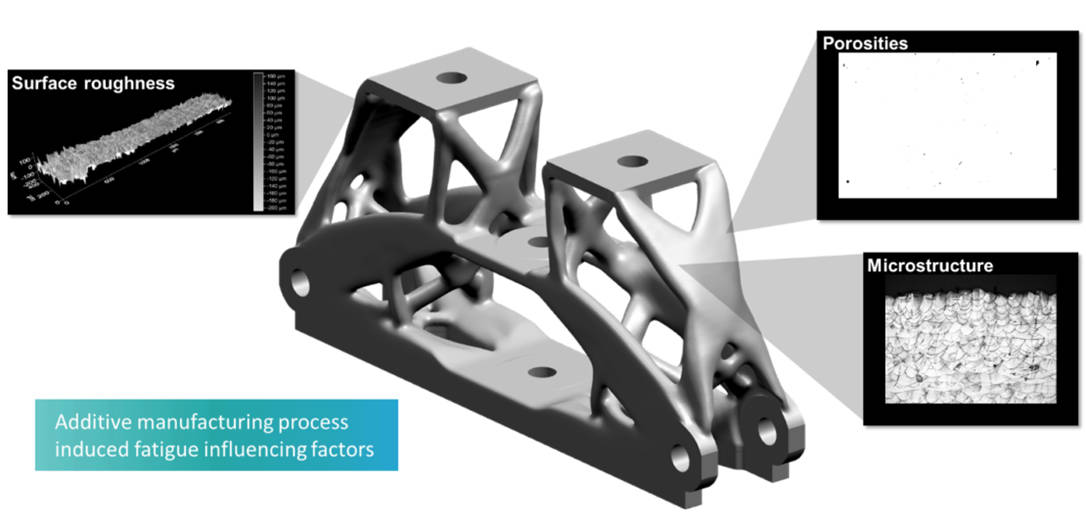
The fatigue performance of a metallic component is determined by features within the material's microstructure and the geometry of the specimen. As with any manufacturing technique, components produced through AM contain features inherent to the process — residual stresses, porosities, or differences in surface roughness — and their presence depends heavily on the local geometry of the component, as shown in Figure 1. This means the relationship between a component's geometry and the microstructural features that dictate its fatigue performance becomes highly complex; mathematically modeling the interaction between these features, and each feature's individual impact, becomes effectively impossible.
For manufacturers producing performance-critical components, investigating fatigue characteristics typically means heavy reliance on prototype testing and extensive, expensive testing campaigns. This is due to a lack of computer-aided engineering (CAE) tools capable of predicting how dynamic performance differs depending on the array and combination of features found locally within each component.
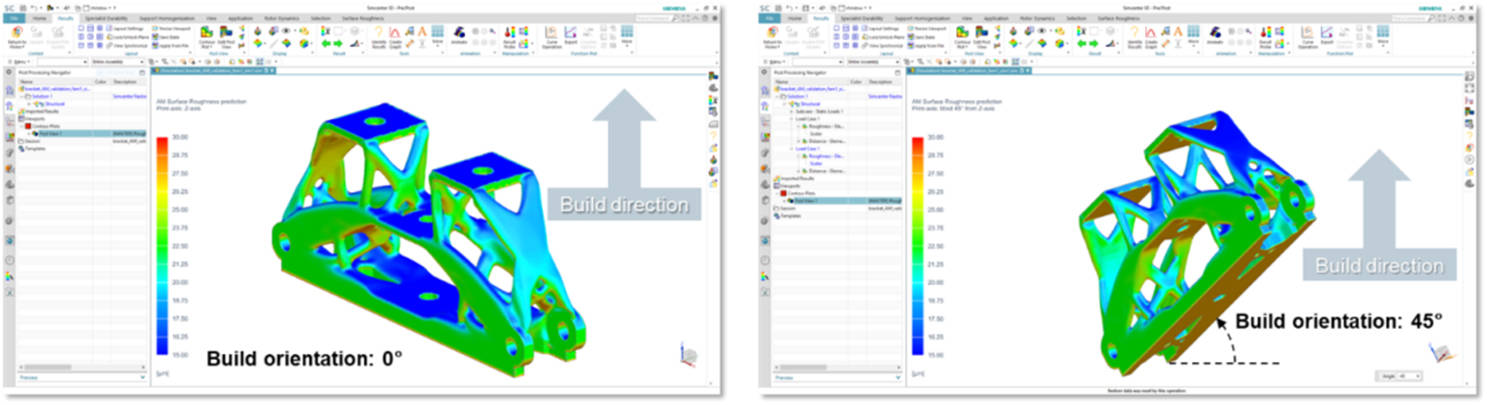
Surface roughness is a clear example of how local features can differ across 3D-printed components, since parts are built up through overhanging layers of material by a small amount, as shown by the differing distributions in Figure 2. Manufacturers must therefore print and test parts in as many orientations as possible to determine which produces the best fatigue characteristics.
It isn't feasible to test every build orientation or assess every combination of microstructural features — not to mention the effects of loading conditions, residual stresses, and post-treatments. Nonetheless, for 3D-printed parts to be used in safety-critical scenarios, these effects must be reliably predicted.
A Machine Learning Solution
Through machine learning, Siemens Digital Industries Software can assess the fatigue performance of 3D-printed components that have never been mechanically tested. The methodology was evaluated on specimens printed by 3D Systems according to a fixed set of processing parameters, with fatigue testing and analysis performed by the Additive Manufacturing team at KU Leuven's Mechanical Engineering Department, using an Instron® ElectroPuls E10000.
With its integrated T-slot table, the ElectroPuls E10000 from Instron is optimized for fatigue testing of additively manufactured products. Its all-electric design, paired with user-friendly WaveMatrix™3 software and features such as patented Stiffness Based Tuning, combine into a versatile, highly effective system for testing within a small footprint. Simple connectivity to strain gauges, DIC cameras, and a host of other sensors allows users to record detailed strain mapping across the surface of complex test components — making it faster and easier than ever to produce a detailed dataset for a test campaign.
From the real-world S-N data acquired by the ElectroPuls system, the software can then predict the S-N curve for untested combinations of conditions.
The machine learning approach uses Gaussian Process Regression — a method that provides a probability distribution for outcomes based on a minimal set of input data, offering advantages over classical interpolation or extrapolation approaches.
From Test Data to Durability Predictions
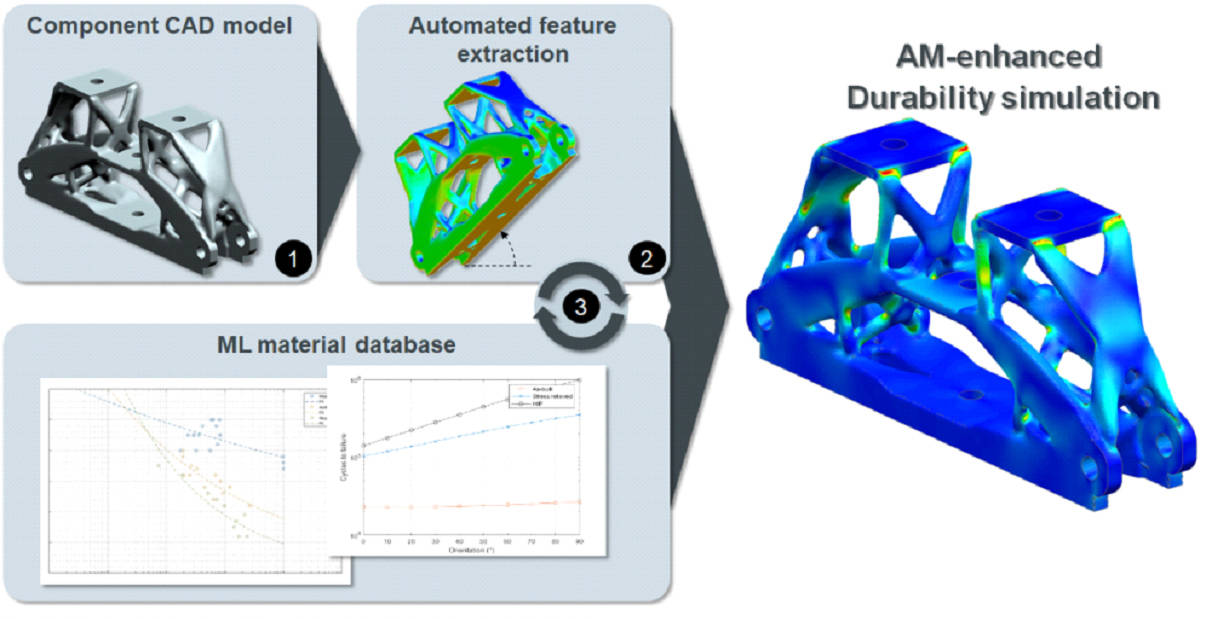
After incorporating machine learning into the Siemens Simcenter 3D Specialist Durability software, fatigue properties can be defined by region or element, including additional material treatments. From the CAD model, the system identifies fatigue-affecting features in the component, and the machine learning algorithm predicts local S-N curves corresponding to different surface elements in the model. A durability calculation then quantifies damage accumulation for the entire structure, based on its local features, material properties, and the mapping of S-N curves across the model — producing a simulation like the one shown schematically in Figure 3.
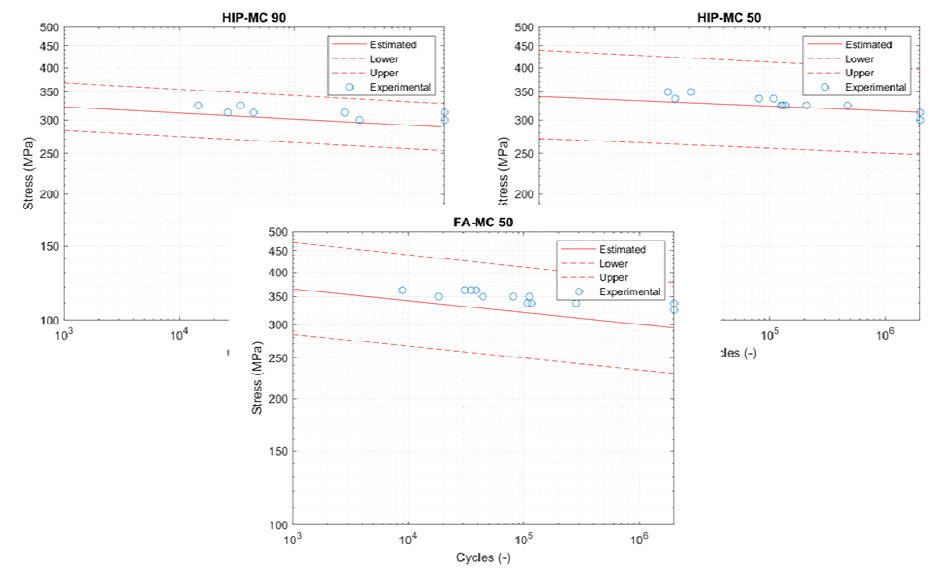
The results in Figure 4 show predicted fatigue behavior for three different samples. In each case, the actual test data for that sample (shown as blue data points) was not fed into the machine learning algorithm. The algorithm successfully predicted each sample's behavior, with all points falling within the upper and lower bounds of the prediction and close to the predicted S-N curve (solid red line). The samples included a build oriented at 90 degrees with subsequent machining and Hot Isostatic Pressing (HIP) treatment, and two builds oriented at 50 degrees — one receiving Full Annealing (FA) treatment, the other HIP treatment.
A Faster Path to Reliable Fatigue Data
This machine learning approach from Siemens offers a successful method for characterizing the fatigue properties of additively manufactured components, without requiring specific inference of every fatigue-affecting factor. The method is also flexible enough to account for local phenomena within a given sample.
For additive manufacturing facilities that typically have a limited number of specialized personnel but high demand for testing, the combination of Siemens' machine learning approach and the testing efficiency of the ElectroPuls E10000 results in a significant reduction in both the time and number of tests required to achieve a wide range of results.
Additional Reading
Read Siemens' original article

Talk to an Instron Expert.
Not sure if the ElectroPuls E10000 fits your fatigue testing or additive manufacturing application? Tell us about your requirements and we will help you find the right solution.
Talk to an Applications Engineer
Tell us about your testing needs, and we'll help you configure the right frame, load cell, grips, and software for your lab. Please complete the form below, and we'll respond within 1-2 business days. For a faster response, call +1-800-473-7838 or +1 781 828 2500 if you are outside of the US.