Load String
A load string is the complete set of components that carries force through a testing machine during a test. It runs from the moving crosshead or actuator to the base of the load frame, or to the fixed crosshead on frames with two test spaces. A typical load string includes a load cell, adapters, grips or fixtures, and the specimen.
What Is in a Load String?
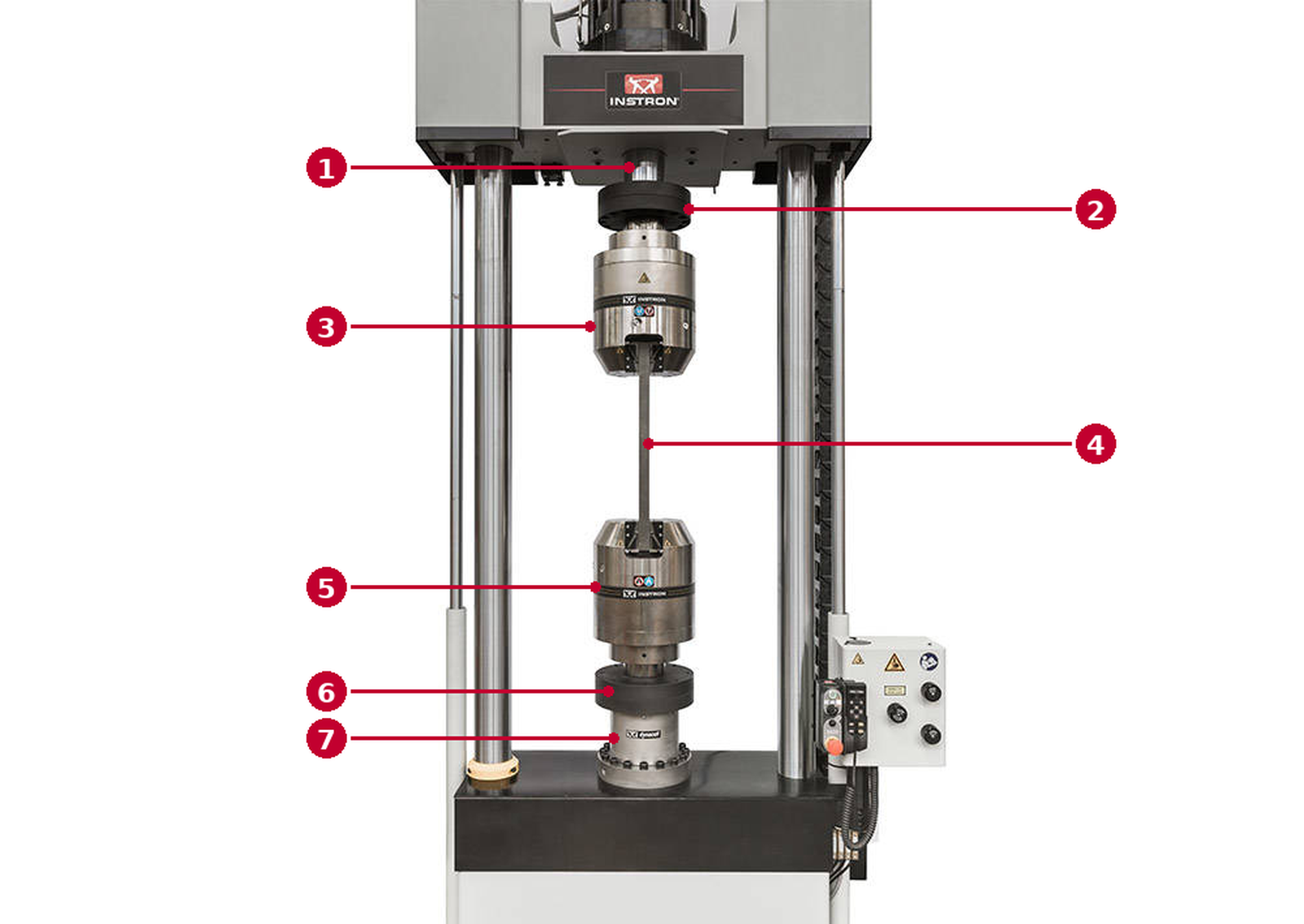
The photo shows a load string on a servohydraulic fatigue testing system. Each number marks a part, listed from top to bottom in the table.
Why Does the Load String Matter?
The order changes from system to system. On many electromechanical systems, the load cell is at the top, on the moving crosshead, and the lower grip mounts to the base. Some load strings also include an alignment fixture, pullrods that pass into an environmental chamber or furnace, or extension rods that position the specimen.
Every component in the load string affects the result, not just the specimen. Four properties matter most:
- Alignment: if the components are offset or tilted, the specimen bends as well as stretches. Bending adds stress the test does not account for, which shortens fatigue life and breaks brittle specimens early.
- Stiffness: every adapter, grip, and rod stretches a little under load. Crosshead movement includes that stretch, so strain calculated from crosshead movement is too high. An extensometer measures strain on the specimen itself.
- Capacity: the load string is only as strong as its lowest-rated component. Check the capacity of every grip, adapter, and fixture, not just the frame and load cell.
- Mass: in dynamic and fatigue tests, heavy grips and fixtures between the load cell and the specimen add inertial force to the reading as they accelerate. 2527 Series Dynacell load cells compensate for this.
Load String vs. Load Frame
The load frame is the machine's structure: the base, the columns, and the crosshead. The load string is everything mounted in the test space that the force passes through. You change the load string for each type of test, swapping grips for compression platens or a bend fixture, while the frame stays the same.
How to Keep the Load String Aligned
- Use as few adapters as possible. Each joint adds a small offset or tilt.
- Center the specimen in the grips. Grip faces and specimen stops help place it the same way every time.
- Measure and adjust alignment. The AlignPRO Alignment System measures bending in the load string and shows the effect of each adjustment as you make it.
- Verify alignment on a schedule. Labs working to ASTM E1012 or Nadcap requirements need regular checks. See our load frame alignment test service.

Talk to an Instron Expert
Changing test types or seeing scatter in your results? Tell us your frame, load cell, and specimens, and our applications engineers will help you build a load string with the right capacity, stiffness, and alignment.
Talk to an Applications Engineer
Tell us about your testing needs, and we'll help you configure the right frame, load cell, grips, and software for your lab. Please complete the form below, and we'll respond within 1-2 business days. For a faster response, call +1-800-473-7838 or +1 781 828 2500 if you are outside of the US.