Tensile Strength (Ultimate Tensile Strength)
Tensile strength, also called ultimate tensile strength (UTS), is the maximum stress a material can withstand while it is pulled before it breaks. It is calculated by dividing the maximum force by the specimen's original cross-sectional area, and it is reported in megapascals (MPa) or pounds per square inch (psi).
Engineers use tensile strength to compare materials, set design limits, and confirm that each production batch meets its specification. It is measured in a tensile test on a universal testing machine.
Formula
How Is Tensile Strength Calculated?
Tensile strength is the maximum force recorded during a tensile test divided by the specimen's original cross-sectional area:
- σUTS : ultimate tensile strength (MPa or psi)
- Fmax : maximum force reached during the test (N or lbf)
- A0 : original cross-sectional area of the specimen, measured before the test (mm² or in²)
Example: a flat specimen is 10 mm wide and 4 mm thick, so its cross-sectional area is 40 mm². If the maximum force is 2,000 N, the tensile strength is 2,000 N ÷ 40 mm² = 50 MPa.
What Units Is Tensile Strength Measured In?
Tensile strength is a stress, so it is expressed as force per unit area.
- SI units: megapascals (MPa). One megapascal equals one newton per square millimeter (N/mm²). One pascal (Pa) equals one newton per square meter (N/m²).
- US customary units: pounds per square inch (psi) or thousands of pounds per square inch (ksi). One megapascal equals about 145 psi.
Tensile Strength vs. Yield Strength
Tensile strength and yield strength are two different points on the same test.
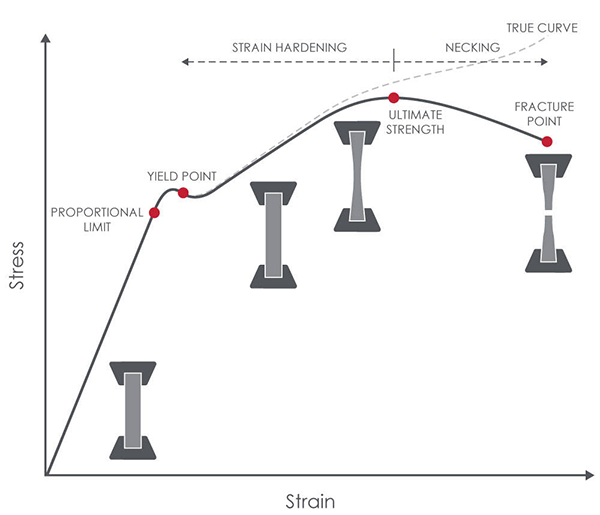
- Elastic region: at low stress, the material stretches and returns to its original shape when the load is removed.
- Yield strength: the stress at which the material begins to deform permanently. Many materials have no sharp yield point, so labs report an offset yield strength, often at 0.2% strain.
- Plastic region: beyond yield, the material deforms permanently. In many metals the stress keeps rising as the material strain hardens.
- Tensile strength: the highest stress on the curve. After this point, a ductile specimen narrows in one area, a behavior called necking, and the force falls until the specimen breaks.
Which value matters depends on the material. Designers of ductile metal parts often work to yield strength, because a part that has yielded no longer fits or works as designed. Brittle materials, such as many composites and ceramics, break with little or no yield, so their tensile strength and breaking strength are nearly the same.
Why Report Tensile Strength Instead of Maximum Force?
Specimens cut from the same batch still vary slightly in width and thickness. A thicker specimen needs more force to break, even though the material is the same. Dividing force by each specimen's own cross-sectional area removes that difference, so results from different specimens, and from different labs, can be compared. Measure each specimen's dimensions accurately before the test, because any error in area goes straight into the result.
Reading Tensile Strength on a Stress-Strain Curve
A stress-strain curve plots stress on the vertical axis against strain on the horizontal axis. Tensile strength is always the highest point on the curve, but where that point falls depends on how the material behaves after yield. The graph to the right shows four common curve shapes for plastics:
- Specimen 1: a brittle plastic that breaks at yield, with low strain. Yield strength, tensile strength, and breaking strength are nearly the same value.
- Specimen 2: a plastic whose stress rises again after yield. Tensile strength is reached late in the test, often close to break, and is higher than the yield strength.
- Specimen 3: a plastic whose stress does not rise after yield. The yield peak is the highest point, so tensile strength equals the yield strength, even though the specimen keeps stretching.
- Specimen 4: a soft elastomeric material with no clear yield point. It stretches to a large strain, and tensile strength is reported at or near break.
Because the highest point can come at yield or at break, always report which one you mean. Standards such as ISO 527 and ASTM D638 define how to report each value.

Upper and Lower Yield Strength in Metals
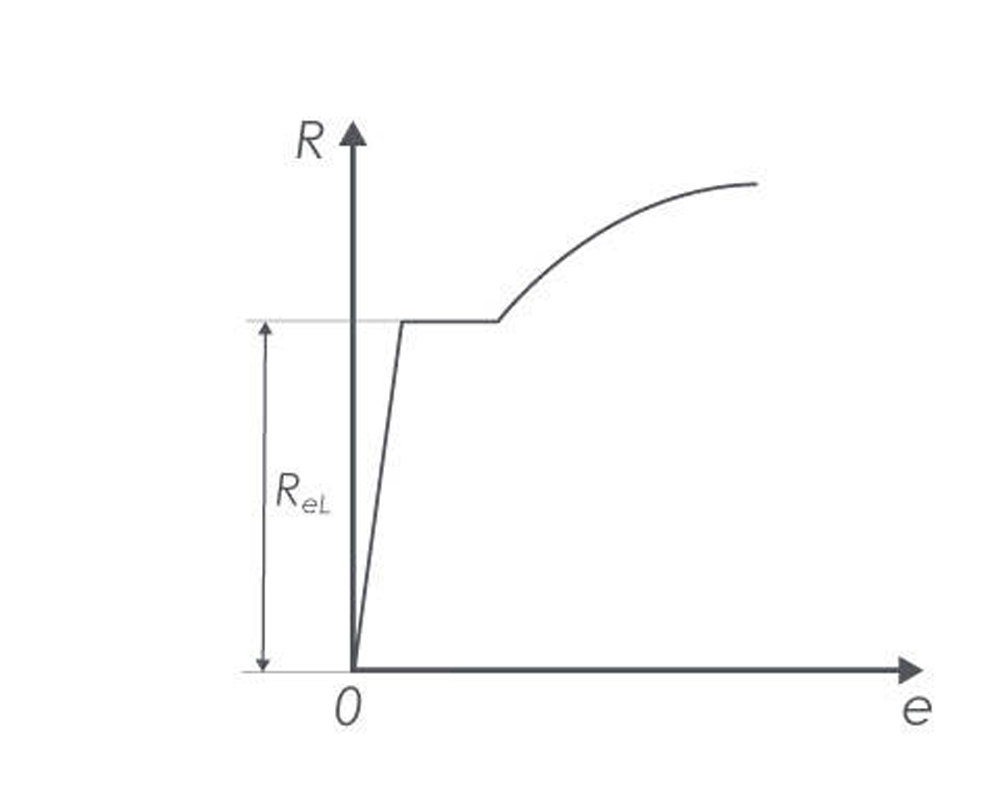
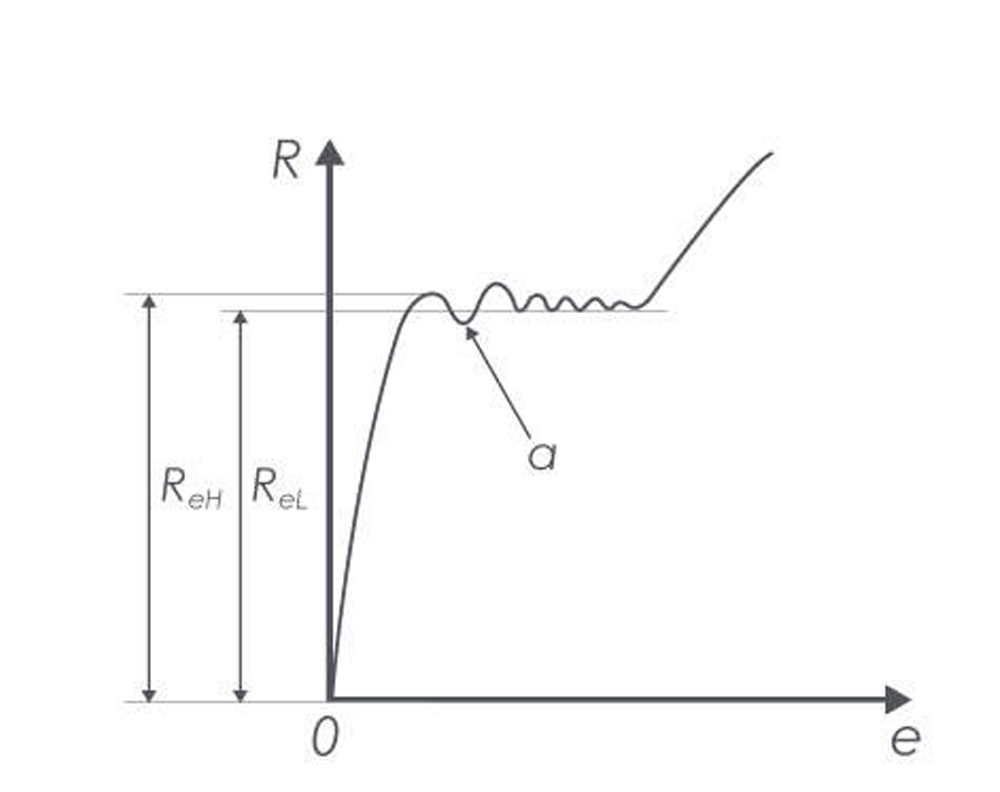
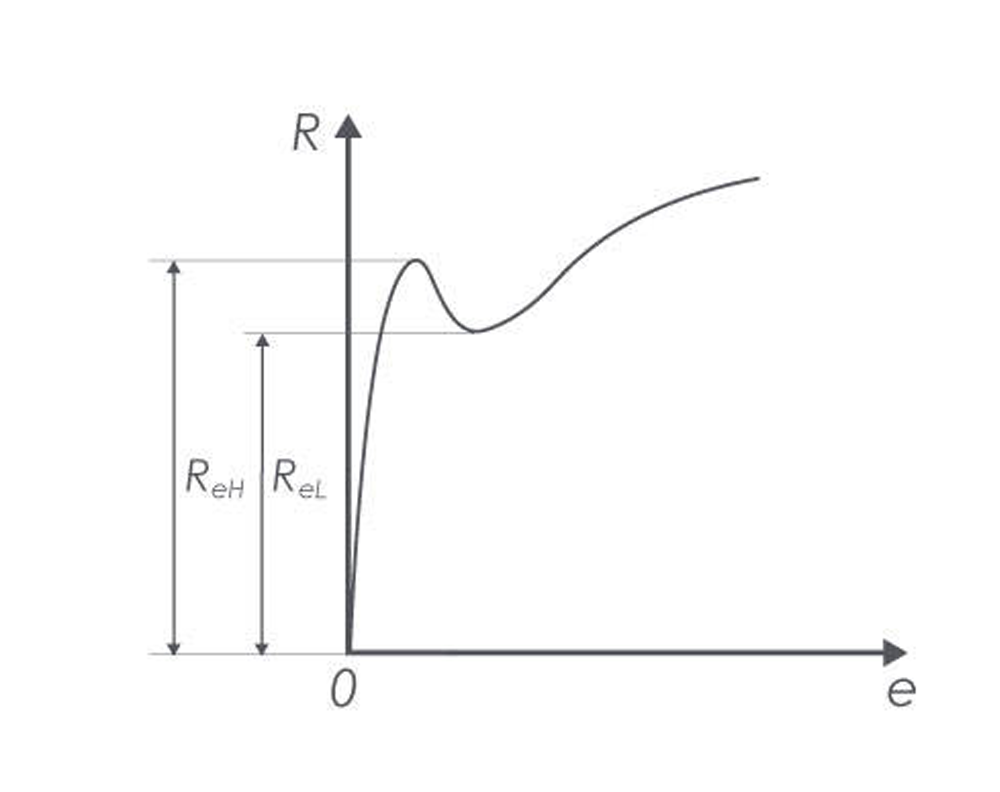
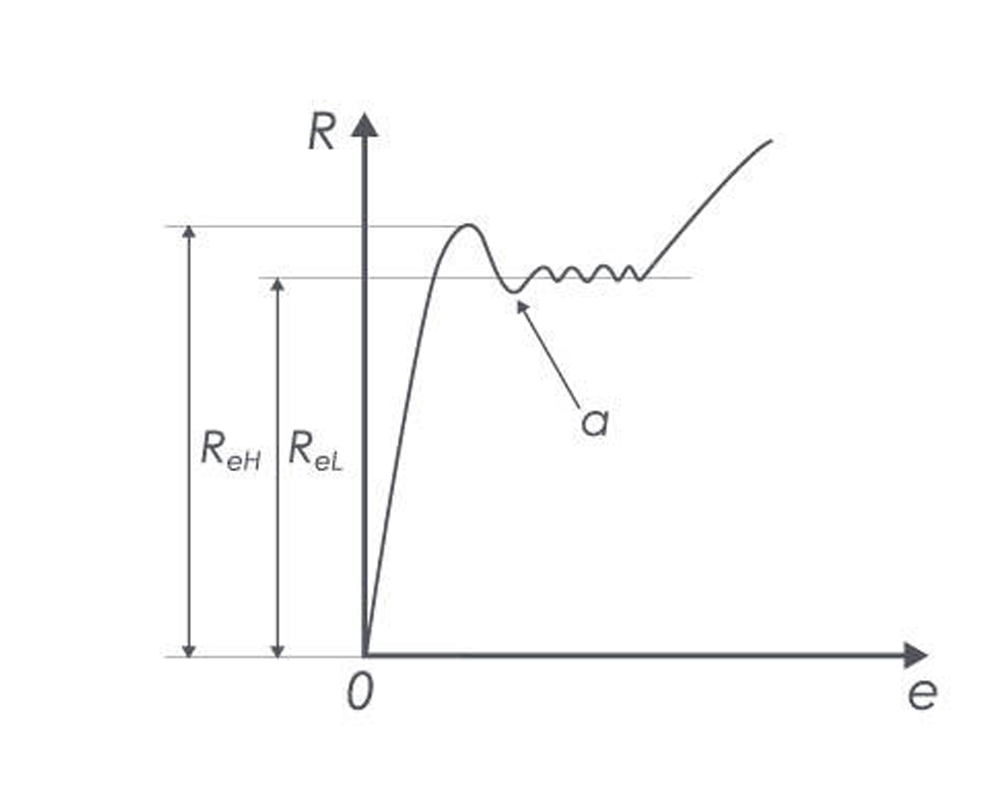
Some metals, such as low-carbon steels, do not yield smoothly. The stress rises to a peak, drops suddenly, then stays close to a lower value while the specimen stretches. During this stage, bands of yielded material spread along the gauge length. After the plateau, the material strain hardens and the stress rises again to the tensile strength.
ISO 6892-1 reports two values for this behavior. In the graphs below, R is stress and e is strain:
- ReH, upper yield strength: the stress at the first peak, just before the drop.
- ReL, lower yield strength: the lowest stress during the yield plateau, ignoring the first dip.
- "a," initial transient effect: the first dip after the peak. It is not used to calculate ReL.
The upper yield peak is sensitive to test speed and to how well the specimen is aligned, so many specifications use ReL for design and acceptance.
Tensile Strength of Common Materials
Values depend on grade, temper, and processing. Use the supplier's data sheet or your own test results for design work.
How Is Tensile Strength Measured?
Tensile strength is measured in a tensile test. A universal testing machine pulls a standard specimen at a controlled rate until it breaks, while a load cell records the force. The standard for your material sets the specimen shape, the test speed, and how to report the result:
- Metals: ASTM E8/E8M and ISO 6892-1
- Plastics: ASTM D638 and ISO 527-2
- Polymer matrix composites: ASTM D3039
Tensile strength needs only force and the original area. Yield strength, modulus, and elongation also need accurate strain, so most standards call for an extensometer on the specimen. Automatic extensometers attach and remove themselves, which keeps strain results consistent between operators.
Equipment for Measuring Tensile Strength
Instron® universal testing systems measure tensile strength from soft films to high-strength alloys. The same systems also run compression, flexure, peel, tear, shear, and other tests.



Talk to an Instron Expert
Tell us what you test and the standard you follow. Our applications engineers will recommend the testing system, grips, and extensometer you need to measure tensile strength, yield, and elongation accurately.
Talk to an Applications Engineer
Tell us about your testing needs, and we'll help you configure the right frame, load cell, grips, and software for your lab. Please complete the form below, and we'll respond within 1-2 business days. For a faster response, call +1-800-473-7838 or +1 781 828 2500 if you are outside of the US.