The Challenges of Closed-Loop Strain Control
Use the links below to jump directly to the section you are interested in:
Why Strain Control? | Requirements to Achieve Closed-Loop Strain Control | Advantages of Closed-Loop Strain Control
Why Strain Control?
Some of the mechanical properties of metals are affected by the speed of the test and are therefore "strain-rate sensitive." In 2009, one of the primary metals testing standards, ASTM E8, was updated to include a method based on controlling the strain rate on the specimen. Prior to this change, tests could only be run in stress control or crosshead speed control, where overall machine stiffness can affect the speed on the specimen and cause differences in results. When testing strain-sensitive materials with crosshead speed control, the allowable test speeds can cause more than a 10% difference in proof stress results between testing at the slowest and fastest rates allowed in ASTM E8/E8M and ISO 6892-1.
Running a test in strain control, however, allows the test speed to change during testing in order to compensate for machine compliance and maintain a constant strain rate on the specimen. This method increases throughput by reducing overall test time. It can also save time and prevent specimens from being wasted on tuning. Unlike the stress control method, closed-loop strain control does not require multiple trial-and-error adjustments to the crosshead speed to ensure the strain rate complies with the testing standards.

Subscribe to the Instron Update
Stay up to date on industry trends, testing standards, applications, tips and tricks, and so much more!
Requirements to Achieve Closed-Loop Strain Control
In order for a testing system to achieve closed-loop strain control, certain requirements must be met. In all cases, it is important that the test machine and extensometer be isolated from any sudden or repetitive vibrations or shocks, as this could cause interference in your testing.
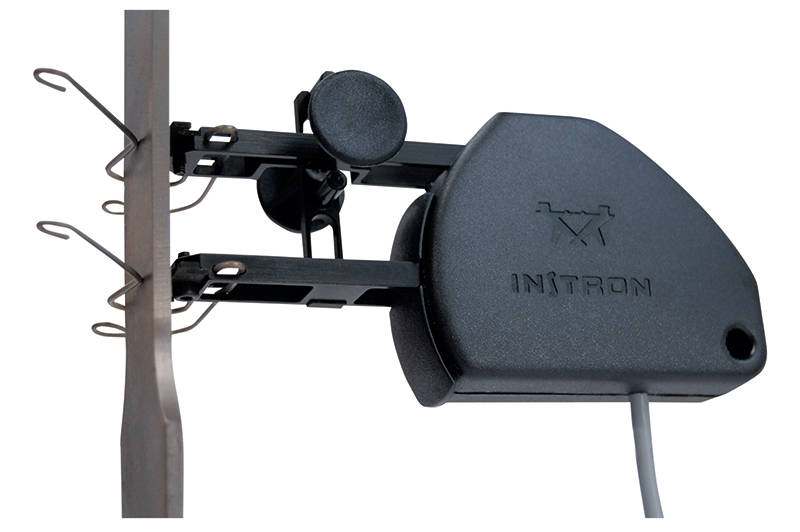
An extensometer is a high-precision device used to measure deformation of a specimen. Extensometers remove system compliance from the strain measurement calculation, but it's important that the chosen extensometer is appropriate for the travel length of the specimen and has a suitable ratio of parallel length to gauge length.
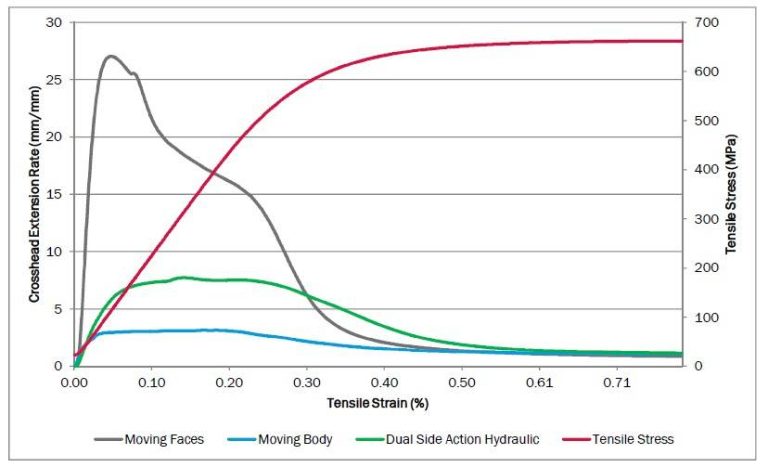
Grips need to securely hold the specimen during testing, preferably with high stiffness and minimal compliance. The graph shows how different types of gripping devices can effect the system stiffness, and how a machine in strain control would need to compensate.
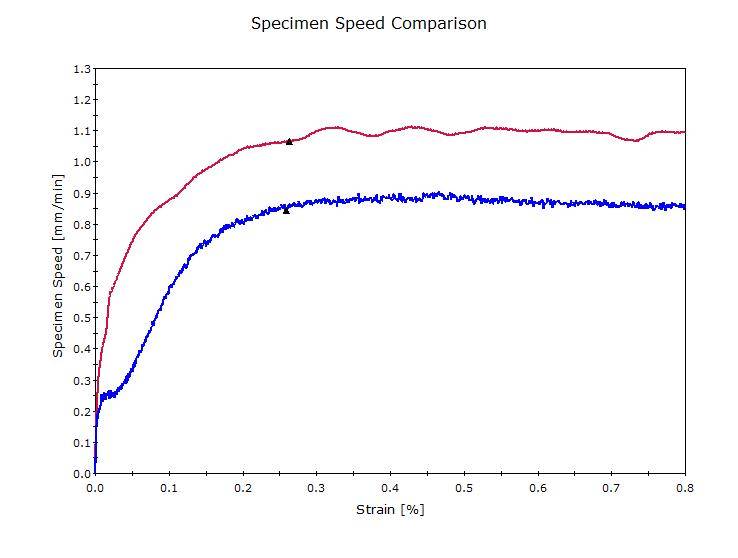
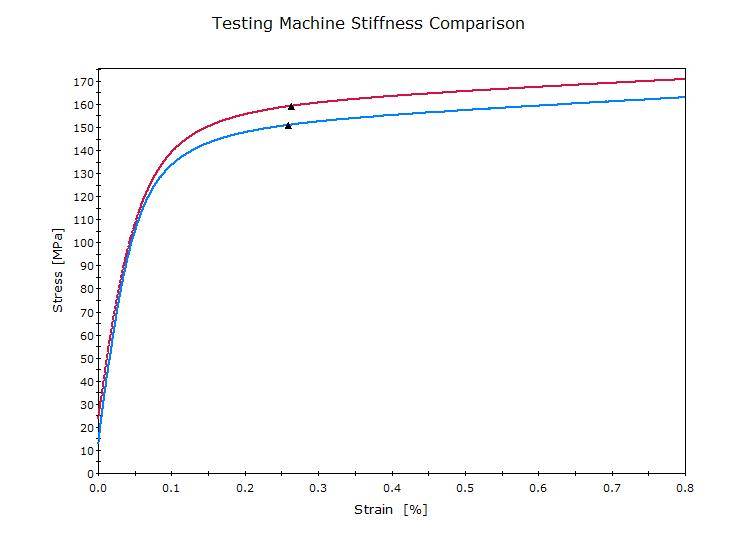
The load frame of the testing system needs a precise and stable drive system with high stiffness. To the right shows a stress strain curve on nominally similar materials - one testing on a high stiffness frame and the other on a low stiffness frame. Using an estimated strain method calculation, both tests are run at a constant crosshead speed of 2.25 mm/min. There was a 21% difference in 'specimen speed' (expressed in mm/min), which lead to a 5% difference in the yield result.
This graph shows the specimen speed difference between a 'stiff' system and a less stiff system. At the start of the test it is shown that the crosshead movement is transferred into strain on the specimen very quickly, whereas on the weaker system it takes longer. This is due to the machine/load cell/grips deflection, which causes that movement to not be transferred to the specimen. If both machines were using strain control then the results would be much more comparable, but the control will likely be more challenging on the weaker system.
Machines capable of strain rate control require a responsive controller and a precise and stable drive system in order to maintain the tolerances required by the testing standard. Some machines are advertised as being able to achieve this method but require the user to manually tune the gain settings of the controller, which can be difficult for even the most experienced system operator.
Specimen
A proportional specimen and a proportional gauge length extensometer are ideal. In reality, a specimen with good gauge length to parallel length ratio is well suited to minimize the strain seen outside of the gauge length, allowing the control to be more stable. If your specimens vary from discontinuous yielding to continuous yielding, it is important to change control methods for each type. As local yielding can occur outside of the gauge length on discontinuous yielding material, it is impossible to control from the strain feedback and should be in crosshead speed control during yield point elongation [YPE/Ae].
Advantages of Closed-Loop Strain Control
✓ More repeatable and comparable results - test results are reliable from machine to machine
✓ Improved efficiency - time per test is minimized and setup time reduced
✓ No need to tune with a specimen when using a testing system with 6800 Series controller electronics

Talk to an Instron Expert
Not sure if your current setup is achieving true closed-loop strain control? Tell us about your application and we will help you find the right solution — no guesswork required..
Talk to an Applications Engineer
Tell us about your testing needs, and we'll help you configure the right frame, load cell, grips, and software for your lab. Please complete the form below, and we'll respond within 1-2 business days. For a faster response, call +1-800-473-7838 or +1 781 828 2500 if you are outside of the US.