ASTM F88 Seal Strength of Flexible Barrier Materials
How to Perform an ASTM F88 Peel Test on Packaging
Medical packaging has two jobs that pull in opposite directions. The seal must be strong enough to keep the device inside sterile through sterilization, shipping, and storage, whether the device is disposable or reusable. The seal must also open cleanly, so healthcare providers can remove the device without tearing the package or contaminating the sterile field.
Getting the balance wrong causes problems on both sides. A seal that is too weak can open in transit and break the sterile barrier. A seal that is too strong can tear the packaging material when opened, which makes clean, aseptic presentation of the device difficult.
ASTM F88 gives manufacturers a consistent way to measure that balance. Seal strength testing is a common part of sterile barrier packaging validation under ISO 11607, and the same test is used in production to confirm the sealing process stays in control. Food and pharmaceutical manufacturers use ASTM F88 to test their packaging seals as well.
This guide covers the basic elements of an ASTM F88 peel test, including the equipment, software, and specimens you need. It does not replace the standard. Read and follow the full standard before you begin testing.
What Does ASTM F88 Measure?
ASTM F88 measures the seal strength of flexible barrier materials at ambient temperature, using one of two peel configurations. It covers seals between two flexible materials, such as a medical device pouch, and seals between a flexible material and a rigid one, such as lidding film on a tray.
The test runs on a universal testing system, also called a tensile testing machine, at a rate between 200 and 300 mm/min (8 and 12 in/min). A strip cut across the seal is pulled apart, and the system records the force needed to peel the seal open.
Manufacturers use ASTM F88 results to validate their sealing process, set sealing temperature, pressure, and dwell time, and monitor seal quality in production.
The standard calls for two results, reported as force per unit of seal width, such as N/15 mm or N/25 mm (lbf/in):

- Average seal strength: The average force per unit of seal width throughout the peel test. This shows how the seal performs along its full length.
- Maximum seal strength: The highest force per unit of seal width recorded during the peel test. This shows the effort needed to open the package.
Both results are calculated from the data points acquired during each test. The standard recommends calculating them between 10% and 90% of the total acquired points, which excludes the start and end of the peel.
ASTM F88 applies to the packaging material only. It does not cover a packaged product, such as a syringe sealed in its sterile pouch. Testing packaged products is often useful, but it falls outside the scope of this standard.
Testing System
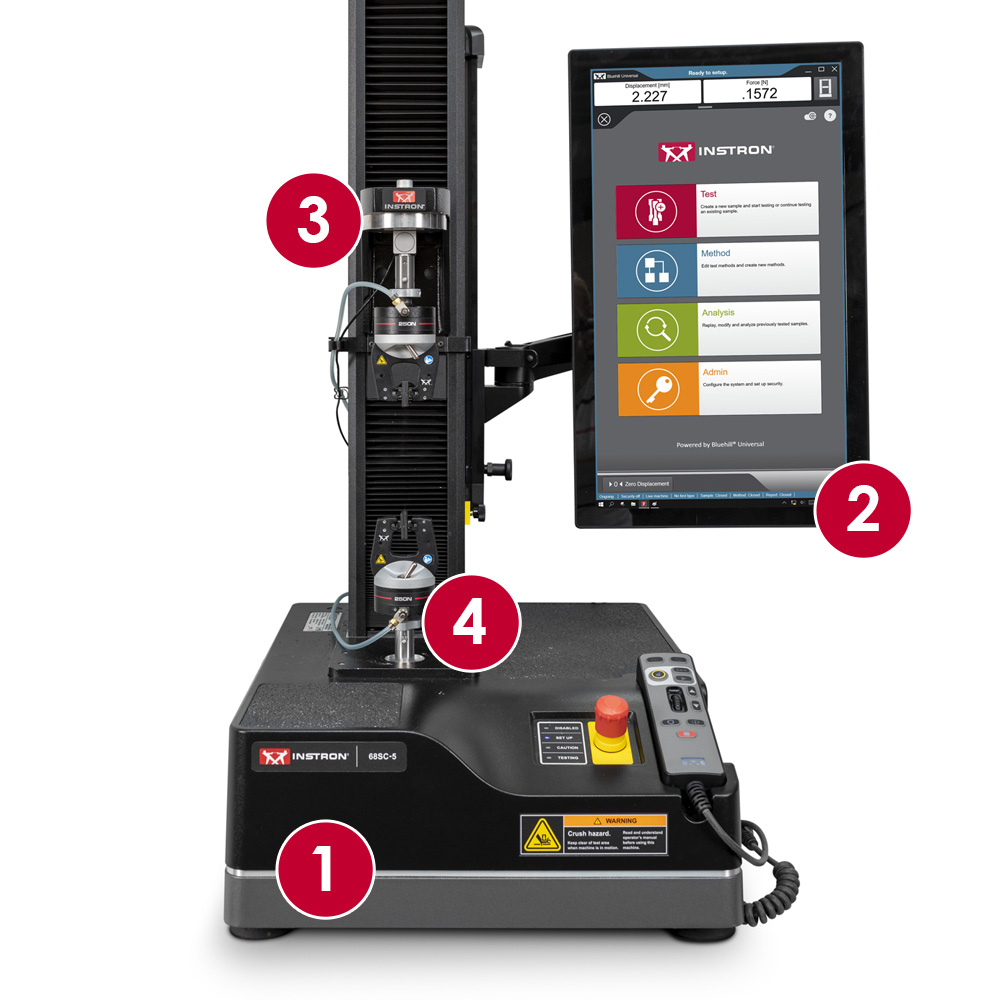
Seal strength tests involve very low forces, so load cell accuracy at the low end of its range matters. A typical ASTM F88 setup uses a single-column 3400 Series or 6800 Series universal testing system, with a load cell capacity from 5 N to 5 kN (1.1 lbf to 1,124 lbf).
- 3400 Series: Single-column systems offer a 1,000 Hz data acquisition rate and ±0.5% accuracy down to 1/250th of load cell capacity.
- 6800 Series: For higher accuracy and data rates, single-column systems offer data acquisition rates up to 5,000 Hz and ±0.5% accuracy down to 1/1000th of load cell capacity with 2580 Series load cells.
Software
Both the 3400 Series and 6800 Series run Bluehill Universal Software, with the Operator Dashboard mounted on the testing system. For ASTM F88, the software controls the test and calculates the seal strength results the standard requires. Every operator runs the test the same way, which keeps results consistent from shift to shift.
- Preloaded test methods: The Adhesives and Biomedical Applications Modules include ready-to-use methods for many standards, including ASTM F88-23. You start from a method built around the standard instead of building one from scratch.
- Seal strength results: Bluehill Universal calculates average and maximum seal strength per unit of seal width. You can set the calculation to the 10% to 90% range the standard recommends, so the start and end of the peel do not skew the average.
- Consistent grip pressure: With pneumatic grips and the Smart-Close Air Kit, the grip pressure is saved in the test method. Every specimen is clamped at the same pressure, which removes a common source of variation in low-force peel tests. The grips can also open automatically at the end of each test.
- Testing at the frame: The Operator Dashboard lets operators start tests, enter specimen details, and review results at the testing system, without walking back to the PC.
- Revision history and traceability: Bluehill Universal records every change to methods, samples, and report templates, so you can see who changed what and when. If your lab works under FDA 21 CFR Part 11, the optional Traceability module adds a secure, searchable audit trail and electronic signatures for change approval.
- Data export: Export results and raw data for your lab's reports and records.

Specimens and Specimen Measurement
ASTM F88 includes two test configurations, T-peel and 180° peel, with three techniques for holding the specimen. In every technique, one leg of the seal is secured in the upper grip and the other leg in the lower grip, and the seal peels apart between them.
The technique you choose changes the angle at which the seal peels, and the peel angle affects the measured force. Choose the technique that best fits the stiffness of your packaging materials, then use it for every test. Report the technique with your results, because results from different techniques cannot be compared directly.

- T-Peel, Technique A: The tail of the specimen is left unsupported during the test. This is the standard T-peel setup.
- T-Peel, Technique B: The tail is supported by hand during the test.
- 180° Peel, Technique C: One side of the specimen is adhered to a substrate or alignment plate. The side with the plate goes in the upper grip, and the other end of the specimen goes in the lower grip.
Cut specimens in accordance with ASTM D882, the standard for tensile properties of thin plastic sheeting. Specimens must be 25 mm (0.98 in), 15 mm (0.59 in), or 25.4 mm (1.0 in) wide.
Grips
Choose between two grip types, based on ease of use, throughput, and whether you run 180° peel tests. Whichever you choose, use rubber-coated jaw faces to avoid tearing delicate specimens. Jaw faces are available in many sizes and are easy to change.
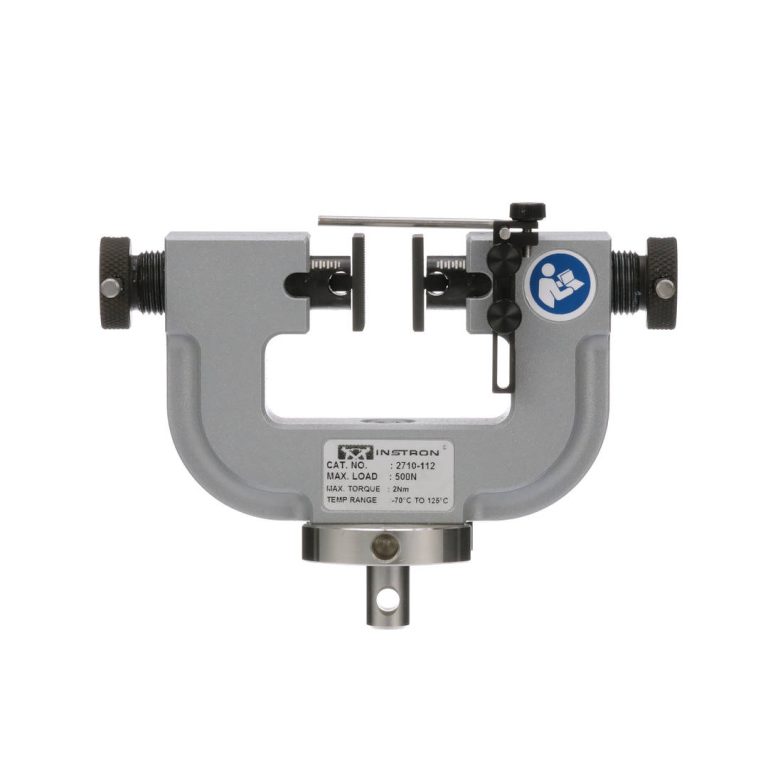
500 N Model | 2710-112
Screw side-action grips cover every configuration in ASTM F88, including 180° peel. You open and close them with a screw on each side of the grip. For 180° peel tests, you can offset either the upper or lower jaw face to account for the thickness of the substrate or alignment plate, which keeps the peel aligned with the load.

250 N Model | 2712-052
Pneumatic side-action grips are designed for T-peel specimens. A footswitch opens and closes the grips, so operators can load specimens faster and test more samples per shift. The grips also apply the same clamping force every time, which removes one source of operator-to-operator variation.
Both grip types accept an optional specimen centering device. Adjustable stops place each specimen in the same position every time, which keeps the peel aligned with the load and reduces scatter in your results.
- 2710-109: Specimen centering device for 2710-112 screw side-action grips
- CP116858: Specimen alignment device for 2712-052 pneumatic side-action grips
- 2701-220: Specimen alignment device for 2712-04x pneumatic side-action grips
Variations in Data
Because ASTM F88 forces are so low, small details in your setup can change your results. Control these three sources of variation:
- Tail support: Supporting the tail by hand (Technique B) or with a fixture gives different results than testing with no tail support. Use the same technique for every test, and report which one you used.
- Cables and hoses: Clip load cell cables and pneumatic grip hoses to the crosshead before testing. Hanging cables create drag forces that add to the measured load.
- Data acquisition: Results can vary between brands of testing systems, because each uses a different data acquisition system. Data rate and bandwidth settings also affect peel test results, so keep these settings the same when you compare results across systems.

Jonathan Camara
Jonathan Camara was Global Applications Engineering and Support Manager at Instron, where he oversaw applications engineering and technical support for customers worldwide. Over more than 25 years at Instron, he held roles in technical support, technical services, and applications engineering, building deep expertise in electromechanical testing systems and software.
He also created and delivered training for Field Service Engineers and customers, helping teams get accurate, repeatable results from their testing systems.

Talk to an Instron Expert
Setting up ASTM F88 testing for your packaging? Our biomedical applications team can help you choose the testing system, load cell, grips, and test method for your seals.
Talk to an Applications Engineer
Tell us about your testing needs, and we'll help you configure the right frame, load cell, grips, and software for your lab. Please complete the form below, and we'll respond within 1-2 business days. For a faster response, call +1-800-473-7838 or +1 781 828 2500 if you are outside of the US.