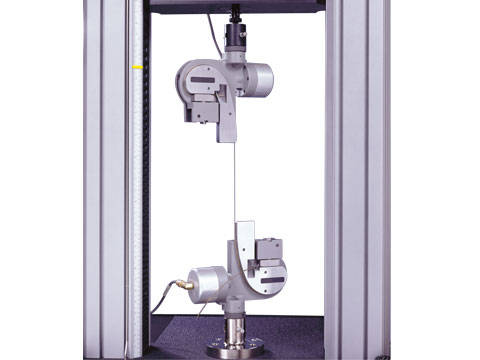
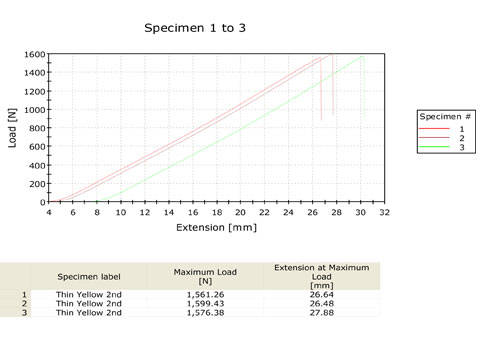
Evaluation of Radial Forces from Embolic Filters

Evaluation of Radial Forces from Embolic Filters
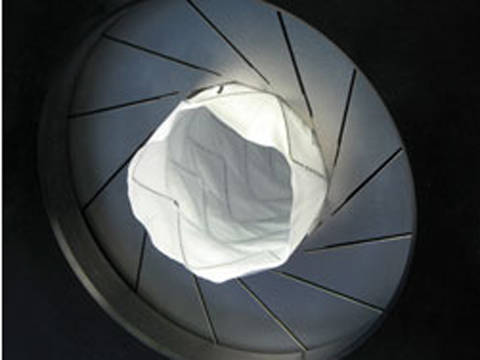
Radial Strength Testing of Stent Grafts and Vascular Devices

Embolic filters are used within a variety of interventional procedures to capture debris resulting from the deployment of a medical device, like a stent. The stent is used to open arterial paths that may be occluded by plaque. Upon placement of the stent, dislodged plaque (or embolic material) can potentially be responsible for heart attacks, strokes, kidney failure, or death. Firm placement of the embolic filter is a critical requirement for successful procedures.

One of the most critical parameters for proper utilization of the filter is the radial forces it imparts on the arterial wall. In particular, the chronic radial force that the filter imparts over time helps to ensure that the device remains in place as intended. This fit ensures that all material is captured before heading further down the arterial pathways.

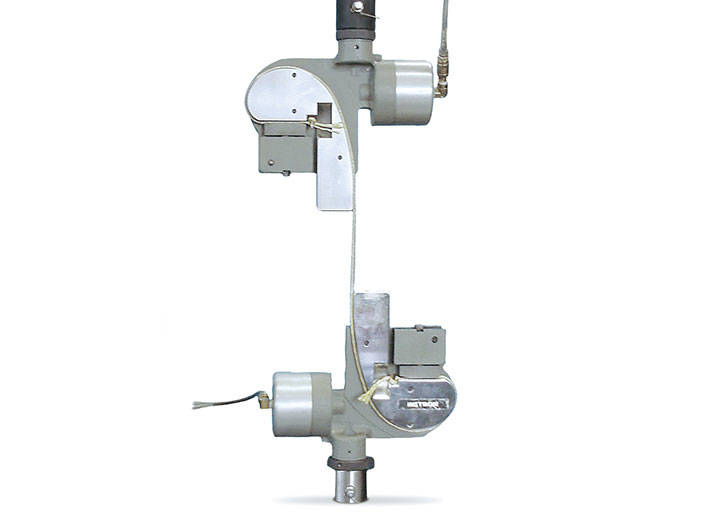
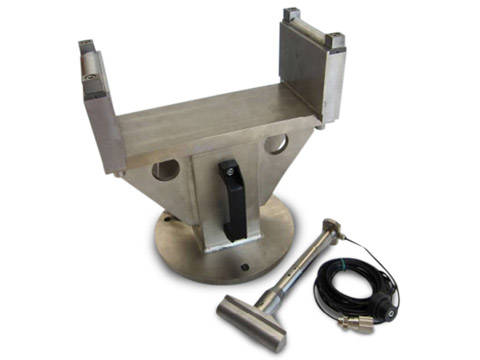
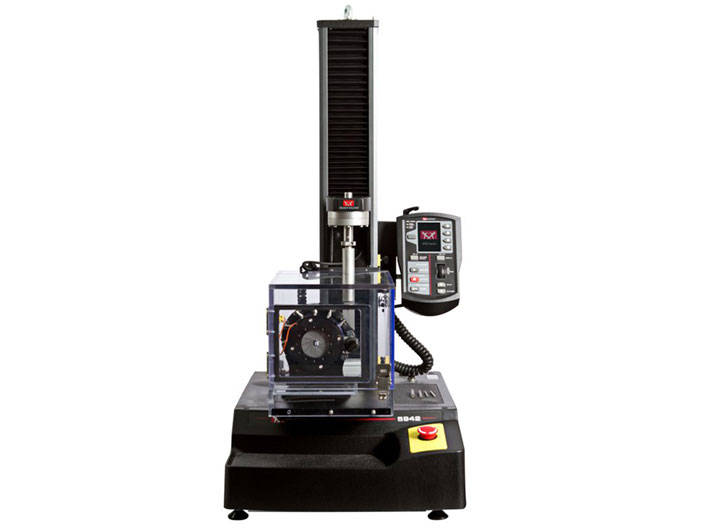
The RX575 system has the fidelity to measure the small radial expansion forces of the embolic filter. The unique segment design of the fixture results in small frictional forces, which ensures that your data will present clean results from the radial tests. The radial fixture mounts to electromechanical instruments, as well as into a fluid bath for accurate simulation of body temperatures. Additionally, the fixture provides the capability for tensile tests to evaluate resistance to tearing properties during deployment.

Bluehill® Software provides an interface to run tests, to evaluate the radial strength, and to generate standard reports that can be submitted for regulatory submissions.

Literature

3400 Series Universal Testing Systems Brochure

Instron 3400 Series universal testing systems for tensile, compression, bend, and other material property tests.

  • Produits
  • 06/27/2022
  • 2.69 MB

6800 Series Premier Testing Systems Brochure

Instron 6800 Series Universal Testing Systems provide unparalleled accuracy and reliability. Built on a patent-pending Operator Protect system architecture with an all-new Smart-Close Air Kit and Collision Mitigation features, the 6800 Series makes materials testing simpler, smarter, and safer than ever before.

  • Produits
  • 02/10/2020
  • 4.15 MB

Essai de Pelage à Angle Variable des Adhésifs de Tissu

Essai de Pelage à Angle Variable des Adhésifs de Tissu

Les tissus adhésifs sont très utilisés dans l’industrie biomédicale pour des applications telles que les bandages, les pansements secondaires et les sutures. Il n’existe pas de norme spécifique concernant les essais de pelage et l'utilisation d'accessoires de pelage à angle variable pour tester les adhésifs utilisés, mais il existe des normes ASTM voisines applicables à cette méthode d’essai : ASTM F2255, F2256, F2258 et F2458. La résistance de l’adhésif de ces produits doit être clairement définie avant qu’on ne les utilise dans un cadre clinique. Si l’adhésif n’est pas suffisamment résistant, le produit peut provoquer des infections ou retarder la guérison. Si l’adhésif est trop résistant, on risque d’endommager le tissu sous-jacent quand on l’enlève.

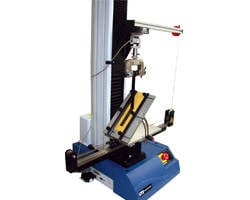
A titre d'exemple, nous avons testé un adhésif en utilisant un banc de pelage à angle variable simulant l’action consistant à enlever l’adhésif du corps d’un patient. Pour cet essai, nous avons utilisé une machine d’essai de traction électromécanique 3345 configurée avec un capteur de force de 50 N, des mâchoires pneumatiques de capacité 250 N à faces métalliques plates de 25 mm x 25 mm et un banc de pelage à angle variable. Cette fixation a été réglée à un angle de 135° pour simuler au mieux le mode de traction que l’on rencontre dans l’utilisation normale du produit adhésif. Nous avons utilisé du cuir pour cet essai pour simuler au mieux les propriétés de la surface de la peau humaine.
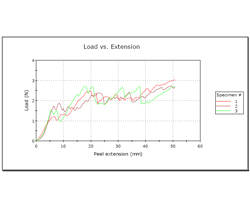
Nous recommandons d’utiliser le module de pelage, déchirement et friction de notre logiciel Bluehill® 2 pour ce type d’essai. Ce module permet de mesurer la première charge maximale, la charge moyenne et la charge moyenne par largeur, qui sont les calculs les plus couramment utilisés.


Littérature

3400 Series Universal Testing Systems Brochure

Instron 3400 Series universal testing systems for tensile, compression, bend, and other material property tests.

  • Produits
  • 06/27/2022
  • 2.69 MB

Bluehill Universal Brochure

Bluehill Universal is Instron’s advanced materials testing software, designed for intuitive touch interaction and streamlined workflows. It offers pre-loaded test methods, QuickTest for rapid setup, enhanced data exporting, and Instron Connect for direct service communication. Users of Bluehill 2 and Bluehill 3 can easily upgrade to the latest version for improved performance and usability.

  • Produits
  • 02/26/2017
  • 3.76 MB

Tensile Test of Fine Wires

Tensile Test of Fine Wires

Fine wires are widely employed in the microelectronic industry. These wires are most commonly used for forming interconnections between ICs (integrated circuit) and PCBs (printed circuit boards). Most interconnection wires today are less than 50µm in diameter and the mechanical characteristics of these wires are crucial in ensuring proper functioning and reliability of the semiconductor device.

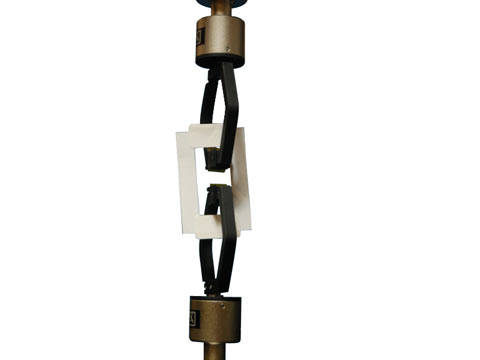
Tensile tests are often conducted to evaluate the wire’s tensile strength, yield strength, and elongation. When testing fine wires, it is often challenging to determine the most suitable test configuration. Grips selected should be able to hold the specimen firmly, without causing any specimen slippage or breaks near the jaws. Since these wires are usually very delicate, clamping pressure and closing speed of the grips must be carefully controlled to prevent any premature failure. Some users attach the test specimen to an aperture card prior to inserting the specimen into the grips. These aperture cards allows for better specimen alignment and easier insertion of specimens into the grips.

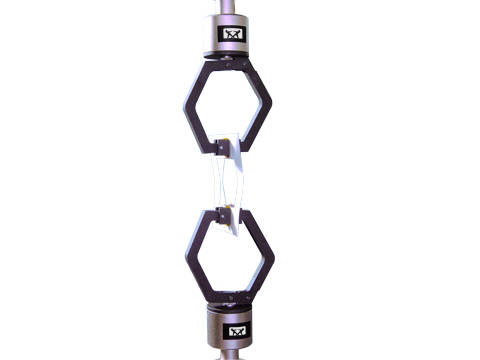
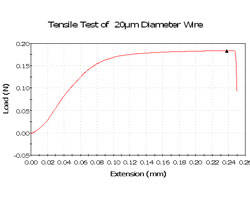
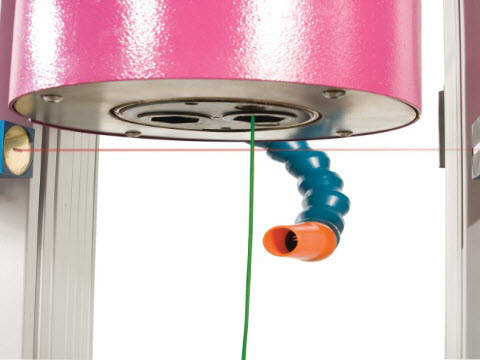
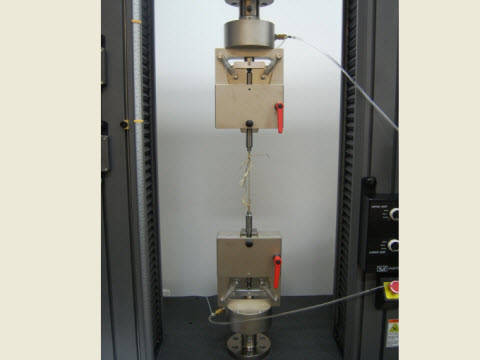
A tensile test was conducted on 20µm diameter wire using our 6800 Series table model electromechanical machine, together with custom 10 N pneumatic side acting grips and Bluehill® Universal Software. The wire specimen was attached to an aperture card and clamped by the grips. The two vertical sections of the aperture card were then cut before starting the test. As the load readings are very low, it is recommended to use a load cell of capacity 10 N or lower. To maximize the working range of the load cell, it is best that the weight the grip does not exceed 50% of the load cell capacity. Our custom pneumatic grips are lightweight and the jaw faces feature a special coating to minimize slippage and breaks within the jaw faces. The low load readings also imply that the test results are highly sensitive to surrounding conditions. For this reason, to obtain accurate results, it is critical that the test area be free of external sources of error such as vibration and wind.

Literature

6800 Series Premier Testing Systems Brochure

Instron 6800 Series Universal Testing Systems provide unparalleled accuracy and reliability. Built on a patent-pending Operator Protect system architecture with an all-new Smart-Close Air Kit and Collision Mitigation features, the 6800 Series makes materials testing simpler, smarter, and safer than ever before.

  • Produits
  • 02/10/2020
  • 4.15 MB

Bluehill Universal Brochure

Bluehill Universal is Instron’s advanced materials testing software, designed for intuitive touch interaction and streamlined workflows. It offers pre-loaded test methods, QuickTest for rapid setup, enhanced data exporting, and Instron Connect for direct service communication. Users of Bluehill 2 and Bluehill 3 can easily upgrade to the latest version for improved performance and usability.

  • Produits
  • 02/26/2017
  • 3.76 MB

Rhéologie des élastomères thermoplastiques pour les composés de pneumatiques : Rhéométrie capillaire selon la norme ISO 11443

Rhéométrie capillaire des élastomères thermoplastiques pour la fabrication de pneumatiques : Essais de viscosité et de gonflement à la filière selon la norme ISO 11443

Hinchamiento del extruido

Hinchamiento del extruido


Les élastomères thermoplastiques sont des matériaux qui possèdent des propriétés mécaniques similaires à celles du caoutchouc thermodurcissable, mais qui peuvent être traités à l'aide de méthodes conçues pour les thermoplastiques standards, telles que l'extrusion et le moulage par injection. De plus, ils peuvent être recyclés beaucoup plus facilement et efficacement. Un rhéomètre capillaire est un outil utile pour déterminer les caractéristiques d'écoulement des élastomères thermoplastiques. Outre la détermination de la courbe viscosité/taux de cisaillement, il est souvent utile d'étudier les caractéristiques de gonflement de l'extrudat, ce qui peut être réalisé avec un dispositif laser additionnel pour la mesure du gonflement.

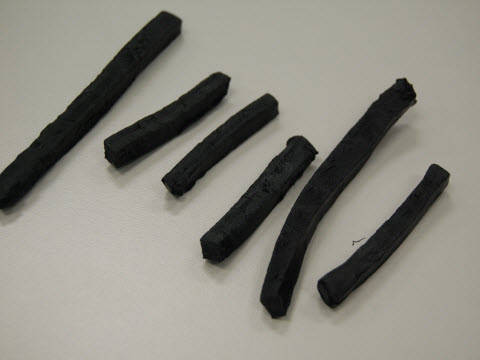
Un fabricant de pneumatiques intéressé par l'étude de son composé d'élastomère thermoplastique nous a fourni un composé d'élastomère thermoplastique composé d'un élastomère, de noir de carbone et d'additifs sous forme de feuilles plates. Nous avons testé ce composé selon la norme ISO 11443 sur un rhéomètre capillaire à double alésage CEAST SR20 (diamètre du barillet 15 mm) équipé de capteurs de force de 20 kN. L'essai a été réalisé à une température de barillet de 100 °C. Nous avons coupé les feuilles d'élastomère thermoplastique en petits morceaux pour alimenter uniformément le barillet, laissé le matériau préchauffer et l'avons compacté avec une force de 2400 N. Nous avons ensuite soumis le matériau fondu à des taux de cisaillement compris entre 1 et 2000 s⁻¹ à travers une filière capillaire. L'essai a été configuré et contrôlé à l'aide du logiciel CEASTVIEW (VISUALRHEO).

Tous les échantillons ont montré un comportement non newtonien avec une viscosité allant de 100 000 Pa.s à un taux de cisaillement de 1 s⁻¹ à 800 Pa.s à 1000 s⁻¹. Nous avons observé que 1000 s⁻¹ était un taux de cisaillement critique pour ce composé, au-delà duquel le maintien d'un plateau de pression stable était assez difficile. La correction de Bagley a été appliquée tout au long de l'essai. Globalement, le matériau a montré une bonne répétabilité et reproductibilité des résultats.

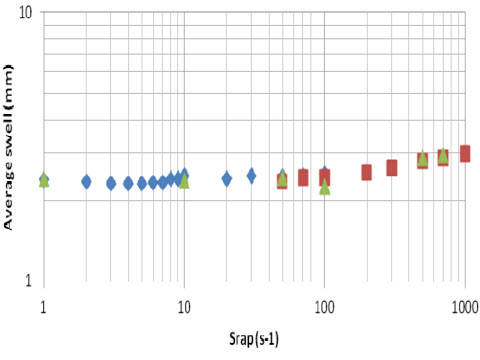
Le gonflement à la filière — la tendance d'un matériau à se dilater en sortant de la filière capillaire — est une caractéristique particulièrement importante pour les composés de pneumatiques, car un gonflement excessif peut affecter le traitement en aval et la cohérence dimensionnelle des profilés extrudés. Nous avons effectué des essais de gonflement à la filière à l'aide du système laser de gonflement à la filière CEAST sur la même plage de taux de cisaillement. Les résultats sont présentés dans le graphique SQC, parallèlement à la courbe viscosité/taux de cisaillement, démontrant un comportement de gonflement à la filière constant et confirmant la répétabilité des résultats entre les échantillons.

Documentation

CEAST SmartRHEO Series: Capillary Rheometer Systems

Thermoplastic materials are processed as fluids under the effect of temperature and pressure. The ability of plastics to be formed into a wide variety of shapes, by the common plastics conversion processes, has a fundamental importance in polymer science and application. The innovative Instron® line of CEAST SmartRHEO Series of Capillary Rheometer systems are designed for an accurate investigation of the rheological properties of polymeric materials.

  • Produits
  • 09/22/2014
  • 3.45 MB

VisualRHEO | Software for CEAST SR Series Capillary Rheometers

A fundamental part of a capillary rheometer system is the software. As the system investigates the flow behavior of
plastics over a wide range of shear conditions, the software controls the instrument from a PC, acquiring and analyzing
data, calculating results, and exporting data to easily share and perform further analysis. Performing tests that are much
more effective and informative than a trial-and-error approach, the software provides a user-friendly interface for lab
operators when programming and monitoring the tests.

  • Produits
  • 02/14/2014
  • 2.46 MB

Impact Tests On Orthopedic Implants

Impact Tests On Orthopedic Implants

A medical condition called Osteoarthritis is caused when there is minimal joint moment in human body. Lack of joint moment can result into damaged or dysfunctional joints. Orthopedic implants are designed to replace the damaged joint (s) and increase the mobility of an affected part in the human body. To name a few, implants used for hip, knee, shoulder or elbow joints are commonly made of stainless steel. It is important for manufacturers of such orthopedic implants to test their components (various implants) to characterize the impact resistance of their product.

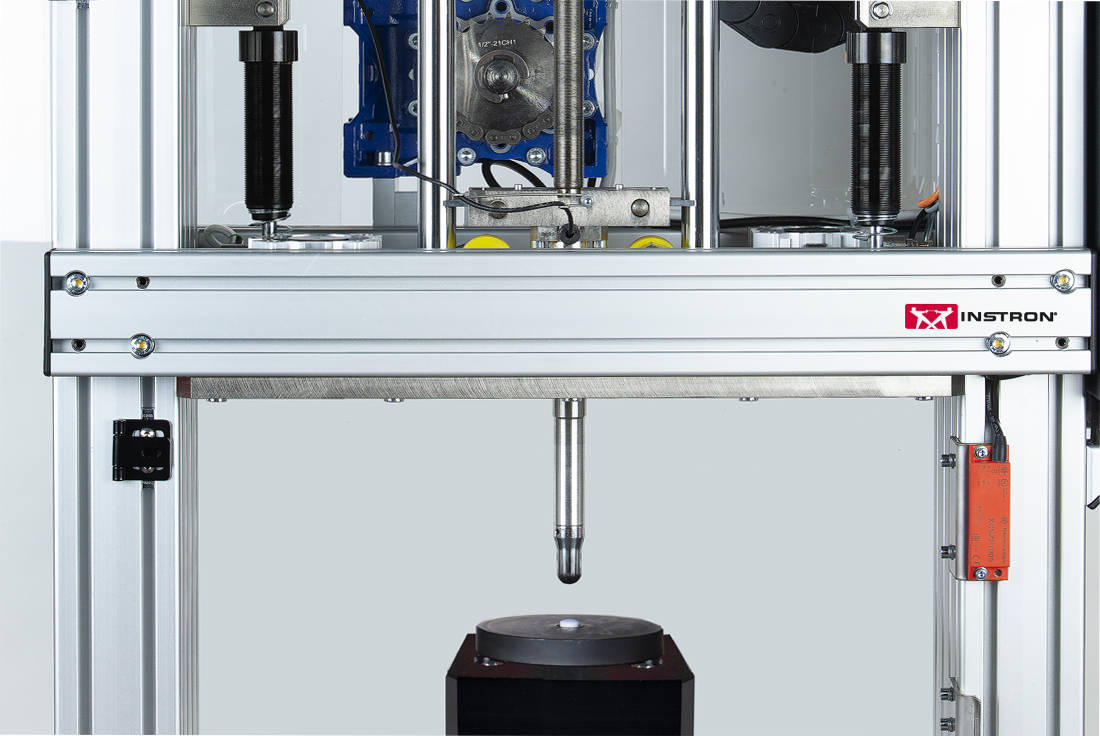
Instron 9400 series is a good fit for such a testing requirement. Since the implants for various body parts are of different shapes & sizes, the testing has to be performed using various custom fixtures. We used a T-slot plate which was bolted at the bottom of 9450. A custom fixture with a clamped knee implant was mounted on the T-slot plate at base of the tower. A 45 kN strain gauge striker was used to impact the knee implant. A Data Acquisition System (DAS) and Bluehill Impact software were used in conjunction with the drop impact machine to collect the force/velocity data and analyze the impact performance.

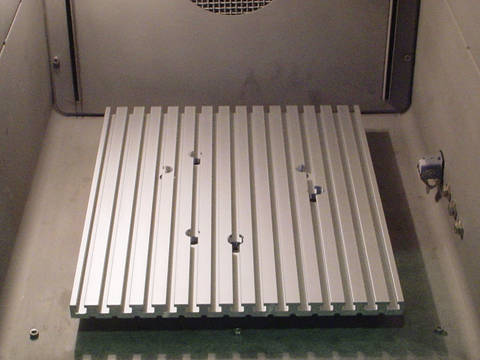
Alternatively a general purpose plate as seen in the picture can be used instead of a T-slot plate.These versatile plates give flexibility to manufacturers to mount a wide range of custom fixtures as per their own requirements. Such impact tests can be customized to an extent where they can replicate the real life low and high velocity impacts during the actual surgical procedures.

Note: The customer's actual test set up is confidential and hence is not displayed in this application note.

Literature

9400 Series Drop Tower Brochure

Instron Drop Towers are used to develop, fine tune, and validate material models. Testing materials under real impact conditions is a crucial step prior of product design. Using the characterization data obtained with the Instron 9400, coupled with customer supplied high-speed video, you can have confidence in your results and deliver new materials to your customers faster. Our Drop Tower impact systems, fixtures, and tups are designed to meet a wide range of applications and testing standards including: ISO, ASTM, ANSI, Airbus, Boeing, BSI, DIN, EN, FDA, Ford, GM, JIS, NASA, GOST, and more.

  • Produits
  • 02/05/2020
  • 763.1 KB

9400 Series Dashboard Brochure

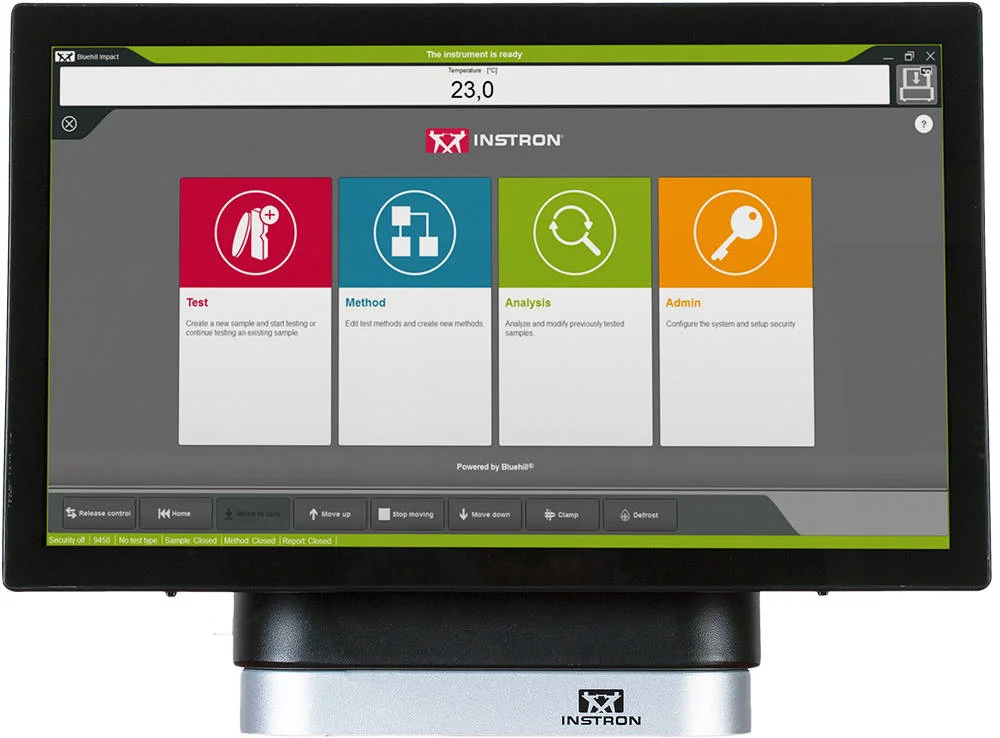
Bluehill® Impact is built from the ground up for touch interaction. The Operator Dashboard features large touchpoints to make the user experience simpler and smarter. Easy-to-understand icons and workflows make it easy to train new or experienced users, simplify operator training, and allow you to start testing even faster than ever before

  • Produits
  • 08/01/2019
  • 2.35 MB

Tensile Testing of Steel Cords

Tensile Testing of Steel Cords

Steel cord is formed by twisting multiple strands of steel wires together to form a cord structure. This is often used as a reinforcement material in conveyor belts and radial tires for passenger cars, buses, or heavy equipment vehicles. Compared to other traditional reinforcement materials like nylon, steel cords possess superior mechanical properties, such as higher tensile strength and modulus and better heat resistance. When used as a reinforcement material in radial tires, it offers high road stability, improved steering response, and longer tire service life. Since some of the key performance indicators of tires are dependent on the reinforcing steel cord, it is important for an engineer to understand the properties of the tire cord and how it functions in a tire.

There are many challenges to account for when testing stranded wire. As stranded wire is not a consistent diameter, generally a nominal diameter is used (as defined in the product standard).  As well as the irregularity of the surface, when a specimen is pulled in tension each strand will rotate. Therefore, if a clip-on extensometer is being used, it must be able to rotate. It is also necessary to have a long gauge length, so Instron offers a 600mm G.L. extensometer with 15 degrees of twist available. When stranded wire breaks, the energy released at failure is substantial, and the specimen ‘splays’ out. This may cause damage to extensometers, machine or even operators.

The challenges of testing to this standard are:

  • Specimen gripping
  • Strain measurement
  • Safety

Instron's Solution:

  • Instron provides side action tensile grips with wire strand inserts that ensure optimum grip face engagement and clamping surface area.
  • Instron’s E-series extensometers allow for a 600mm gauge length and specimen rotation, providing a robust strain-measurement solution.
  • Debris shields are available in many shapes and sizes, and can be interlocked to ensure operators are not in danger at any time throughout testing.

It is important to review the pertinent testing standards in order to fully understand the test setup, procedure, and results requirements.

Literature

6800 Series Premier Testing Systems Brochure

Instron 6800 Series Universal Testing Systems provide unparalleled accuracy and reliability. Built on a patent-pending Operator Protect system architecture with an all-new Smart-Close Air Kit and Collision Mitigation features, the 6800 Series makes materials testing simpler, smarter, and safer than ever before.

  • Produits
  • 02/10/2020
  • 4.15 MB

Bluehill Universal Brochure

Bluehill Universal is Instron’s advanced materials testing software, designed for intuitive touch interaction and streamlined workflows. It offers pre-loaded test methods, QuickTest for rapid setup, enhanced data exporting, and Instron Connect for direct service communication. Users of Bluehill 2 and Bluehill 3 can easily upgrade to the latest version for improved performance and usability.

  • Produits
  • 02/26/2017
  • 3.76 MB

Performance à l’Impact de Comprimés Pharmaceutiques

Performance à l'Impact de Comprimés Pharmaceutiques

Support for pharmaceutical tablet impact testing
Les pilules, cachets et comprimés pharmaceutiques sont habituellement couverts d’un enrobage qui permet de les avaler plus facilement, de libérer le médicament en temps voulu, de les identifier et d’en indiquer la marque. L’enrobage prolonge aussi la durée de vie en stock en protégeant le produit intérieur des conditions ambiantes nuisibles telles que la lumière, la température, l’humidité et les charges mécaniques. Pendant le processus de fabrication et d’emballage, notamment, les enrobages des comprimés sont soumis à des impacts susceptibles de les endommager.
Les essais d’impact peuvent apporter de la valeur pour les fabricants en leur fournissant des données relatives aux performances pour la recherche et le développement de nouveaux matériaux et procédés pour les enrobages. Une fois qu’un produit adapté est mis au point, le fabricant peut mettre en œuvre un programme de contrôle qualité utilisant les données de base d’un essai de performances à l'impact pour valider le procédé de fabrication en cours.
La machine d'essai d'impact Instron 9440, équipée d’un marteau à capteur piézo à faible charge (0,45 kN ou 4,5 kN),  d’un insert hémisphérique ½ pouce, du système d’acquisition de données DAS et du logiciel  Bluehill Impact, est idéale pour tester les pilules et cachets pharmaceutiques. Pour maintenir l’éprouvette, nous recommandons une plaque métallique plate et rigide que l’on peut fixer à la surface de la table de la machine d'essai avec les quatre attaches disponibles. En utilisant une traverse nue et en faisant varier l’énergie des impacts par réglage de la hauteur de chute, on peut tester les pilules et les cachets jusqu’à ce qu’ils ne montrent plus de signe de défaillance.
Cette solution pour les essais d’impact convient parfaitement pour déterminer les performances à l’impact des cachets et comprimés pharmaceutiques, par exemple l’uniformité des lots et les points de défaillance ou de début d’endommagement. Ces caractéristiques peuvent alors être rapprochées du matériau d’enrobage utilisé pour le produit. Si l’on comprend de quelle manière l’enrobage renforce ou fragilise le cachet, on peut effectuer des modifications pour améliorer le produit.
Littérature

9400 Series Drop Tower Brochure

Instron Drop Towers are used to develop, fine tune, and validate material models. Testing materials under real impact conditions is a crucial step prior of product design. Using the characterization data obtained with the Instron 9400, coupled with customer supplied high-speed video, you can have confidence in your results and deliver new materials to your customers faster. Our Drop Tower impact systems, fixtures, and tups are designed to meet a wide range of applications and testing standards including: ISO, ASTM, ANSI, Airbus, Boeing, BSI, DIN, EN, FDA, Ford, GM, JIS, NASA, GOST, and more.

  • Produits
  • 02/05/2020
  • 763.1 KB

9400 Series Dashboard Brochure

Bluehill® Impact is built from the ground up for touch interaction. The Operator Dashboard features large touchpoints to make the user experience simpler and smarter. Easy-to-understand icons and workflows make it easy to train new or experienced users, simplify operator training, and allow you to start testing even faster than ever before

  • Produits
  • 08/01/2019
  • 2.35 MB

Essai de Fatigue de Flexion Dynamique sur les Carbures Métalliques Frittés

Essai de Fatigue de Flexion Dynamique sur les Carbures Métalliques Frittés

Dynamic Fatigue Bend Testing Sintered Powder Metal Carbides

De nombreux matériaux de machines-outils, tels que ceux fabriqués à l'aide de carbures métalliques frittés, sont extrêmement résistants (de manière générale, 5 GPa en compression) et présentent une rigidité importante (plus de 500 GPa). La conception de ces matériaux est onéreuse et ils ne sont souvent disponibles que sous forme d'échantillons de petite taille.

Une machine d'essai de fatigue efficace doit pouvoir appliquer des forces cycliques selon une charge et un déplacement très faibles, tout en préservant une fréquence élevée. Notre système d'essai ElectroPuls™ garantit la précision et la répétabilité nécessaires pour les essais sur métaux et carbures métalliques en traction, compression, flexion et fatigue. Si le capteur de force et les mâchoires sont correctement sélectionnés et configurés, la machine d'essai de fatigue ElectroPuls offre une plate-forme polyvalente permettant d'appliquer des charges stables inférieures au Newton pendant plusieurs heures, ainsi que des charges supérieures à 1 000 N requises pour cet essai spécifique.

Lors d’un essai à faibles charges, le choix du capteur de force est essentiel pour assurer une précision et un contrôle appropriés de la mesure. Pour un fonctionnement à des fréquences plus élevées, la fonction de compensation d'inertie intégrale de nos capteurs de force Dynacell® permet de minimiser les erreurs d'inertie lors des mesures de la charge.

Nous avons testé plusieurs éprouvettes de ces carbures métalliques entaillées et traitées thermiquement avec le logiciel d'essai dynamique WaveMatrix™ et un banc de flexion 4 points fourni par le Laboratoire Physique National (NPL) du Royaume-Uni.

Le logiciel a permis une configuration rapide des essais. En outre, grâce à ses fonctions polyvalentes d'acquisition de données, nous avons recueilli des données précises et pertinentes au format .CSV, notamment un enregistrement précis des événements de rupture. Nous avons obtenu des résultats cohérents et répétitifs sur un grand nombre d'essais.

Littérature

ElectroPuls

With more than ten years of running tests over billions of cycles, ElectroPuls systems are the established materials testing machines using patented linear motor technology. With model capacities up to 20 kN, ElectroPuls systems offer slow-speed static testing and high-frequency dynamic fatigue testing with hundreds of hertz capability. The Linear-Torsion models feature a patented actuator for bi-axial tests on materials and components.

  • Produits
  • 06/05/2019
  • 3.63 MB

Résistance à l’Impact de Poutres Béton

Résistance à l'Impact de Poutres Béton

La demande en essais d'impact en flexion 3 points est de plus en plus importante. Pour cet essai, nous recommandons un puits de chute 9450 ou 9440 , en fonction de l'énergie maximale nécessaire. Nous avons développé une fixation sur mesure de 300mm d'écartement, avec un insert spécial et nous avons utilisé le système d'acquisition de données DAS avec le logiciel Bluehill Impact.

Les dimensions des éprouvettes étaient de 400mm x 100mm x 100mm et ont été testées jusqu'à 4.65m/s. Cette vitesse aurait pu augmentée si besoin. Les essais ont montré les modes de rupture et ont été conçus pour simuler de plus grandes structures qui demanderaient plus d'énergie que celle disponible en laboratoire. Les résultats comparés ont été l'énergie totale absorbée, la charge maximale, l'énergie à la rupture et le déplacement à la rupture.

La série de puits de chute 9400 convient particulièrement pour déterminer les caractéristiques et les performances de matériaux soumis à un impact. Les informations collectées grâce à l'acquisition des données durant l'essai permettent aux fabricants de mesurer les effets des modifications dans la formulation de leur matériau et de savoir comment il se comportera en situation réelle d'utilisation. Une gamme d'essais plus large peut être réalisée en ajoutant une chambre environnementale pour étudier le comportement du matériau à différentes températures ou en utilisant d'autres fixations et inserts.

Littérature

9400 Series Drop Tower Brochure

Instron Drop Towers are used to develop, fine tune, and validate material models. Testing materials under real impact conditions is a crucial step prior of product design. Using the characterization data obtained with the Instron 9400, coupled with customer supplied high-speed video, you can have confidence in your results and deliver new materials to your customers faster. Our Drop Tower impact systems, fixtures, and tups are designed to meet a wide range of applications and testing standards including: ISO, ASTM, ANSI, Airbus, Boeing, BSI, DIN, EN, FDA, Ford, GM, JIS, NASA, GOST, and more.

  • Produits
  • 02/05/2020
  • 763.1 KB

9400 Series Dashboard Brochure

Bluehill® Impact is built from the ground up for touch interaction. The Operator Dashboard features large touchpoints to make the user experience simpler and smarter. Easy-to-understand icons and workflows make it easy to train new or experienced users, simplify operator training, and allow you to start testing even faster than ever before

  • Produits
  • 08/01/2019
  • 2.35 MB

Radial Force Evaluation of Stent Grafts

Radial Force Evaluation of Stent Grafts

Stent grafts are used to treat a wide variety of peripheral arterial issues, as well as abdominal and aortic pathologic conditions like abdominal aortic aneurysms (AAA). The success of endovascular stent grafts for AAA’s has provided motivation to adapt similar technology for descending thoracic aortic aneurysms (TAA’s). Survival rates for untreated and traditionally treated (through complex thoracic surgeries) aneurysms are typically quite poor.

Advantages of stent grafts include shorter operative time, avoidance of major thoracic or thoracoabdominal incisions, and significant reductions in morbidity and mortality. Successful surgery requires the accurate placement of the stent graft to ensure it does not move, especially in upper descending thoracic aorta cases.

Typically, secure placement for stent grafts is a function of the proper selection and sizing since physiological movements of the aorta can be significant. Additionally, stent grafts have much larger diameters than coronary stents (30+ mm versus 2-3 mm). Evaluating the radial strength of a stent graft helps manufacturers to ensure efficacy and reliability of the medical device when implanted in vivo.

Instron partners with Machine Solutions Inc. (MSI) to utilize either a RX575 or RX675 stent iris on an Instron system. The fixture can also be customized and used for special specimen types to provide radial strength and stiffness over the entire graft or the securing graft ends. The control software to operate MSI’s RX fixture on an Instron system is standard Bluehill® 3 and TestProfiler. Although room-temperature testing provides excellent comparative results, the system can also be configured with a chamber to provide simulation of body temperature.

Literature

6800 Series Premier Testing Systems Brochure

Instron 6800 Series Universal Testing Systems provide unparalleled accuracy and reliability. Built on a patent-pending Operator Protect system architecture with an all-new Smart-Close Air Kit and Collision Mitigation features, the 6800 Series makes materials testing simpler, smarter, and safer than ever before.

  • Produits
  • 02/10/2020
  • 4.15 MB

Impact Performance of Composite Decking

Impact Performance of Composite Decking

Composite Decking
Composite Decking

The backyard deck has taken on an ever increasing role in our lives becoming an extension of a homes interior living space. Traditionally decks have been built from pressure treated lumber, however, cost, life cycle, appearance, construction time, maintenance and environmental concerns are all factors contributing to the huge growth in the use of wood–plastic composites, also known as composite decking.

Made from a wide ranging mixture of wood and plastic, composite decking has certain advantages like durability, color retention and reduced maintenance costs over pressure treated wood. With a material cost 20 to 30 percent more than pressure treated pine, impact performance can be critical. Decks are routinely subjected to a wide range of everyday impact events, dropped tools, patio furniture, ladders and paint cans to name a few, and the types and quantities of the various materials used in the manufacturing of the decking can affect their resistance to impacts.

When approached by a manufacturer of composite decking we recommended a Instron 9450 with optional High energy system, instrumented with a 22.2kN tup, ½” hemispherical tup insert, 1” spherical tup insert, Data Acquisition System and Bluehill Impact software. By varying the tup insert and test velocity we were able to create a range of impact profiles and energies that allowed the customer to simulate a wide variety of impacts that their product might be subjected to.

The 9450 is well suited for helping customers determine the performance characteristics of their materials when subjected to an impact event. The information gathered by doing instrumented impact testing can be used to provide the customer with a data baseline whereby they can determine how changes made in the mix of raw materials will perform in real life situations. A broader range of testing could be accomplished with the inclusion of an environmental chamber to study impact characteristics at different temperatures as well as using different fixtures and inserts to simulate other unsupported spans and impact events.

Literature

9400 Series Drop Tower Brochure

Instron Drop Towers are used to develop, fine tune, and validate material models. Testing materials under real impact conditions is a crucial step prior of product design. Using the characterization data obtained with the Instron 9400, coupled with customer supplied high-speed video, you can have confidence in your results and deliver new materials to your customers faster. Our Drop Tower impact systems, fixtures, and tups are designed to meet a wide range of applications and testing standards including: ISO, ASTM, ANSI, Airbus, Boeing, BSI, DIN, EN, FDA, Ford, GM, JIS, NASA, GOST, and more.

  • Produits
  • 02/05/2020
  • 763.1 KB

9400 Series Dashboard Brochure

Bluehill® Impact is built from the ground up for touch interaction. The Operator Dashboard features large touchpoints to make the user experience simpler and smarter. Easy-to-understand icons and workflows make it easy to train new or experienced users, simplify operator training, and allow you to start testing even faster than ever before

  • Produits
  • 08/01/2019
  • 2.35 MB

Essais de Fibres d’Aramide

Essais de Fibres d'Aramide

Les essais de traction sont idéaux pour évaluer les caractéristiques physiques d'un grand nombre de textiles primaires, y compris les matériaux spécialisés. Nous proposons une vaste gamme de machines d'essai universelles pour répondre aux nombreux besoins d'essai sur ces matériaux.

Lors des essais de ces textiles, nous avons utilisé des mâchoires pneumatiques pour corde et fil 2714-010 , ces mâchoires offrant une solution de maintien adaptée à ce type de matériau. Comme pour de nombreux textiles et de nombreuses fibres composites, il est important de veiller à ce qu'aucun glissement ne se produise lors de l'essai afin de ne pas compromettre la précision des résultats d'essai. En raison de la conception spéciale de ces mâchoires, la fibre est maintenue de manière à ce qu'aucun glissement ne se produise. Les résultats d'essai obtenus sont donc corrects, fiables et homogènes.

Pour les essais des fibres d'aramide, nous proposons une gamme de mâchoires pneumatiques spécialement conçues à cette fin.

Par conséquent, que vous suiviez des normes d'essai spécifiques ou que vous réalisiez des essais selon vos propres procédures, nous recommandons d'utiliser les machines de traction 3300 ou 5900 avec les modules du logiciel Bluehill® 3 pour obtenir la solution adaptée à vos besoins.

Littérature

3400 Series Universal Testing Systems Brochure

Instron 3400 Series universal testing systems for tensile, compression, bend, and other material property tests.

  • Produits
  • 06/27/2022
  • 2.69 MB

Brochure sur les systèmes d’essais de premier plan série 6800

Les systèmes d’essai universels Instron série 6800 offrent une précision et une fiabilité inégalées. Conçue sur une architecture système Operator Protect en instance de brevet, avec un tout nouveau kit d’air Smart-Close et des fonctions d’atténuation des collisions, la série 6800 rend les essais de matériaux plus simples, plus intelligents et plus sûrs que jamais.

  • Produits
  • 02/10/2020
  • 4.06 MB

Pneumatic Tire Cord Grips (CP105953)

The Instron® pneumatic tire cord grips provide a convenient method for clamping tire cord and braided wire during testing.

  • Produits
  • 08/14/2013
  • 599.82 KB

Bluehill Universal Brochure

Bluehill Universal is Instron’s advanced materials testing software, designed for intuitive touch interaction and streamlined workflows. It offers pre-loaded test methods, QuickTest for rapid setup, enhanced data exporting, and Instron Connect for direct service communication. Users of Bluehill 2 and Bluehill 3 can easily upgrade to the latest version for improved performance and usability.

  • Produits
  • 02/26/2017
  • 3.76 MB