

Essais de la prochaine génération de produits biologiques auto-administrés :
Dispositifs d'administration de médicaments à grand volume
Les thérapies biologiques passent du fauteuil de perfusion au domicile, grâce aux auto-injecteurs conçus pour gérer des volumes plus importants. Voici un aperçu de ce qui motive ce changement et de ce qu'il faut pour tester ces dispositifs.
Pendant des années, de nombreuses thérapies biologiques ont signifié une chose pour les patients : un déplacement à la clinique et une longue perfusion intraveineuse. Au cours des dernières années, cela a changé, les sociétés pharmaceutiques développant de plus en plus d'auto-injecteurs capables d'administrer des volumes plus importants et des produits biologiques à haute viscosité. Cela permet aux patients de s'auto-administrer à domicile selon leur propre emploi du temps, sans nécessiter de fauteuil de perfusion ni de visite clinique.
Ce changement crée une amélioration significative de l'autonomie des patients, et apporte également un ensemble de considérations d'ingénierie et d'essais qui évoluent parallèlement au volume de médicament plus important.
De 1 à 2,25 mL à 5 mL et au-delà
Les auto-injecteurs conventionnels sont conçus pour administrer 1 à 2,25 mL de produit médicamenteux. Les auto-injecteurs à grand volume fonctionnent généralement selon les mêmes principes de base, mais sont généralement considérés comme tout dispositif administrant 3 mL ou plus. Dans les dispositifs actuellement en cours d'évaluation par les grandes sociétés pharmaceutiques, nous constatons que les volumes atteignent jusqu'à 5,5 mL, tandis que des dispositifs d'une capacité allant jusqu'à 10 mL sont en développement.
Cette augmentation de volume n'est pas un ajustement mineur. Des volumes ou des viscosités de fluide plus élevés introduisent différentes considérations de conception — notamment le mécanisme qui entraîne l'injection et les composants nécessaires pour loger et supporter un contenant primaire plus grand. Tester ces dispositifs de manière approfondie, en tant que système complet, avant qu'ils n'atteignent jamais un patient, est essentiel pour comprendre comment ils fonctionneront réellement.
Les essais d'auto-injecteurs sont généralement guidés par des normes telles que ISO 11608-5 et le projet de directive de la FDA sur les Essential Drug Delivery Outputs (EDDO), couvrant des facteurs tels que la précision de la dose, la profondeur de l'aiguille, la force d'activation, le temps d'injection et le retour sonore. Les auto-injecteurs à grand volume sont évalués par rapport à ces mêmes paramètres fondamentaux en tant que mesures sous-jacentes.

Pourquoi cela nécessite une approche d'essai flexible
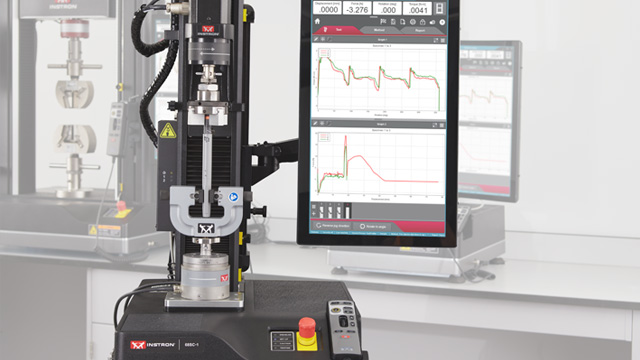
Le système d'essai d'auto-injecteurs Instron® a été conçu comme une plateforme standard qui peut être configurée pour gérer une large gamme de profils de dispositifs, des auto-injecteurs à petit volume jusqu'à l'extrémité du spectre des grands volumes.
Quelques considérations importantes entrent en jeu lors des essais de dispositifs à grand volume :
Dispositifs à cartouche : Certains auto-injecteurs, en particulier les dispositifs à grand volume, utilisent une cartouche comme contenant primaire plutôt qu'une seringue préremplie (PFS). Spécifiquement pour le dispositif SHL Magnitude(s'ouvre dans un nouvel onglet) (anciennement Maggie), le capuchon doit être dévissé pour engager l'aiguille et connecter le circuit fluidique avant que l'injection puisse commencer. Tester ce type de dispositif nécessite une capacité biaxiale, qui peut être ajoutée au système via un module complémentaire de torsion.
Retour sonore : De nombreux auto-injecteurs utilisent un clic audible pour informer le patient qu'une injection a commencé et s'est terminée. Les auto-injecteurs à grand volume utilisent parfois plutôt un son continu pendant toute la durée de l'injection, le silence indiquant l'achèvement. Capturer cet audio parallèlement à la force, au volume distribué et à d'autres données d'essai (via un microphone intégré) donne une image plus complète de la façon dont le dispositif communique avec l'utilisateur pendant une injection réelle.
Profondeur de l'aiguille et suivi de l'administration : Le système utilise une caméra de vision artificielle pour mesurer la profondeur d'injection et le temps d'injection. Cette approche est utilisée sur toute la gamme d'auto-injecteurs et est suffisamment robuste pour gérer la gamme plus large de viscosités ou de temps d'injection qui peuvent être observés avec les dispositifs à grand volume.
Une plateforme, un minimum de pièces de changement
Chaque dispositif d'administration de médicaments est unique, avec différents mécanismes de capuchon, signaux de retour et profils de force et de volume, il n'est donc pas pratique de construire un système d'essai sur mesure pour chacun. Notre approche traite plutôt le système d'essai d'auto-injecteurs comme une plateforme standard qui est adaptée par des modules complémentaires et des modifications de configuration pour mieux accueillir le dispositif évalué, avec des méthodes d'essai également construites autour des exigences spécifiques de ce dispositif.
L'une des priorités de conception du système est de maintenir le nombre de pièces de changement au minimum, de sorte que le passage d'un type de dispositif à un autre sur le même système d'essai soit simple. Cela compte pour les laboratoires évaluant une gamme de dispositifs, car cela signifie moins de temps passé à reconfigurer l'équipement et une plus grande répétabilité des essais lorsque le processus de changement est simple.
C'est là qu'intervient la configuration à grand volume. La version à grand volume du système d'essai d'auto-injecteurs est conçue pour gérer toute la gamme de tailles d'auto-injecteurs, d'une capacité de 1 mL à 5,5 mL, en utilisant cette même approche de pièces de changement minimales pour passer de l'un à l'autre.

Surveiller cet espace
Il convient de noter qu'à la date de publication originale de cet article en septembre 2026, aucun produit combiné d'auto-injecteur à grand volume — c'est-à-dire un médicament approuvé administré via l'un de ces dispositifs — n'a été mis sur le marché. Les plateformes de dispositifs elles-mêmes sont disponibles auprès des fabricants pour que les sociétés pharmaceutiques les utilisent dans leurs efforts de développement, mais la phase de R&D est toujours en cours pour les produits médicamenteux eux-mêmes.
La plupart de ce que nous voyons est encore dans la phase de recherche et développement, largement motivée par les équipes de R&D pharmaceutiques évaluant si un format à grand volume auto-administré est la bonne approche d'administration pour un candidat médicament particulier. En d'autres termes, il s'agit d'un espace très émergent où les essais de dispositifs jouent un rôle central dans l'élaboration de décisions qui n'ont pas encore été finalisées.
Les auto-injecteurs capables d'administrer des volumes plus importants représentent un changement significatif dans la façon dont les produits biologiques pourraient être administrés, déplaçant les thérapies à haute viscosité et à grand volume hors de la clinique et entre les mains du patient. À mesure que davantage de ces dispositifs passent de la R&D au développement en phase avancée, disposer d'une plateforme d'essai construite autour de l'adaptabilité, plutôt qu'une configuration fixe à usage unique, signifie qu'elle est prête à soutenir tout ce qui vient ensuite dans cet espace.
Nous continuerons à partager ce que nous apprenons au fur et à mesure que cette catégorie se développe. Si vous travaillez sur un dispositif à grand volume et souhaitez discuter de vos exigences d'essai spécifiques, notre équipe se fera un plaisir de vous aider à déterminer la configuration appropriée.
Foire aux questions (FAQ)
Il s'agit d'un auto-injecteur conçu pour administrer un volume de produit médicamenteux plus important qu'un auto-injecteur conventionnel. Ce format de dispositif est développé pour soutenir certaines formulations biologiques qui nécessiteraient autrement une perfusion intraveineuse dans un cadre clinique, permettant plutôt une auto-administration à domicile.
Vous pourriez également être intéressé par
Publié :
23 septembre 2026

Rédigé par :
Meredith Bernstein(s'ouvre dans un nouvel onglet)(s'ouvre dans un nouvel onglet)
Édité par :
Nick Erickson
Révisé par :
Landon Goldfarb(s'ouvre dans un nouvel onglet)(s'ouvre dans un nouvel onglet)
Vous souhaitez voir toute la gamme de ce que notre système d'essai d'auto-injecteurs peut faire ?
De la plateforme au montage, Instron dispose des outils dont les équipes pharmaceutiques et de dispositifs médicaux ont besoin pour tester les auto-injecteurs de toutes tailles, y compris les dispositifs à grand volume et les dispositifs portables.

Conçu spécifiquement pour les essais d'auto-injecteurs, avec une configuration à grand volume qui couvre toute la gamme de tailles de dispositifs — prenant en charge les essais de fonctionnalité complète pour la R&D et les essais de contrôle qualité.
Ajoute une capacité d'essai biaxiale, torsion plus axiale, pour les dispositifs à cartouche qui nécessitent le retrait du capuchon à visser pour connecter le circuit fluidique avant l'injection.

Montages et automatisation conçus pour les essais de seringues préremplies, notamment la force de break loose et la force de glissement, la force de pénétration de l’aiguille et les applications de retrait de capuchon.
ou

Parler à un expert Instron
Obtenez des conseils spécifiques à l'application sur les essais d'auto-injecteurs à grand volume et d'autres dispositifs d'administration de médicaments.
À propos de l’auteur
Meredith Bernstein
Meredith Bernstein(s'ouvre dans un nouvel onglet) est la responsable produit biomédical chez Instron, où elle dirige la stratégie d'Instron pour les produits et le support client dans les industries des dispositifs médicaux et pharmaceutiques. En se concentrant principalement sur le domaine de l'administration de médicaments, Meredith supervise des projets clients complexes et fournit des conseils techniques depuis la demande initiale jusqu'aux essais d'acceptation en usine. Elle développe également de nouvelles méthodes d'essai pour les dispositifs médicaux et les produits pharmaceutiques, garantissant les normes les plus élevées en matière de développement de produits et de qualité. Son approche méticuleuse, son expertise technique approfondie et sa passion pour l'avancement des processus d'essai font d'elle une force motrice derrière le leadership continu d'Instron dans l'industrie biomédicale.